

Knowness brings your learning, revision, assignments, progress, and study tools together in one place. The best way to use Knowness is to work through your lessons consistently, complete the activities as you go, and keep on top of your revision over time.
1. How Learning Works on Knowness
Knowness is built on over 50 years of learning science. Six core principles sit behind the way the platform works:
- Retrieval Practice
- Spaced Practice
- Interleaving
- Dual Coding
- Concrete Examples
- Elaboration
You can explore these in more detail in 10. Learning Science. The most important thing to remember is that consistency is key.
For GCSE courses, each subject contains the content you need, directly aligned to the relevant exam board specification.
As soon as a concept is introduced, Knowness prompts you to test yourself using flashcards and exercises. This is called retrieval practice. Instead of simply rereading the information, you are encouraged to bring it back to mind yourself. Each time you successfully retrieve something from memory, that memory becomes stronger.
2. Complete Your Lessons
To complete a lesson, you need to work through all of its associated flashcards and exercises. This helps make sure you have not only read the lesson, but also actively recalled and applied the knowledge within it.

Figure 1. The lesson completion button is locked until all remaining flashcards and exercises are completed.
Once a lesson is completed, its flashcards and exercises become available for revision. This is where the longer-term learning begins.
3. Revise Over Time
Revision on Knowness is not about repeating everything at once. Knowness uses spaced practice to work out when you should see each flashcard or exercise again.
- If you find something difficult, you will usually see it again sooner (e.g. tomorrow).
- If you can recall it confidently, Knowness can leave a longer period (e.g. 7 days) before showing it again.
Over time, this helps you focus more attention on the knowledge that needs it most instead of repeatedly reviewing things you already know well.
4. Build Your Proficiency
As you keep reviewing your flashcards and exercises, their proficiency increases. Proficiency represents how secure that knowledge currently is in your memory.
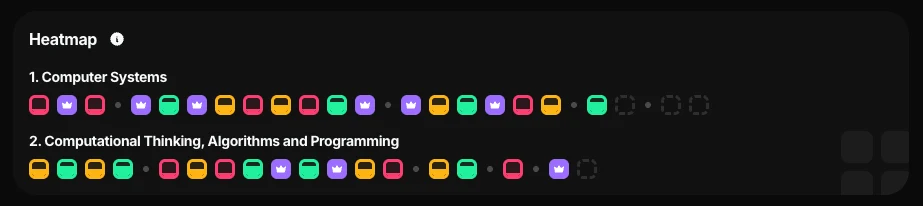
Figure 2. Proficiency levels across each lesson in GCSE Computer Science (OCR), where red is Low Proficiency, amber is Medium Proficiency, green is High Proficiency, and purple is Max Proficiency.
The more successfully you recall and apply something over time, the more secure that memory becomes.
However, knowledge can also decay if it is not revisited. If you leave something for too long, it can become harder to recall. Knowness reflects this by allowing proficiency to decrease over time.
This is why it is important to keep on top of your revision. A small amount of regular revision is much more effective than leaving everything until just before an exam and trying to cram it all at once.