

General
Biology
Plant Cells and Tissues
Plant cells are similar to animal cells in many ways, but they have some unique characteristics. Like animal cells, plant cells have a cell membraneA thin, partially permeable barrier surrounding the cell that controls movement of substances in and out., cytoplasmA jelly-like substance in cells where most chemical reactions occur., and organelles such as the nucleusA membrane-bound organelle in eukaryotic cells that contains DNA., endoplasmic reticulum, and Golgi apparatus. However, plant cells also have cell walls and chloroplasts, which are not found in animal cells.
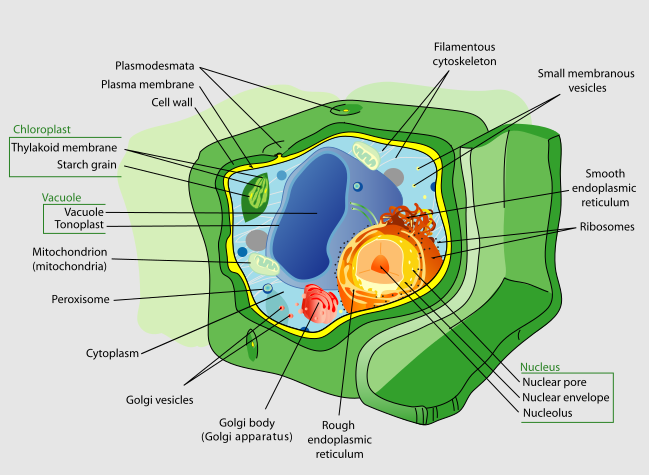
The cell walls of plant cells provide support and protection, and they also help to maintain the shape of the cell. The cell walls of plant cells are made up of cellulose, a complex carbohydrate, and pectin, a type of polysaccharide.
Chloroplasts are organelles that are found in plant cells and are the site of photosynthesisThe process by which plants use light energy to produce glucose.. Chloroplasts contain chlorophyllA green pigment found in chloroplasts that absorbs light energy for photosynthesis., a pigment that absorbs light energy and converts it into chemical energy. Chloroplasts also contain thylakoid membranes, which are the site of the light-dependent reactions of photosynthesis.
Plants also have specialized tissues that perform specific functions. Some of the main types of plant tissues are:
Epidermal tissueA group of similar specialised cells working together to perform a function.: Epidermal tissue covers the surface of the plant and protects the plant from the environment. Epidermal tissue is made up of epidermal cells, which are tightly packed together and have a single layer of cell walls. Epidermal cells also have a waxy cuticle, which helps to prevent water loss from the plant.
Vascular tissue: Vascular tissue is responsible for transporting water and nutrients throughout the plant. Vascular tissue is made up of xylemPlant tissue that transports water and mineral ions from roots to the rest of the plant. and phloemPlant tissue that transports dissolved sugars around the plant. cells, which are arranged in tubes. Xylem is made up of xylem cells, which are long and narrow and have thick cell walls. Phloem is made up of phloem cells, which are shorter and wider and have thinner cell walls.
Dermal tissue: Dermal tissue covers the surface of organs such as roots and leaves. Dermal tissue is made up of dermal cells, which are similar to epidermal cells but are more loosely packed and have thicker cell walls.
Ground tissue: Ground tissue makes up the bulk of the plant and performs a variety of functions, such as supporting the plant and storing food. Ground tissue is made up of parenchyma cells, which are typically thin-walled and have large central vacuoles. Ground tissue also includes collenchyma cells, which have thickened cell walls and are found in areas of the plant where support is needed. Ground tissue also includes sclerenchyma cells, which have very thick cell walls and are found in areas of the plant where support is needed.
Continue the lesson
This section is available to learners with course access. Continue learning with Knowness to unlock the full explanation, examples, revision tools, and progress tracking.
The remaining lesson content includes further guided explanation, important learning points, and supporting interactive material designed to help you understand and revise this topic.
Unlock this topic to view the full activity, worked examples, common mistakes, and additional revision support.
More content available
Knowness lessons are structured to build understanding step by step. Create an account or upgrade your access to continue from this point.
This preview does not include the hidden lesson text, answers, explanations, or embedded interactions.
Continue learning with Knowness
Sign up to access the full lesson, predicted grades, revision tools, progress tracking, and more.
Create a free account