

General
Biology
The Cell Membrane and its Functions
The cell membraneA thin, partially permeable barrier surrounding the cell that controls movement of substances in and out. is a thin, flexible barrier that surrounds the cell and separates the interior of the cell from the external environment. The cell membrane is made up of lipids and proteins, and it plays a number of important roles in the functioning of the cell.
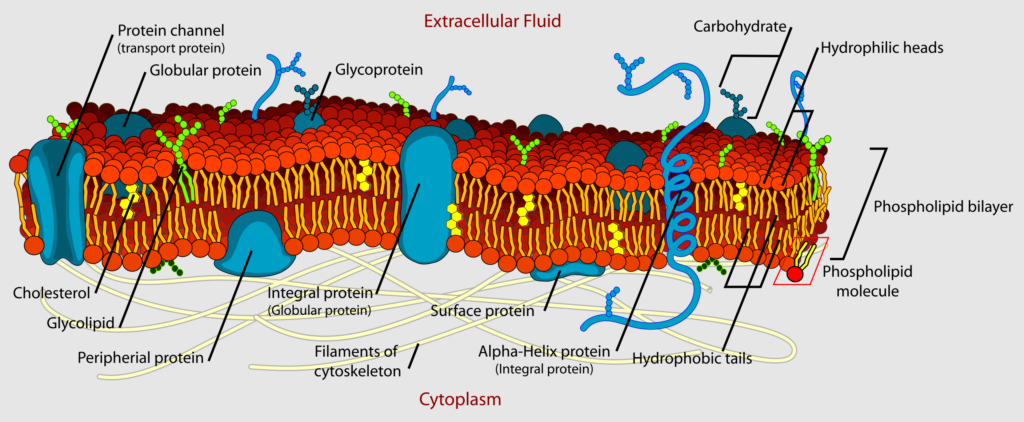
The cell membrane is selectively permeable, which means that it allows certain substances to pass through it while preventing others from crossing. The cell membrane controls the movement of substances into and out of the cell, and it plays a key role in maintaining homeostasis (the stable internal environment of the cell). The cell membrane is also involved in communication with the external environment, and it contains receptors that allow the cell to detect and respond to signaling molecules.
The cell membrane is made up of a phospholipid bilayer, which is a double layer of phospholipid molecules arranged in a specific orientation. The phospholipid bilayer is a dynamic structureThe organisation and order of information in a text. that is constantly undergoing changes, and it is influenced by a number of factors, including temperature, pH, and the presence of certain chemicals. The phospholipid bilayer is composed of two layers of phospholipid molecules, with the hydrophobic (water-repelling) tails facing inward and the hydrophilic (water-attracting) heads facing outward. This arrangement creates a barrier that prevents the free movement of substances across the membrane.
The cell membrane also contains proteins, which are embedded in the phospholipid bilayer and play a number of important roles. Some proteins act as channels or pumps, allowing certain substances to cross the membrane, while others act as receptors, allowing the cell to detect and respond to signaling molecules. Other proteins serve as anchors, attaching the cell to the extracellular matrixUsed in mathematics, this is an arrangement of numbers, symbols, or expressions arranged into rows and columns. or to other cells.
Continue the lesson
This section is available to learners with course access. Continue learning with Knowness to unlock the full explanation, examples, revision tools, and progress tracking.
The remaining lesson content includes further guided explanation, important learning points, and supporting interactive material designed to help you understand and revise this topic.
Unlock this topic to view the full activity, worked examples, common mistakes, and additional revision support.
More content available
Knowness lessons are structured to build understanding step by step. Create an account or upgrade your access to continue from this point.
This preview does not include the hidden lesson text, answers, explanations, or embedded interactions.
Continue learning with Knowness
Sign up to access the full lesson, predicted grades, revision tools, progress tracking, and more.
Create a free account