

General
Biology
DNA Structure and Function
DNA (deoxyribonucleic acid)The molecule carrying genetic instructions used in the growth, development, functioning, and reproduction of all living organisms. is the genetic materialDNA that carries the instructions for cell structure and function. of all living organisms, and it is responsible for storing and transmitting the genetic information that controls the development, growth, and function of the organism. DNA is a long, double-stranded molecule that is made up of four nitrogenous bases: adenine (A), guanine (G), cytosine (C), and thymine (T). The sequence of these bases forms a code that carries the genetic information of the organism.
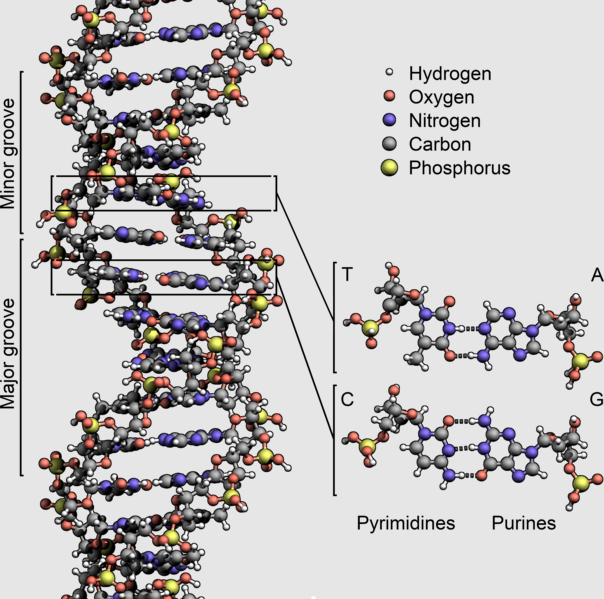
This file is licensed under the Creative Commons Attribution-Share Alike 3.0 Unported license.
DNA is a double helix, which means that it is a spiral-shaped molecule made up of two strands that are twisted around each other. The two strands of DNA are held together by hydrogen bonds between the bases, and the sequence of the bases on one strand determines the sequence of the bases on the other strand. The base pairs are A-T and C-G, which means that adenine pairs with thymine, and cytosine pairs with guanine.
DNA is found in the nucleusA membrane-bound organelle in eukaryotic cells that contains DNA. of cells, and it is organized into structures called chromosomes. Humans have 23 pairs of chromosomes, and each chromosomeA structure made of DNA that carries genetic information. contains a long strand of DNA that is made up of thousands of genes. Genes are the functional units of DNA, and they contain the information needed to produce proteins, which are the building blocks of the body.
The structureThe organisation and order of information in a text. of DNA was first proposed by James Watson and Francis Crick in 1953, based on the work of Rosalind Franklin and Maurice Wilkins. Watson and Crick received the Nobel Prize in Physiology or Medicine in 1962 for their discovery of the structure of DNA.
Continue the lesson
This section is available to learners with course access. Continue learning with Knowness to unlock the full explanation, examples, revision tools, and progress tracking.
The remaining lesson content includes further guided explanation, important learning points, and supporting interactive material designed to help you understand and revise this topic.
Unlock this topic to view the full activity, worked examples, common mistakes, and additional revision support.
More content available
Knowness lessons are structured to build understanding step by step. Create an account or upgrade your access to continue from this point.
This preview does not include the hidden lesson text, answers, explanations, or embedded interactions.
Continue learning with Knowness
Sign up to access the full lesson, predicted grades, revision tools, progress tracking, and more.
Create a free account