

General
Biology
Respiration
Respiration is the process by which cells produce energy by breaking down organic molecules. Respiration occurs in all forms of life, and it is essential for the production of ATP, which is the energy currency of the cell. There are two main types of respiration: aerobic respirationA chemical process that releases energy from glucose using oxygen, occurring in mitochondria. and anaerobic respiration.
Aerobic respiration is the most efficient form of respiration, and it requires oxygen. Aerobic respiration occurs in the mitochondriaAn organelle where aerobic respiration occurs and energy is released. of the cell, and it involves the breakdown of glucose (or other organic molecules) into ATP, water, and carbon dioxide. Aerobic respiration is a multi-step process that involves the breakdown of glucose through glycolysis, the citric acid cycle (also known as the Krebs cycle), and the electron transport chain.
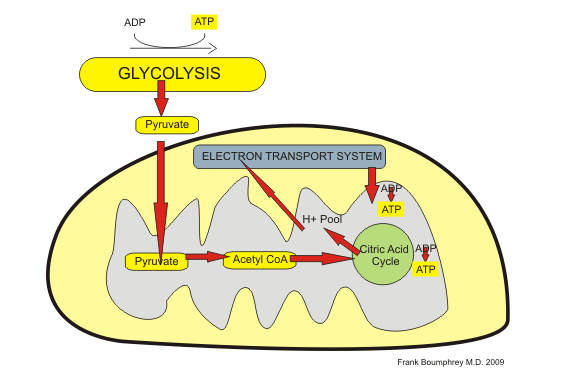
This file is licensed under the Creative Commons Attribution-Share Alike 3.0 Unported license.
Glycolysis is the first step of aerobic respiration, and it occurs in the cytoplasmA jelly-like substance in cells where most chemical reactions occur. of the cell. Glycolysis involves the breakdown of glucose into two molecules of pyruvate, producing a small amount of ATP and NADH in the process. Pyruvate is then transported into the mitochondria, where it is converted into acetyl-CoA in the presence of oxygen.
The citric acid cycle (Krebs cycle) is the second step of aerobic respiration, and it occurs in the mitochondria of the cell. The citric acid cycle involves the breakdown of acetyl-CoA into CO2, producing ATP, NADH, and FADH2 (flavin adenine dinucleotide) in the process. The NADH and FADH2 are used in the electron transport chain to generate ATP.
The electron transport chain is the third and final step of aerobic respiration, and it also occurs in the mitochondria of the cell. The electron transport chain involves the transfer of electrons from NADH and FADH2 to oxygen, producing ATP in the process. The electron transport chain is a series of enzymes that are embedded in the inner mitochondrial membrane, and it involves the transfer of electrons from one enzymeA biological catalyst that speeds up chemical reactions in cells. to another, producing ATP as the electrons are passed down the chain.
Anaerobic respiration is a less efficient form of respiration that does not require oxygen. Anaerobic respiration occurs in the cytoplasm of the cell, and it involves the breakdown of glucose (or other organic molecules) into ATP and lactic acid (in animals) or ethanol and carbon dioxide (in plants and some bacteriaA single-celled prokaryotic microorganism.). Anaerobic respiration is less efficient than aerobic respiration, as it produces only a small amount of ATP per molecule of glucose.
Continue the lesson
This section is available to learners with course access. Continue learning with Knowness to unlock the full explanation, examples, revision tools, and progress tracking.
The remaining lesson content includes further guided explanation, important learning points, and supporting interactive material designed to help you understand and revise this topic.
Unlock this topic to view the full activity, worked examples, common mistakes, and additional revision support.
More content available
Knowness lessons are structured to build understanding step by step. Create an account or upgrade your access to continue from this point.
This preview does not include the hidden lesson text, answers, explanations, or embedded interactions.
Continue learning with Knowness
Sign up to access the full lesson, predicted grades, revision tools, progress tracking, and more.
Create a free account