

General
Biology
The Cell Organelles
Cell organelles are specialized structures that are found within the cytoplasmA jelly-like substance in cells where most chemical reactions occur. of eukaryotic cells, and they are involved in various functions such as energy production, protein synthesisCombining information from more than one text to show comparison., and waste removal. There are several types of cell organelles, including the nucleusA membrane-bound organelle in eukaryotic cells that contains DNA., endoplasmic reticulum, Golgi apparatus, mitochondriaAn organelle where aerobic respiration occurs and energy is released., lysosomes, peroxisomes, and vacuoles.
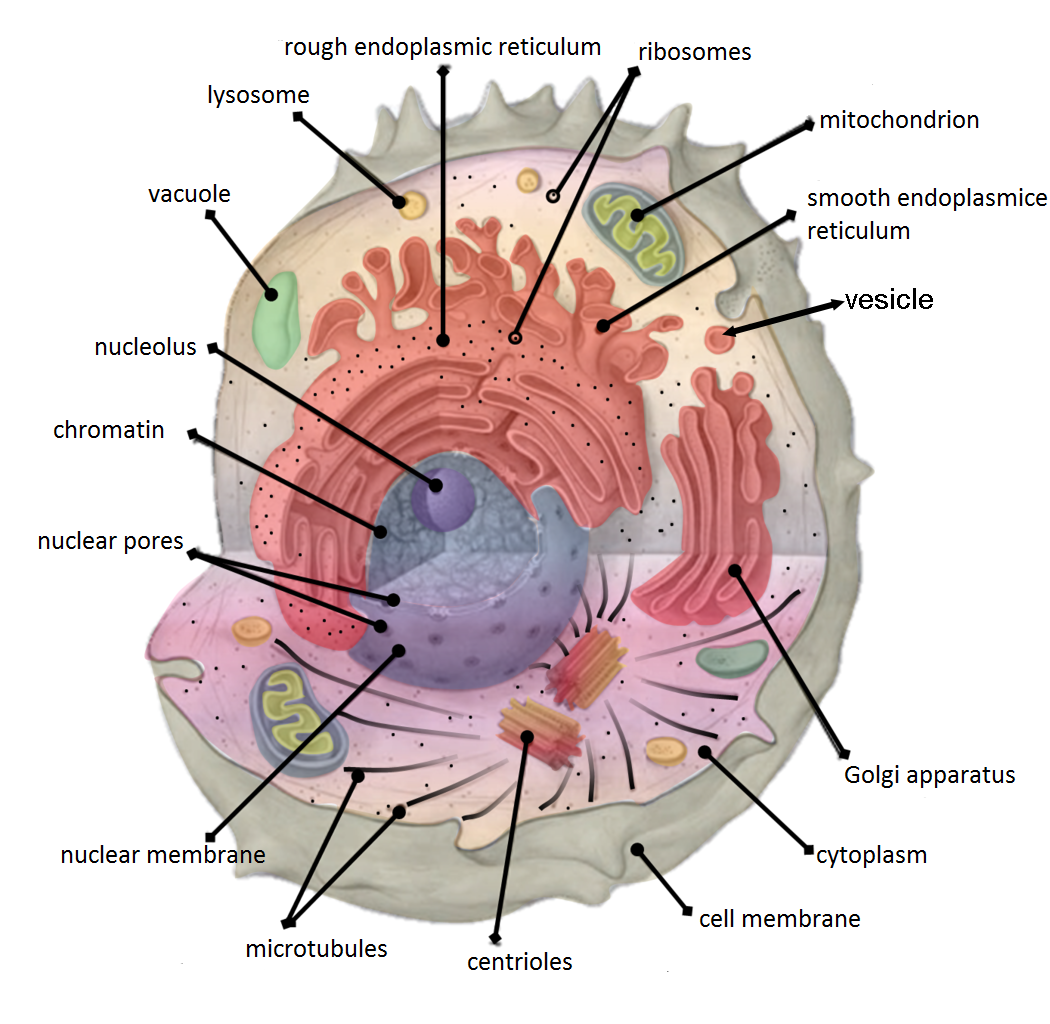
This file is licensed under the Creative Commons Attribution-Share Alike 4.0 International license.
The nucleus is a large, spherical organelleA specialised structure within a cell that performs a particular function. that is found in the center of the cell, and it is separated from the cytoplasm by the nuclear envelope. The nucleus contains the cell's genetic materialDNA that carries the instructions for cell structure and function. (DNA), and it is the control center of the cell. The nucleus is involved in the synthesis of ribonucleic acid (RNA) and the transcription of DNA into RNA.
The endoplasmic reticulum (ER) is a series of flattened, interconnected sacs or tubes that are found in the cytoplasm of the cell. There are two types of endoplasmic reticulum: rough endoplasmic reticulum (RER) and smooth endoplasmic reticulum (SER). The RER is studded with ribosomes, which are small organelles that are involved in protein synthesis, and it is involved in the synthesis and transport of proteins. The SER is smooth and lacks ribosomes, and it is involved in the synthesis of lipids and the detoxification of drugs and other harmful substances.
The Golgi apparatus is a stack of flattened, membrane-bound sacs that is found near the nucleus. The Golgi apparatus is involved in the synthesis, modification, and sorting of proteins and lipids. Proteins and lipids that are synthesized in the RER are transported to the Golgi apparatus, where they are modified and sorted into vesicles (small, membrane-bound sacs). The vesicles are then transported to their destination, either to be secreted from the cell or to be used in other cellular processes.
Mitochondria are small, rod-shaped organelles that are found in the cytoplasm of the cell. Mitochondria are the powerhouses of the cell, and they are involved in the production of ATP (adenosine triphosphate), which is the energy currency of the cell. Mitochondria contain their own DNA and are thought to have evolved from prokaryotic cells that were engulfed by eukaryotic cells in a process called endosymbiosis.
Lysosomes are small, spherical organelles that contain hydrolytic enzymes (enzymes that break down molecules). Lysosomes are involved in the digestion and recycling of materials within the cell, and they are important for maintaining the health of the cell. Lysosomes are formed from the Golgi apparatus, and they contain enzymes that can break down a variety of materials, including proteins, lipids, carbohydrates, and nucleic acids.
Peroxisomes are small, spherical organelles that contain enzymes that are involved in the breakdown of fatty acids and the detoxification of harmful substances. Peroxisomes are similar to lysosomes, but they contain different enzymes and are formed in a different way. Peroxisomes are formed from the cytosol (the fluid portion of the cytoplasm), rather than from the Golgi apparatus.
Vacuoles are large, fluid-filled organelles that are found in the cytoplasm of the cell. Vacuoles are involved in the storage of materials, and they are important for maintaining the shape and turgor (pressure) of the cell. Plant cells have a large central vacuoleA fluid-filled space in plant cells that maintains internal pressure. that takes up most of the cell volume, while animal cells have smaller vacuoles that are scattered throughout the cytoplasm. Vacuoles can storeThe stage where the CPU saves the result of the execution back into memory or registers. a variety of materials, including water, ions, and other small molecules, and they are also involved in the digestion and disposal of waste materials.
Continue the lesson
This section is available to learners with course access. Continue learning with Knowness to unlock the full explanation, examples, revision tools, and progress tracking.
The remaining lesson content includes further guided explanation, important learning points, and supporting interactive material designed to help you understand and revise this topic.
Unlock this topic to view the full activity, worked examples, common mistakes, and additional revision support.
More content available
Knowness lessons are structured to build understanding step by step. Create an account or upgrade your access to continue from this point.
This preview does not include the hidden lesson text, answers, explanations, or embedded interactions.
Continue learning with Knowness
Sign up to access the full lesson, predicted grades, revision tools, progress tracking, and more.
Create a free account