

University Taster
Chemistry – University Taster
6.2 Recrystallisation
Recrystallisation is a common separation technique which you will encounter during your degree. In this lesson, you will be introduced to the core concepts and the required knowhow required to perform a successful recrystallisation.
The Concept of Recrystallisation
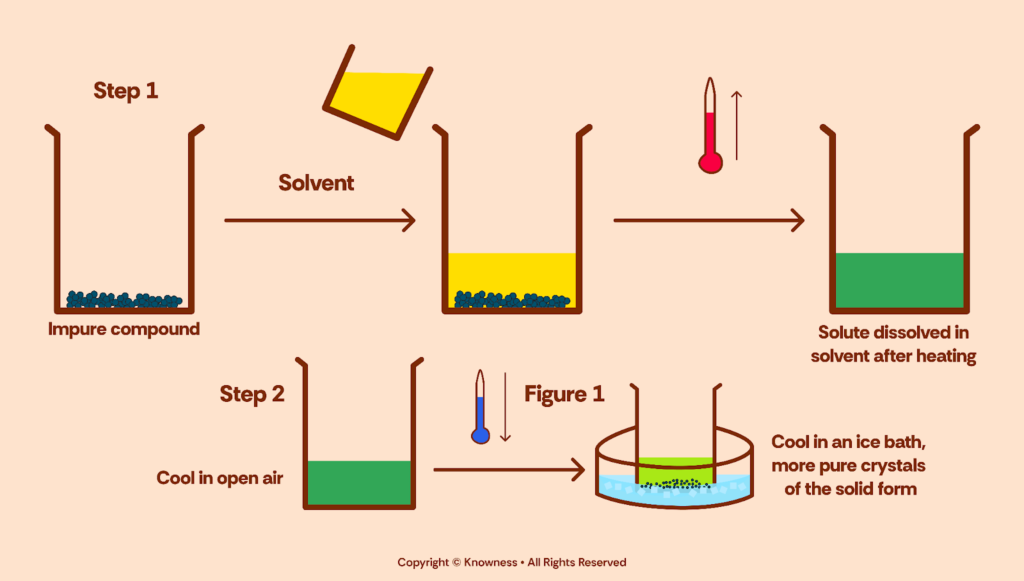
Recrystallisation is a technique used to purify compounds in solvents. It is built on the concept that ideally in a certain solvent your desired compound will not be soluble at room temperature while any impurities will. It takes advantage of the fact that the solubility of most solids increases with rising temperature. Meaning that as temperature increases, the amount of solute that can be dissolved in a solvent also increases.
The aim is to reach an elevated temperature at which both your desired compound and the impurity is dissolved. When everything is dissolved the mixture can be cooled again at which point (hopefully) only your desired compound becomes crystalline again (this is called crashing out) as it is not soluble at lower temperatures while the impurity stays dissolved.
Continue the lesson
This section is available to learners with course access. Continue learning with Knowness to unlock the full explanation, examples, revision tools, and progress tracking.
The remaining lesson content includes further guided explanation, important learning points, and supporting interactive material designed to help you understand and revise this topic.
Unlock this topic to view the full activity, worked examples, common mistakes, and additional revision support.
More content available
Knowness lessons are structured to build understanding step by step. Create an account or upgrade your access to continue from this point.
This preview does not include the hidden lesson text, answers, explanations, or embedded interactions.
Continue learning with Knowness
Sign up to access the full lesson, predicted grades, revision tools, progress tracking, and more.
Create a free account