5.3 Mass Spectrometry
In this lesson we will learn about mass spectroscopyThe study of how matter interacts with electromagnetic radiation. Depending on what radiation is used there are different types of spectroscopy UV, NMR, IR. Note mass spectroscopy does not actually utilise electromagnetic radiation but is still referred to as spectroscopy.. Mass spectroscopy is commonly used to analyse chemical compounds and provide information about the molecular weight of the analysed compound.
Mass Spectrometry
Mass spectrometry does not use light to help characterise the structure of a molecule. Instead, it works by the vaporisation and subsequent ionisationThe process of turning an uncharged molecule into an ion. In MS this is done so the ionised fragment can be analysed as it is affected by electric and magnetic fields. of the unknown sample.
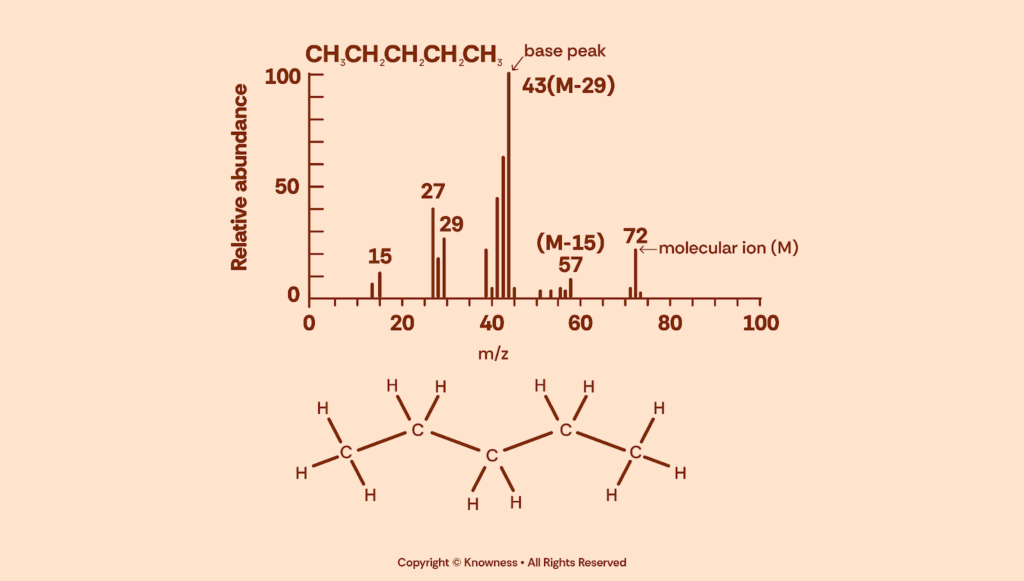
The most common method of ionisation is electron bombardment of the sample, which knocks out electrons in the sample to produce positive ions. The high energy transferred from the electrons to the molecules in the ionisation process can lead to fragmentation. This results in some of the original sample molecules breaking apart into smaller molecules (a.k.a. fragments), of various sizes.
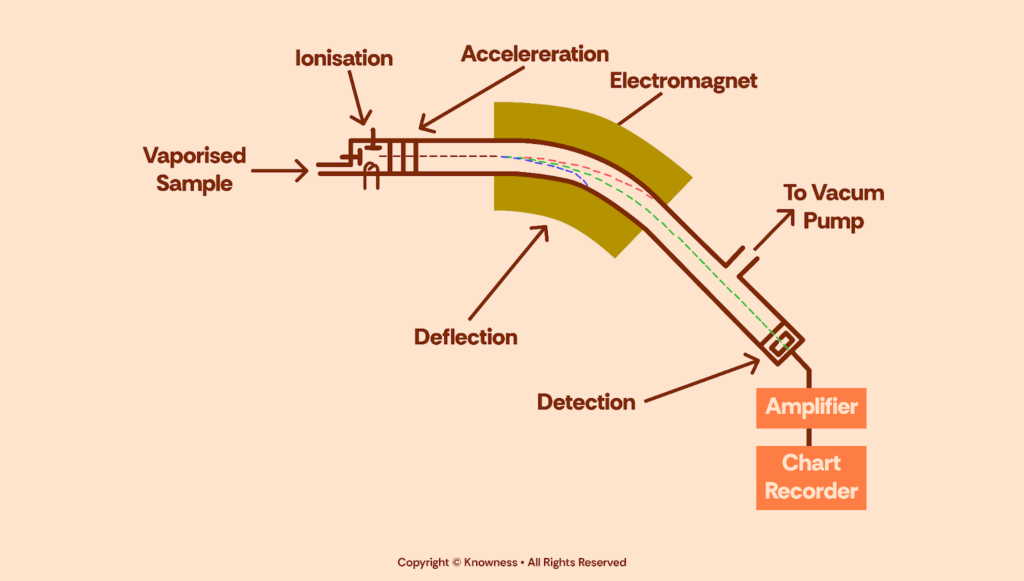
The ionised molecules and fragments are then accelerated by an electric field so each has the same kinetic energy. These ions are then deflected by a magnetic field. The smaller ions which have a smaller mass, are deflected more than the larger ions which have a larger mass. The deflection leads to fragments of different sizes being detected at different points on the detector.
This information is used by the mass spectrometer to work out the masses and relative abundance of the original molecule and its fragments. This information can be critical in helping us characterise unknown molecules and compounds.