

3.3 Paracetamol Synthesis
In this lesson, you will learn about how paracetamol is made by performing a nucleophilic substitution reaction, as previously discussed. Paracetamol is a common painkiller and its synthesis demonstrates how Organic Chemistry is crucial for drug development.
Synthesis of Paracetamol Introduction
One of the primary areas of research organic chemists work in is Medicinal Chemistry, which involves the designing and synthesising of medicines and pharmaceuticals.
An example is the synthesis of the household painkiller Paracetamol. Paracetamol is commonly synthesised from 4-Aminophenol, as shown above, through a nucleophilic substitution reaction just like the one you have learned in the previous lesson.
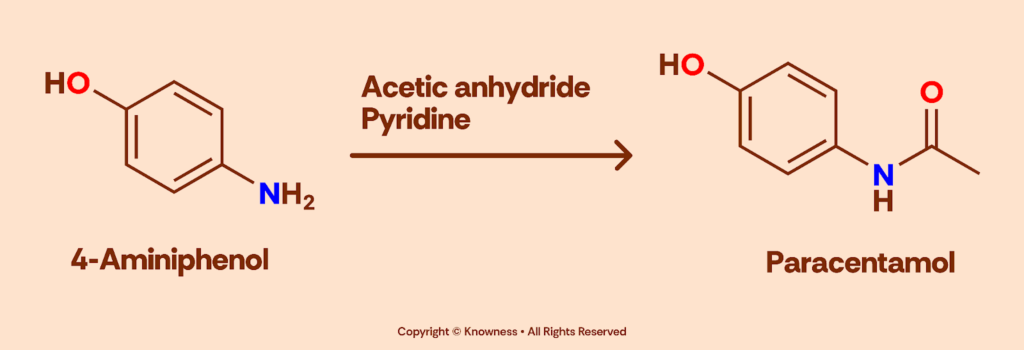
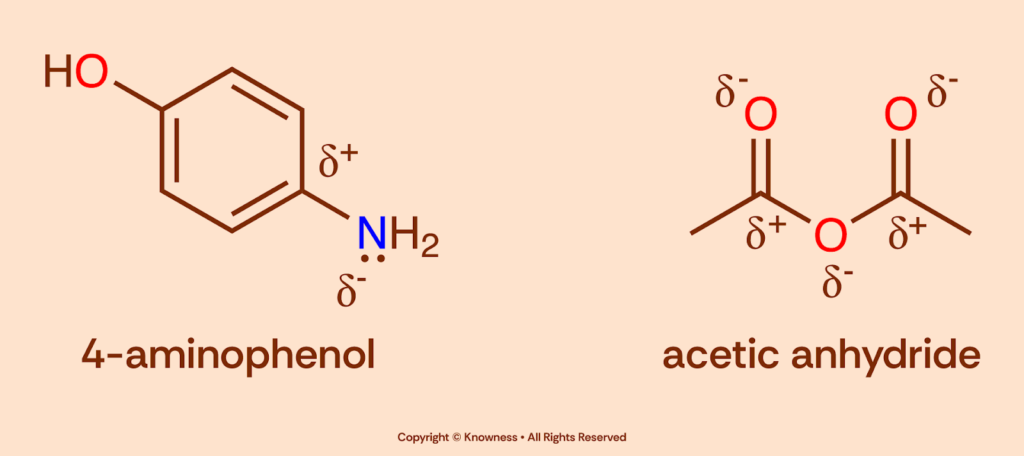
To make Paracetamol from 4-aminophenol we need to convert the amine group (\(-\ce{NH2}\)), into an amide group (\( -\ce{NHOR}\)). This can be done by reacting 4-aminophenol with acetic anhydride. First, let's examine acetic anhydride. We can see it contains two highly electron-poor carbons, each of which is double-bonded to a highly electronegative oxygen and single-bonded to another oxygen. As a result, these carbons act as strong electrophiles.
In the 4-aminophenol, we can see the presence of two electronegative groups, an alcohol (\(-\ce{OH}\)) group and an amine group (\(-\ce{NH3}\)). The oxygen and the nitrogen atoms in each of these groups respectively can act as nucleophiles. However, we only want the nitrogen atom in 4-aminophenol to attack the acetic anhydride molecule as this will make the desired amide group.
How the oxygen is prevented from attacking the electrophile is by using something called a protecting group. We will not go into much detail about protecting groups in this course, just know that they are molecules that can react with specific functional groupsAny group of atoms in a molecule that causes the molecule's characteristic chemical reactions. The same functional group will undergo the same or similar chemical reactions regardless of the rest of the molecule's composition., like the alcohol group in 4-aminophenol, to prevent them from taking part in unwanted reactions. Once the desired reaction has taken place, these protecting groups can be removed to regenerate the original functional group.