

University Taster
Chemistry – University Taster
4.3 Colours of Transition Metal Complexes
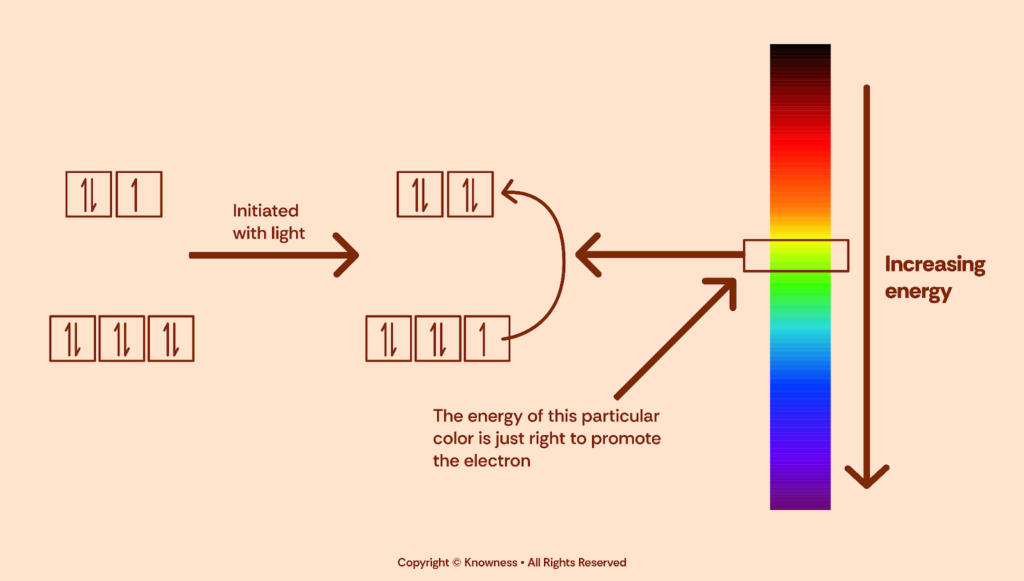
This lesson will build on your understanding of how colours occur chemically. A little spoiler: it all has to do with how electrons can jump between energy states. As they jump they can absorb or emit energy (light) of a certain colour (wavelength) making the compound appear coloured.
Electromagnetic Spectrum of Light
A fascinating property of transition metal complexesAre combinations of a metal center and ligands. They are denoted by the use of square brackets [ ]. The central metal atom is always named first. This is sometimes followed by the ligands. Outside the square brackets any counterions or the charge of the complex is listed. is that they can display widely varying colours. There are two main ways a complex can appear coloured. Firstly, an electron from the ligand can jump on to the metal and then back to the ligand, this is called charge transfer. The second way, which we will look at here is an electron jumping between different energies in d-orbitals which have undergone crystal field splitting.
In Module 5. Analytical Chemistry, where we learn more about how photons of light have energy which is proportional to their wavelength and how light that in the visible and UV wavelength range of the electromagnetic spectrum can excite electrons to transition to higher energy levels.
Continue the lesson
This section is available to learners with course access. Continue learning with Knowness to unlock the full explanation, examples, revision tools, and progress tracking.
The remaining lesson content includes further guided explanation, important learning points, and supporting interactive material designed to help you understand and revise this topic.
Unlock this topic to view the full activity, worked examples, common mistakes, and additional revision support.
More content available
Knowness lessons are structured to build understanding step by step. Create an account or upgrade your access to continue from this point.
This preview does not include the hidden lesson text, answers, explanations, or embedded interactions.
Continue learning with Knowness
Sign up to access the full lesson, predicted grades, revision tools, progress tracking, and more.
Create a free account