

2.3 Covalent Bonding in Depth
In this lesson, we will build on the description of covalent bonding from the previous lesson, perhaps already familiar to you, and we will add in what we have learned about the shapes and energies of orbitals to begin to provide you with a university level of understanding of this type of bonding.
Covalent Bonds
Covalent bonding involves the sharing of electrons between electronegative atoms. The bond length in a covalent bond is dictated by the electrostatic push and pull of the negatively charged electrons and the positively charged nuclei in the bonding atoms. The electrons in both atoms will be attracted to the nucleus of the other atom while. Meanwhile, the electrons in each atom will be repelled by the electrons in the other atom. The nuclei of the two atoms will also repel each other.
Covalent bonds are possible as there is a distance between the two bonding atoms where the attractive forces outweigh the repulsive forces, allowing for covalent bond formation to be preferable over not bonding at all. This distance is called the equilibrium bond length, as it dictates the length of the covalent bond between the atoms. It is important to remember that in a covalent bond the electrons in the outermost shell of the atoms, the valence electrons, are the ones shared between the two atoms, and that electrons in the inner shells, the core electrons are not shared.
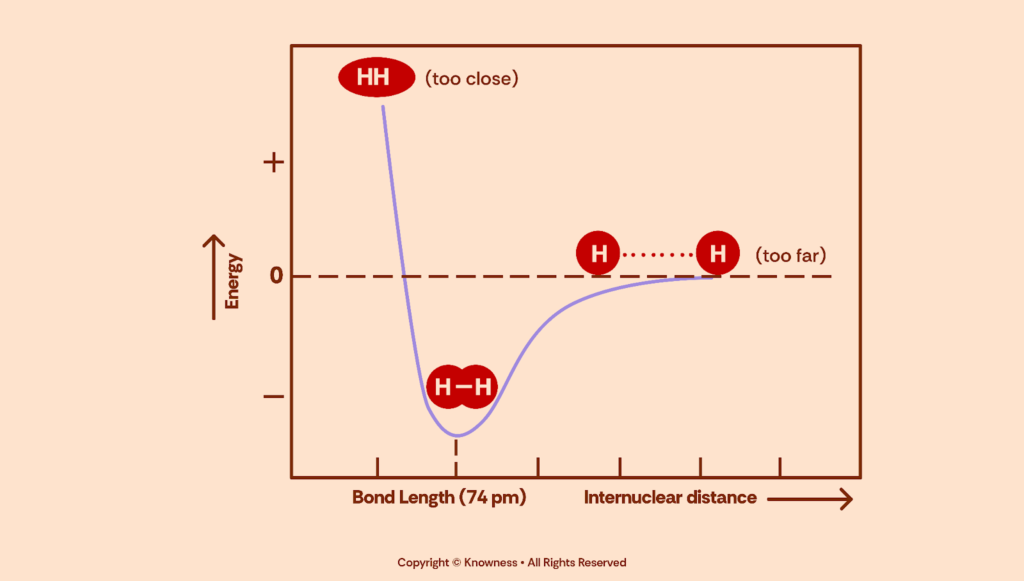
As can be seen in the graph above, when the hydrogen atoms are too far apart, they cannot benefit from electron to nucleus attraction. When the atoms are too close to each other, the repulsive force is significant and the atoms want to get further away from each other. At a middle distance, shown as a dip in the graph, the atoms are at the equilibrium bond length; this is the most stable interatomic separation as it has the lowest energy.