

University Taster
Chemistry – University Taster
This lesson will give you a basic idea of how to set up a simple apparatus to heat and stir reactions. This apparatus will form the basis of many reactions and purification techniques you will perform during your degree.
What is a Reflux Apparatus?
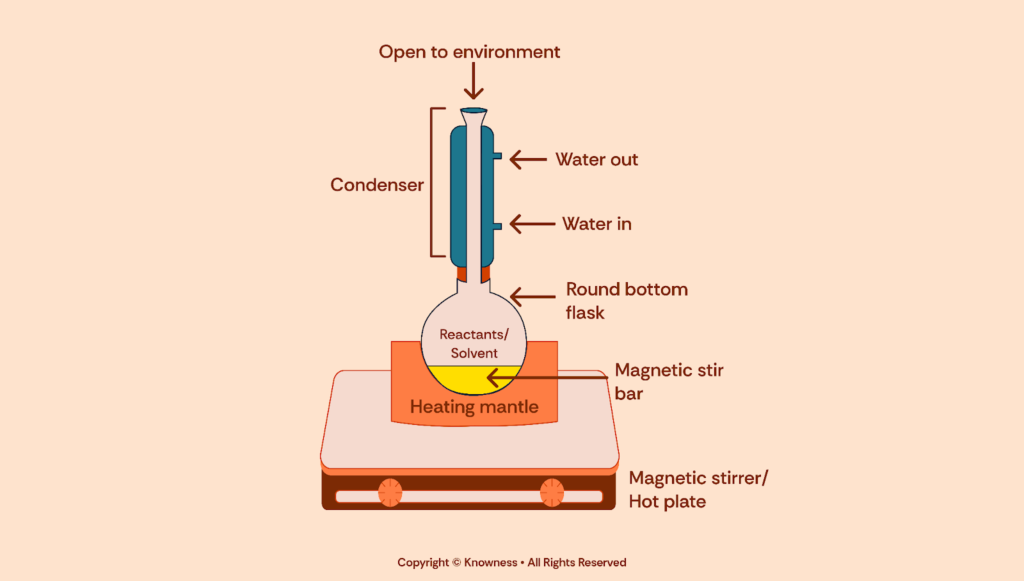
One of the first synthetic techniques you will learn to set-up and use is a refluxThe process of evaporating a solvent and condensing it again. Running a reaction at reflux means to run a reaction at the boiling point of the solvent. apparatus. A reflux allows you to stir and heat any mixture without losing the solvent. The condenser is placed vertically above the flask the reaction is happening in to allow any evaporated liquid to condense and fall back into the reaction mixture.
The point of a refluxing solution is to heat a solution in a controlled manner at constant temperature. The reaction mixture always stays at, or close to, the boiling point of the solvent as any excess heat is lost in the evaporation and condensation process. This is very useful for reactions that need to be carried out for long periods of time. It also means any solvent vapours are contained within the apparatus which could otherwise pose fire hazards or be harmful to health.
Common Mistake
Why put a condenser on your apparatus? Why not just use a stopper on the top of the round bottom flask to stop vapour escaping? One of the first rules of Practical Chemistry is to never heat a closed apparatus (unless specially designed for it). By putting a stopper on the round bottom flask. Pressure can build up especially if the solvent is evaporating and turning into gas. This can be incredibly dangerous due to the risk of the flask exploding.
Continue the lesson
This section is available to learners with course access. Continue learning with Knowness to unlock the full explanation, examples, revision tools, and progress tracking.
The remaining lesson content includes further guided explanation, important learning points, and supporting interactive material designed to help you understand and revise this topic.
Unlock this topic to view the full activity, worked examples, common mistakes, and additional revision support.
More content available
Knowness lessons are structured to build understanding step by step. Create an account or upgrade your access to continue from this point.
This preview does not include the hidden lesson text, answers, explanations, or embedded interactions.
Continue learning with Knowness
Sign up to access the full lesson, predicted grades, revision tools, progress tracking, and more.
Create a free account