

GCSE
Computer Science
-
Introduction to GCSE Computer Science -
1.1 Systems Architecture -
1.2 Memory and Storage -
1.3 Computer Networks, Connections and Protocols -
1.4 Network Security -
1.5 Systems Software -
1.6 Ethical, Legal, Cultural and Environmental Impacts of Digital Technology -
2.1 Algorithms -
2.2 Programming Fundamentals -
2.3 Producing Robust Programs -
2.4 Boolean Logic -
2.5 Programming Languages and Integrated Development Environments
1. Computer Systems
1.3.1 Networks and Topologies
In this lesson, we will explore various aspects of computer networks, including types of networks and factors affecting their performance. There are two primary types of networks: LAN (Local Area Network) and WAN (Wide Area Network).
LAN (Local Area Network)
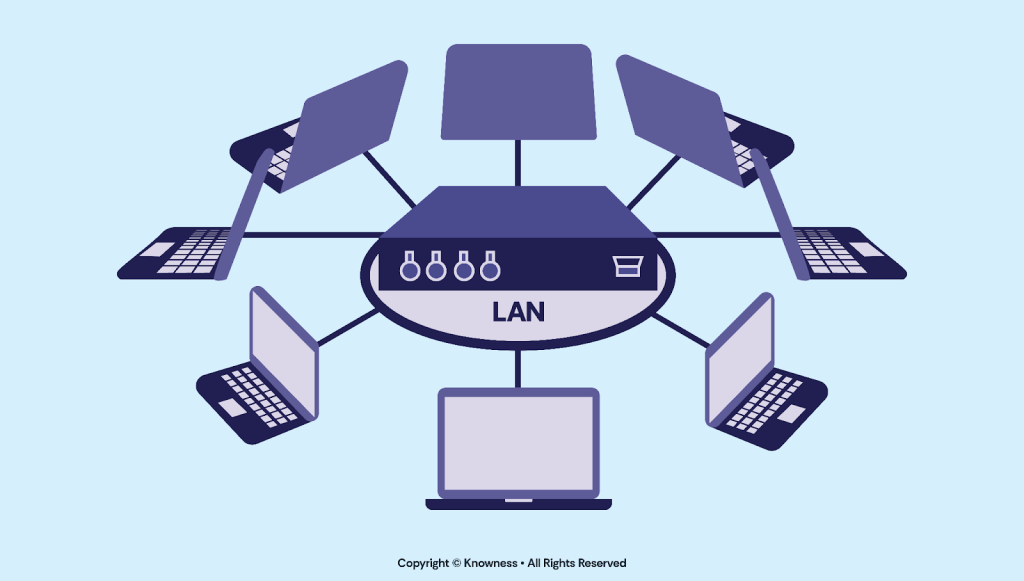
A LAN is a network of computers and devices that are interconnected within a limited geographic area, such as a home, office, or campus. LANs allow devices to communicate and share resources like printers, files, and internet connections. LANs are commonly used in homes and small to medium-sized businesses to facilitate communication and data sharing among devices.
Tip
Make sure you understand that LANs are not just about internet access, but that they enable devices to communicate with each other even if the internet is down, as long as they are on the same network.
Example
Examples of LANs include home networks, school networks, and office networks within a building.
| Advantages | Disadvantages |
|---|---|
| High Speed: LANs provide fast data transfer rates, making them suitable for tasks requiring quick communication. | Limited Range: LANs are restricted to a small area, such as a home or office. |
| Lower Cost: Setting up and maintaining a LAN is relatively inexpensive compared to WANs. | Infrastructure Dependency: If a central device, such as a router or switch, fails, the entire network may be affected. |
| Secure Communication: Since LANs operate within a limited area, security is easier to manage. | Internal Security Risks: Unauthorised users within the network may access sensitive data if proper security measures are not in place. |
| Efficient Resource Sharing: Users can share files, applications, and hardware like printers within the network. |
Continue the lesson
This section is available to learners with course access. Continue learning with Knowness to unlock the full explanation, examples, revision tools, and progress tracking.
The remaining lesson content includes further guided explanation, important learning points, and supporting interactive material designed to help you understand and revise this topic.
Unlock this topic to view the full activity, worked examples, common mistakes, and additional revision support.
More content available
Knowness lessons are structured to build understanding step by step. Create an account or upgrade your access to continue from this point.
This preview does not include the hidden lesson text, answers, explanations, or embedded interactions.
Continue learning with Knowness
Sign up to access the full lesson, predicted grades, revision tools, progress tracking, and more.
Create a free accountLAN (Local Area Network)
- A LAN (Local Area Network) connects devices within a limited area, such as a home, office, or school.
- LANs are faster, cheaper, and easier to secure but are limited in range.
WAN (Wide Area Network)
- A WAN (Wide Area Network) connects multiple LANs over large distances, often spanning countries or continents.
- WANs offer global communication and remote access but are slower, costlier, and more prone to cyber threats.
Advantages and Disadvantages of Networks
- Networks allow efficient communication, resource sharing, and centralised data storage.
- Networks support remote access and improve collaboration among users.
- Security risks, network failures, and privacy concerns are key disadvantages of networking.
- Networks require ongoing maintenance, cost, and IT management.
Factors Affecting Network Performance
- More connected devices increase traffic and can cause network congestion.
- Bandwidth determines the amount of data a network can handle at once — higher bandwidth improves performance.
- Latency is the delay in data transmission — lower latency leads to faster communication.
- The quality of network hardware (e.g., routers, switches, NICs) affects overall speed and stability.