

GCSE
Physics
-
Introduction to GCSE Physics (AQA) Coming soon
-
1.1 Energy Stores, Transfers and Power
-
1.2 Conservation and Dissipation of Energy Coming soon
-
1.3 National and Global Energy Resources Coming soon
-
2.1 Current, Potential Difference and Resistance Coming soon
-
2.2 Series and Parallel Circuits Coming soon
-
2.3 Domestic Uses and Safety Coming soon
-
2.4 Energy Transfers Coming soon
-
2.5 Static Electricity Coming soon
-
3.1 Changes of State and the Particle Model Coming soon
-
3.2 Internal Energy and Energy Transfers Coming soon
-
3.3 Particle Model and Pressure Coming soon
-
4.1 Atoms and Isotopes Coming soon
-
4.2 Atoms and Nuclear Radiation Coming soon
-
4.3 Hazards and Uses of Radioactive Emissions and of Background Radiation Coming soon
-
4.4 Nuclear Fission and Fusion Coming soon
-
5.1 Forces and their Interactions Coming soon
-
5.2 Work Done and Energy Transfer Coming soon
-
5.3 Forces and Elasticity Coming soon
-
5.4 Moments, Levers and Gears Coming soon
-
5.5 Pressure and Pressure Differences in Fluids Coming soon
-
5.6 Forces and Motion Coming soon
-
5.6.1 Describing Motion Along a Line
-
5.6.2 Distance and Displacement
-
5.6.3 Speed
-
5.6.4 Velocity
-
5.6.5 The Distance–Time Relationship
-
5.6.6 Acceleration
-
5.6.7 Forces, Accelerations and Newton's Laws of Motion
-
5.6.8 Newton's First Law
-
5.6.9 Newton's Second Law
-
5.6.10 Newton's Third Law
-
5.6.11 Forces and Braking
-
5.6.12 Stopping Distance
-
5.6.13 Reaction Time
-
5.6.14 Factors Affecting Braking Distance
-
5.6.1 Describing Motion Along a Line
-
5.7 Momentum [HT] Coming soon
-
6.1 Waves in Air, Fluids and Solids Coming soon
-
6.2 Electromagnetic Waves Coming soon
-
6.3 Black Body Radiation Coming soon
-
7.1 Permanent and Induced Magnetism, Magnetic Forces and Fields Coming soon
-
7.2 The Motor Effect Coming soon
-
7.3 Induced Potential, Transformers and the National Grid [HT] Coming soon
-
8.1 Solar System; Stability of Orbital Motions; Satellites Coming soon
-
8.2 Red-Shift Coming soon
-
9.1 Required Practicals Coming soon
-
9.1.1 Required Practical Activity 1
-
9.1.2 Required Practical Activity 2
-
9.1.3 Required Practical Activity 3
-
9.1.4 Required Practical Activity 4
-
9.1.5 Required Practical Activity 5
-
9.1.6 Required Practical Activity 6
-
9.1.7 Required Practical Activity 7
-
9.1.8 Required Practical Activity 8
-
9.1.9 Required Practical Activity 9
-
9.1.10 Required Practical Activity 10
-
9.1.1 Required Practical Activity 1
1. Energy
8.1.2 The Life Cycle of a Star
In this lesson, we will explore the life cycle of stars, from the relatively small Sun to massive stellar giants. We will also delve into the fascinating process of fusion, which generates elements within stars, including those heavier than iron, and the crucial role of supernovae in dispersing these elements throughout the universe.
The Life Cycle of a Star
Stars, the celestial bodies that illuminate our universe, go through a remarkable life cycle. The various stages of a star's life are determined by its size and mass.
The Size of the Sun:
- The Sun is classified as a medium-sized star, belonging to the main sequence of stars.
- It has a diameter of about 1.4 million kilometres and a mass roughly 330,000 times that of Earth.
More Massive Stars:
- Stars that are much more massive than the Sun follow a different life cycle due to their increased gravitational forces and energy production.
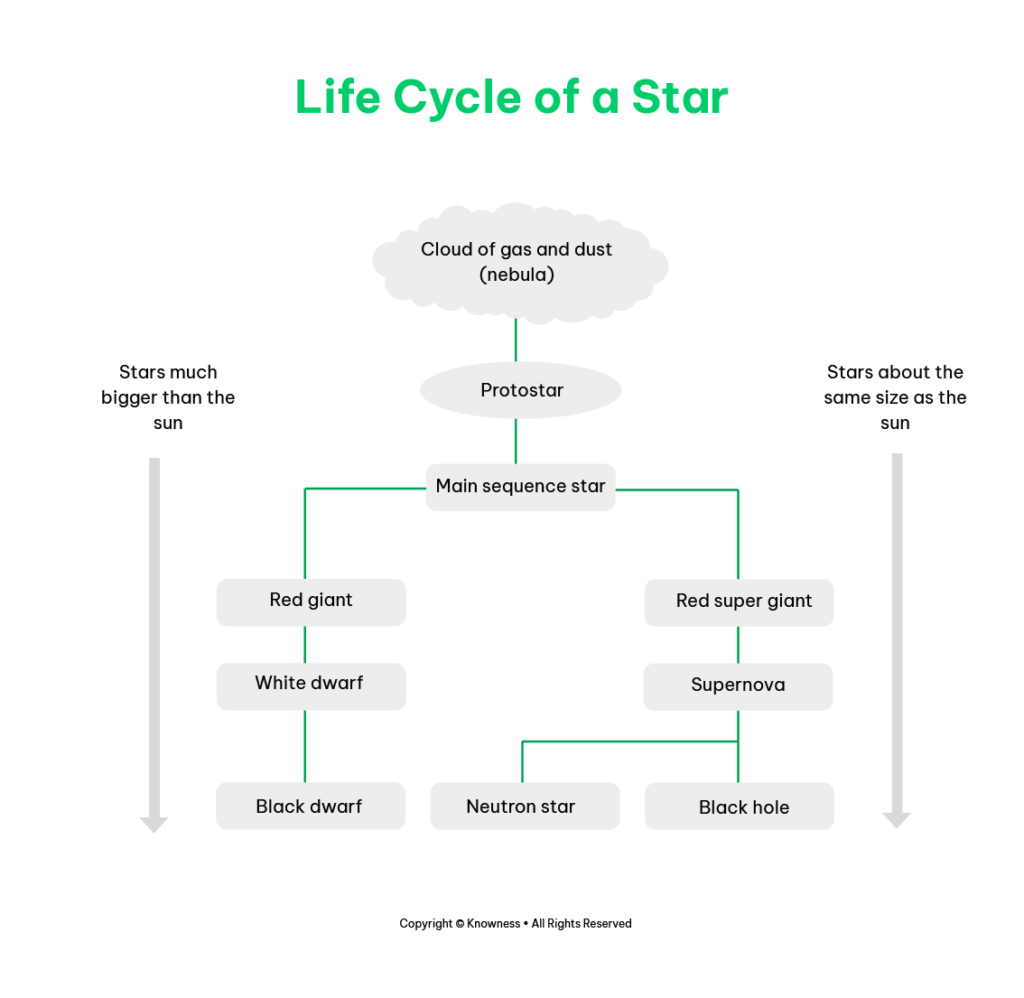
The life cycle of a star begins with a cloud of gas and dust called a nebula. Within this nebula, gravitational forces cause the gas and dust to come together, forming a protostar. As the protostar continues to contract, its core temperature rises, and nuclear fusionNuclear fusion is a reaction in which two or more atomic nuclei, combine to form one or more atomic nuclei and neutrons. reactions ignite, marking the birth of a main sequence star.
Stars About the Same Size as the Sun:
For stars that are about the same size as the Sun, they eventually enter the red giant phase.
- During this stage, the core contracts while the outer layers expand, causing the star to increase in size.
- Subsequently, the outer layers are expelled, creating a shell of gas known as a planetary nebula.
- The core that remains behind becomes a white dwarf, a compact and dense stellar remnant.
- Over time, the white dwarf cools and fades, becoming a black dwarf, which emits little to no light.
Stars Much Bigger Than the Sun:
For stars that are much bigger than the Sun, they follow a different path.
- After their main sequence stage, they expand into red supergiants, growing much larger and brighter.
- Eventually, they undergo a violent supernova explosion, releasing an immense amount of energy and matter into space.
- The core left behind after the explosion can either become a neutron star or collapse further into a black hole, depending on its mass.
- Neutron stars are incredibly dense, consisting mainly of neutrons, while black holes are regions with such strong gravitational forces that nothing, not even light, can escape their pull.
Fusion Processes and Element Production
Stars generate energy through fusion processes occurring in their cores.
- In the core, hydrogen atoms combine to form helium, releasing vast amounts of energy in the process known as nuclear fusion.
- This fusion process converts a small fraction of the star's mass into energy, following Einstein's famous equation, E = mc2.
Formation of New Elements
The fusion reactions in stars produce all naturally occurring elements up to iron.
- Elements heavier than iron, such as gold, uranium, and lead, are not formed through ordinary stellar fusion.
- These heavier elements are created during the explosive process of a supernova.
Supernovae and Element Distribution
A supernova is a powerful explosion that occurs at the end of a massive star's life cycle.
- During a supernova, the star releases an enormous amount of energy and expels its outer layers into space.
- The explosion creates shock waves that cause the fusion of lighter elements into heavier ones, generating elements beyond iron.
- The ejected material, enriched with these newly formed elements, is dispersed throughout the universe, eventually becoming part of interstellar clouds and future star-forming regions.
Conclusion
The life cycle of stars is a captivating journey influenced by their size and mass. From the smaller Sun to massive stellar giants, stars undergo fusion processes that produce all naturally occurring elements. Elements heavier than iron are synthesised during the explosive phenomenon of a supernova, scattering these elements into the vast expanse of the universe.
Continue the lesson
This section is available to learners with course access. Continue learning with Knowness to unlock the full explanation, examples, revision tools, and progress tracking.
The remaining lesson content includes further guided explanation, important learning points, and supporting interactive material designed to help you understand and revise this topic.
Unlock this topic to view the full activity, worked examples, common mistakes, and additional revision support.
More content available
Knowness lessons are structured to build understanding step by step. Create an account or upgrade your access to continue from this point.
This preview does not include the hidden lesson text, answers, explanations, or embedded interactions.
Continue learning with Knowness
Sign up to access the full lesson, predicted grades, revision tools, progress tracking, and more.
Create a free account