

GCSE
Physics
-
Introduction to GCSE Physics (AQA) Coming soon
-
1.1 Energy Stores, Transfers and Power
-
1.2 Conservation and Dissipation of Energy Coming soon
-
1.3 National and Global Energy Resources Coming soon
-
2.1 Current, Potential Difference and Resistance Coming soon
-
2.2 Series and Parallel Circuits Coming soon
-
2.3 Domestic Uses and Safety Coming soon
-
2.4 Energy Transfers Coming soon
-
2.5 Static Electricity Coming soon
-
3.1 Changes of State and the Particle Model Coming soon
-
3.2 Internal Energy and Energy Transfers Coming soon
-
3.3 Particle Model and Pressure Coming soon
-
4.1 Atoms and Isotopes Coming soon
-
4.2 Atoms and Nuclear Radiation Coming soon
-
4.3 Hazards and Uses of Radioactive Emissions and of Background Radiation Coming soon
-
4.4 Nuclear Fission and Fusion Coming soon
-
5.1 Forces and their Interactions Coming soon
-
5.2 Work Done and Energy Transfer Coming soon
-
5.3 Forces and Elasticity Coming soon
-
5.4 Moments, Levers and Gears Coming soon
-
5.5 Pressure and Pressure Differences in Fluids Coming soon
-
5.6 Forces and Motion Coming soon
-
5.6.1 Describing Motion Along a Line
-
5.6.2 Distance and Displacement
-
5.6.3 Speed
-
5.6.4 Velocity
-
5.6.5 The Distance–Time Relationship
-
5.6.6 Acceleration
-
5.6.7 Forces, Accelerations and Newton's Laws of Motion
-
5.6.8 Newton's First Law
-
5.6.9 Newton's Second Law
-
5.6.10 Newton's Third Law
-
5.6.11 Forces and Braking
-
5.6.12 Stopping Distance
-
5.6.13 Reaction Time
-
5.6.14 Factors Affecting Braking Distance
-
5.6.1 Describing Motion Along a Line
-
5.7 Momentum [HT] Coming soon
-
6.1 Waves in Air, Fluids and Solids Coming soon
-
6.2 Electromagnetic Waves Coming soon
-
6.3 Black Body Radiation Coming soon
-
7.1 Permanent and Induced Magnetism, Magnetic Forces and Fields Coming soon
-
7.2 The Motor Effect Coming soon
-
7.3 Induced Potential, Transformers and the National Grid [HT] Coming soon
-
8.1 Solar System; Stability of Orbital Motions; Satellites Coming soon
-
8.2 Red-Shift Coming soon
-
9.1 Required Practicals Coming soon
-
9.1.1 Required Practical Activity 1
-
9.1.2 Required Practical Activity 2
-
9.1.3 Required Practical Activity 3
-
9.1.4 Required Practical Activity 4
-
9.1.5 Required Practical Activity 5
-
9.1.6 Required Practical Activity 6
-
9.1.7 Required Practical Activity 7
-
9.1.8 Required Practical Activity 8
-
9.1.9 Required Practical Activity 9
-
9.1.10 Required Practical Activity 10
-
9.1.1 Required Practical Activity 1
1. Energy
1.2.1 Energy Transfers in a System
In this lesson, we will explore the fundamental principles of energy conservationThe professional care, preservation, and restoration of archaeological materials and sites, often requiring scientific expertise. and understand how energy can be transferred, stored, or dissipated within a closed system. We will also explore various ways to minimise the dissipation of energy in undesired forms.
Conservation of Energy
Energy is neither created nor destroyed but can be transferred from one form to another. This principle is known as the conservation of energy.
Within a closed system, energy can undergo various transformations, including useful energy transfers, energy storage, and dissipation into less useful forms.
Energy Transfers in Closed Systems
Energy transfers within closed systems occur without any net change to the total energy.
Example 1: Pendulum Swing:
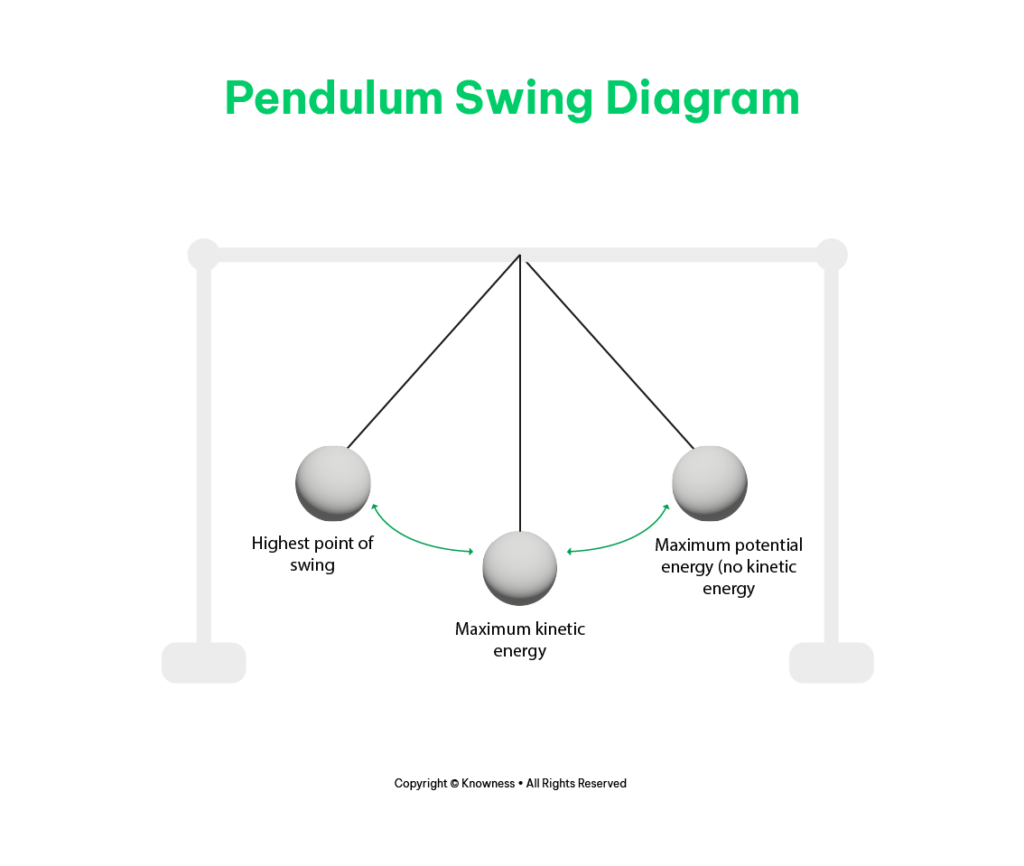
Consider a simple pendulum swinging back and forth. As it swings, there are energy transfers between kinetic energy and potential energy. At the highest point, the pendulum has maximum potential energy, which is then converted into maximum kinetic energy at the lowest point. Despite these energy transfers, the total energy of the pendulum remains constant within the closed system.
Example 2: Mechanical Clock:
In a mechanical clock, energy is transferred from a wound spring or weight to various components that enable the clock to function. As the clock operates, energy is continuously transferred between different parts, such as gears and hands. However, the total energy within the closed system remains constant.
Energy Dissipation and Wasted Energy
In all system changes, some energy is dissipated and stored in less useful forms. This energy is often referred to as "wasted" energy.
Example 1: Friction:
Consider the motion of a car. As the car moves, energy is transferred from the engine to the wheels, enabling the car to accelerate. However, a significant amount of energy is dissipated as heat due to friction between the car's tires and the road surface. This dissipated energy is not used to further enhance the car's motion, making it less useful or "wasted" energy.
Example 2: Electrical Appliances:
When using electrical appliances, such as a light bulb or computer, energy is transferred from the electrical source to the appliance. However, a portion of this energy is dissipated as heat due to resistance within the appliance or transmission lines. This dissipated energy is not utilised for the intended purposeThe reason for writing (to inform, persuade, describe, etc.). and is considered as wasted energy.
Reducing Unwanted Energy Transfers
Let's begin by understanding the ways in which we can minimise unwanted energy transfers.
- Lubrication: Using lubrication can help reduce friction between moving parts, thereby minimising energy loss through heat dissipation. By applying a lubricant, such as oil or grease, to surfaces in contact, we can create a lubricating film that reduces friction and enhances the efficiency of mechanical systems.
- Thermal Insulation: Thermal insulation involves the use of materials with low thermal conductivity to reduce heat transfer. Insulation helps to minimise the dissipation of thermal energy and maintain desired temperature conditions. By using insulating materials, such as foam, fibreglass, or cellulose, we can reduce heat flow through walls, roofs, and other surfaces.
Impact of Thermal Conductivity
The thermal conductivity of a material plays a role in determining the rate of energy transfer by conduction. Materials with higher thermal conductivity allow for a higher rate of energy transfer by conduction across the material. These materials facilitate the efficient transfer of heat and are commonly used in applications where heat dissipation is desirable, such as in thermal conductors or heat sinks.
Rate of Cooling in Buildings
The rate of cooling in a building is influenced by the thickness and thermal conductivity of its walls.
- Thickness of Walls: ,Thicker walls tend to slow down the rate of heat transfer between the interior and exterior of a building. This means that buildings with thicker walls experience slower cooling rates compared to those with thinner walls.
- Thermal Conductivity of Walls: The thermal conductivity of the walls affects the rate of heat transfer through conduction. Materials with higher thermal conductivity allow for faster heat transfer, resulting in faster cooling rates. On the other hand, materials with lower thermal conductivity impede heat transfer, leading to slower cooling rates.
Conclusion
We learned that energy can be transferred, stored, or dissipated within a closed system, following the principle of energy conservation. While energy transfers occur without changing the total energy within the system, some energy is lost and stored in less useful forms, known as wasted energy. We also discussed strategies for reducing unwanted energy transfers, such as using lubrication and thermal insulation to minimise energy dissipation. Additionally, we observed how materials with higher thermal conductivity enable faster energy transfer by conduction, and we investigated the impact of thickness and thermal conductivity of building walls on the rate of cooling.
Continue the lesson
This section is available to learners with course access. Continue learning with Knowness to unlock the full explanation, examples, revision tools, and progress tracking.
The remaining lesson content includes further guided explanation, important learning points, and supporting interactive material designed to help you understand and revise this topic.
Unlock this topic to view the full activity, worked examples, common mistakes, and additional revision support.
More content available
Knowness lessons are structured to build understanding step by step. Create an account or upgrade your access to continue from this point.
This preview does not include the hidden lesson text, answers, explanations, or embedded interactions.
Continue learning with Knowness
Sign up to access the full lesson, predicted grades, revision tools, progress tracking, and more.
Create a free account