

GCSE
Physics
-
Introduction to GCSE Physics (AQA) Coming soon
-
1.1 Energy Stores, Transfers and Power
-
1.2 Conservation and Dissipation of Energy Coming soon
-
1.3 National and Global Energy Resources Coming soon
-
2.1 Current, Potential Difference and Resistance Coming soon
-
2.2 Series and Parallel Circuits Coming soon
-
2.3 Domestic Uses and Safety Coming soon
-
2.4 Energy Transfers Coming soon
-
2.5 Static Electricity Coming soon
-
3.1 Changes of State and the Particle Model Coming soon
-
3.2 Internal Energy and Energy Transfers Coming soon
-
3.3 Particle Model and Pressure Coming soon
-
4.1 Atoms and Isotopes Coming soon
-
4.2 Atoms and Nuclear Radiation Coming soon
-
4.3 Hazards and Uses of Radioactive Emissions and of Background Radiation Coming soon
-
4.4 Nuclear Fission and Fusion Coming soon
-
5.1 Forces and their Interactions Coming soon
-
5.2 Work Done and Energy Transfer Coming soon
-
5.3 Forces and Elasticity Coming soon
-
5.4 Moments, Levers and Gears Coming soon
-
5.5 Pressure and Pressure Differences in Fluids Coming soon
-
5.6 Forces and Motion Coming soon
-
5.6.1 Describing Motion Along a Line
-
5.6.2 Distance and Displacement
-
5.6.3 Speed
-
5.6.4 Velocity
-
5.6.5 The Distance–Time Relationship
-
5.6.6 Acceleration
-
5.6.7 Forces, Accelerations and Newton's Laws of Motion
-
5.6.8 Newton's First Law
-
5.6.9 Newton's Second Law
-
5.6.10 Newton's Third Law
-
5.6.11 Forces and Braking
-
5.6.12 Stopping Distance
-
5.6.13 Reaction Time
-
5.6.14 Factors Affecting Braking Distance
-
5.6.1 Describing Motion Along a Line
-
5.7 Momentum [HT] Coming soon
-
6.1 Waves in Air, Fluids and Solids Coming soon
-
6.2 Electromagnetic Waves Coming soon
-
6.3 Black Body Radiation Coming soon
-
7.1 Permanent and Induced Magnetism, Magnetic Forces and Fields Coming soon
-
7.2 The Motor Effect Coming soon
-
7.3 Induced Potential, Transformers and the National Grid [HT] Coming soon
-
8.1 Solar System; Stability of Orbital Motions; Satellites Coming soon
-
8.2 Red-Shift Coming soon
-
9.1 Required Practicals Coming soon
-
9.1.1 Required Practical Activity 1
-
9.1.2 Required Practical Activity 2
-
9.1.3 Required Practical Activity 3
-
9.1.4 Required Practical Activity 4
-
9.1.5 Required Practical Activity 5
-
9.1.6 Required Practical Activity 6
-
9.1.7 Required Practical Activity 7
-
9.1.8 Required Practical Activity 8
-
9.1.9 Required Practical Activity 9
-
9.1.10 Required Practical Activity 10
-
9.1.1 Required Practical Activity 1
1. Energy
4.4.1 Nuclear Fission
Nuclear Fission
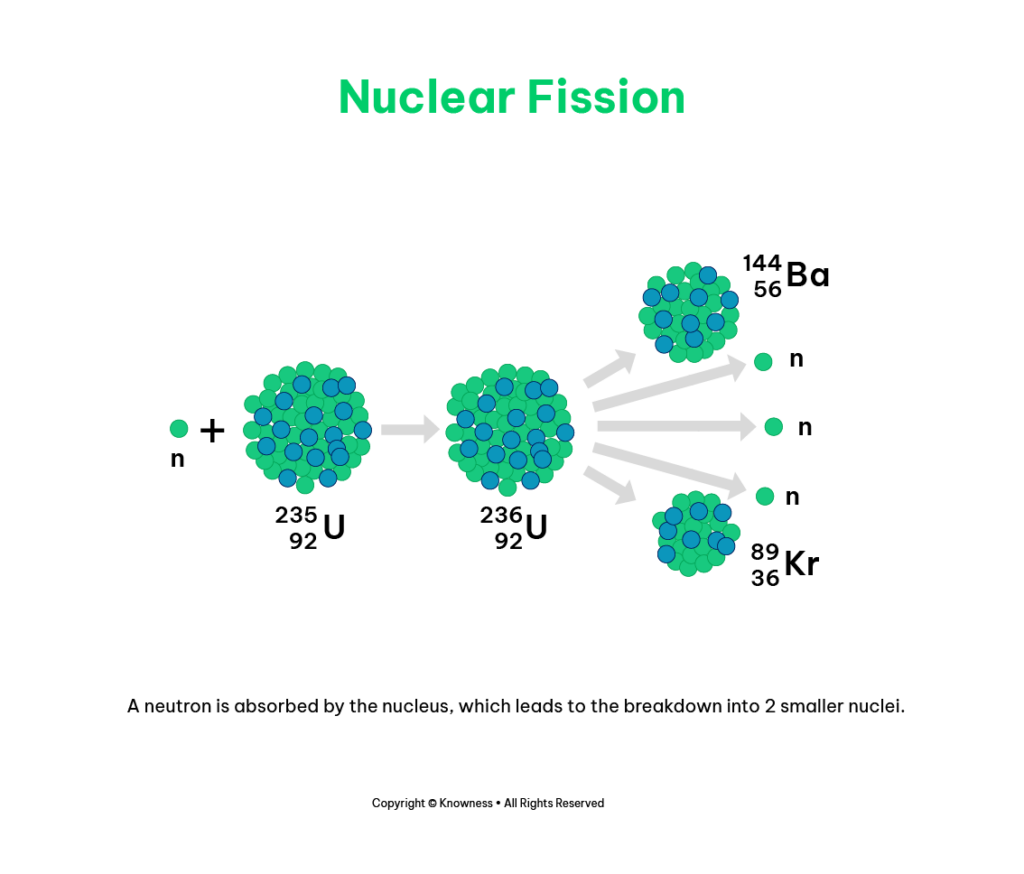
Nuclear fission is a process in which a large and unstable nucleusA membrane-bound organelle in eukaryotic cells that contains DNA., such as uranium or plutonium, is split into two smaller nuclei. This process releases a significant amount of energy and is responsible for both controlled energy generation in nuclear reactors and the destructive force of nuclear weapons.
Process of Nuclear Fission:
- Activation: Nuclear fission typically requires the absorption of a neutron by an unstable nucleus. Spontaneous fission is rare and less common than induced fission.
- Splitting: Upon absorbing a neutron, the unstable nucleus becomes highly excited and undergoes fission, breaking into two smaller nuclei. These nuclei are roughly equal in size and are accompanied by the release of two or three neutrons and gamma rays.
- Energy Release: The fission process releases a significant amount of energy in the form of kinetic energy of the fission products and gamma rays. This energy is harnessed for various applications.
Chain Reaction:
- Neutron Production: During the fission process, two or three neutrons are released. These neutrons can go on to initiate additional fissions in nearby nuclei, creating a chain reaction.
- Controlled Chain Reaction: In a nuclear reactor, the chain reaction is carefully controlled by regulating the number of neutrons available to sustain the reaction. Control rods, made of materials that absorb neutrons, are inserted or withdrawn to adjust the neutron population and maintain a stable reaction.
- Energy Generation: The controlled chain reaction in a nuclear reactor produces a steady release of energy, which is utilised to generate electricity in a controlled and sustained manner.
Controlled and Uncontrolled Chain Reactions
- Controlled Chain Reaction: In a nuclear reactor, the chain reaction is carefully regulated to maintain a steady energy release and prevent overheating or uncontrolled reactions. Control mechanisms, such as control rods and coolants, help maintain a controlled and sustained reaction.
- Uncontrolled Chain Reaction: In the contextA discrete unit of archaeological evidence, such as a layer of soil, a structure, or a feature, that can be recorded and interpreted. of a nuclear weapon, an uncontrolled chain reaction occurs, leading to a rapid and explosive release of energy. The sudden increase in energy results in a destructive explosion.
Conclusion
Nuclear fission is a process that involves splitting large and unstable atomic nuclei, releasing a substantial amount of energy. Understanding the mechanics of nuclear fission, including the absorption of neutrons, splitting of nuclei, and the concept of a chain reaction, is crucial. The controlled chain reaction in nuclear reactors enables the sustained generation of energy, while uncontrolled chain reactions can lead to devastating consequences.
Continue the lesson
This section is available to learners with course access. Continue learning with Knowness to unlock the full explanation, examples, revision tools, and progress tracking.
The remaining lesson content includes further guided explanation, important learning points, and supporting interactive material designed to help you understand and revise this topic.
Unlock this topic to view the full activity, worked examples, common mistakes, and additional revision support.
More content available
Knowness lessons are structured to build understanding step by step. Create an account or upgrade your access to continue from this point.
This preview does not include the hidden lesson text, answers, explanations, or embedded interactions.
Continue learning with Knowness
Sign up to access the full lesson, predicted grades, revision tools, progress tracking, and more.
Create a free account