

GCSE
Physics
-
Introduction to GCSE Physics (AQA) Coming soon -
1.1 Energy Stores, Transfers and Power -
1.2 Conservation and Dissipation of Energy Coming soon -
1.3 National and Global Energy Resources Coming soon -
2.1 Current, Potential Difference and Resistance Coming soon -
2.2 Series and Parallel Circuits Coming soon -
2.3 Domestic Uses and Safety Coming soon -
2.4 Energy Transfers Coming soon -
2.5 Static Electricity Coming soon -
3.1 Changes of State and the Particle Model Coming soon -
3.2 Internal Energy and Energy Transfers Coming soon -
3.3 Particle Model and Pressure Coming soon -
4.1 Atoms and Isotopes Coming soon -
4.2 Atoms and Nuclear Radiation Coming soon -
4.3 Hazards and Uses of Radioactive Emissions and of Background Radiation Coming soon -
4.4 Nuclear Fission and Fusion Coming soon -
5.1 Forces and their Interactions Coming soon -
5.2 Work Done and Energy Transfer Coming soon -
5.3 Forces and Elasticity Coming soon -
5.4 Moments, Levers and Gears Coming soon -
5.5 Pressure and Pressure Differences in Fluids Coming soon -
5.6 Forces and Motion Coming soon-
5.6.1 Describing Motion Along a Line -
5.6.2 Distance and Displacement -
5.6.3 Speed -
5.6.4 Velocity -
5.6.5 The Distance–Time Relationship -
5.6.6 Acceleration -
5.6.7 Forces, Accelerations and Newton's Laws of Motion -
5.6.8 Newton's First Law -
5.6.9 Newton's Second Law -
5.6.10 Newton's Third Law -
5.6.11 Forces and Braking -
5.6.12 Stopping Distance -
5.6.13 Reaction Time -
5.6.14 Factors Affecting Braking Distance
-
-
5.7 Momentum [HT] Coming soon -
6.1 Waves in Air, Fluids and Solids Coming soon -
6.2 Electromagnetic Waves Coming soon -
6.3 Black Body Radiation Coming soon -
7.1 Permanent and Induced Magnetism, Magnetic Forces and Fields Coming soon -
7.2 The Motor Effect Coming soon -
7.3 Induced Potential, Transformers and the National Grid [HT] Coming soon -
8.1 Solar System; Stability of Orbital Motions; Satellites Coming soon -
8.2 Red-Shift Coming soon -
9.1 Required Practicals Coming soon-
9.1.1 Required Practical Activity 1 -
9.1.2 Required Practical Activity 2 -
9.1.3 Required Practical Activity 3 -
9.1.4 Required Practical Activity 4 -
9.1.5 Required Practical Activity 5 -
9.1.6 Required Practical Activity 6 -
9.1.7 Required Practical Activity 7 -
9.1.8 Required Practical Activity 8 -
9.1.9 Required Practical Activity 9 -
9.1.10 Required Practical Activity 10
-
1. Energy
1.1.1 Energy Stores and Systems
In this lesson, you will learn what systems and energy are, explore the different types of energy, and understand concepts such as total energy, net energy, and closed systems. You will also examine how changes in systems occur through energy transfers. Finally, you will apply these ideas by exploring how energy is transferred in familiar, everyday situations.
Systems and Energy Stores
A system is just an object or a group of objects (e.g. a ball), while energy is what makes things happen or makes things change (e.g. a ball moves when kicked by a person because of the energy given to the ball by the person). All objects are able to hold energy in their energy stores. Energy never disappears or gets “used up”, instead it moves from one energy store to another.
There are eight different types of energy stores that you need to know, each of which holds a different type of energy in an object, these are shown in Table 1 below.
| Energy Store | Description |
|---|---|
| 🔥 Thermal Energy | The energy stored in an object from the movement of the particles that the object is made of. Hot objects have greater thermal energy stores because their particles move faster than the particles in cold objects. |
| 🚴♀️ Kinetic Energy | The energy stored in an object because it is moving. As an object speeds up, its kinetic energy stores increase, as the same object slows down, its kinetic energy stores decrease. |
| 🌍 Gravitational Potential Energy | The energy stored in an object from the gravitational force (or gravity) pulling the object towards the centre of our planet. The higher up an object is or the further away from Earth it is, the more its gravitational potential energy store increases. |
| 🪀 Elastic Potential Energy | The energy stored in an object when it is stretched out or compressed, like a spring or rubber band. |
| ⛽ Chemical Energy | The energy stored in an object’s chemical bonds. Food, batteries and fuel are sources of chemical energy. Whenever a person or animal performs an action they are using energy from their chemical energy stores. |
| 🧲 Magnetic Energy | The energy stored when two magnets, or a magnet and a magnetic material, are attracted or repelled. |
| ⚡ Electrostatic Energy | The energy stored when charged objects (e.g. electrons), are attracted or repelled. |
| ⚛️ Nuclear Energy | The energy stored inside the nucleus of an atom. This energy is released during nuclear reactions. |
Total Energy, Net Energy and Closed Systems
The total energy of a system is the sum of all the energy in all the energy stores inside the system. You can see an example of how you can workout the total energy of a system in Figure 1 below.
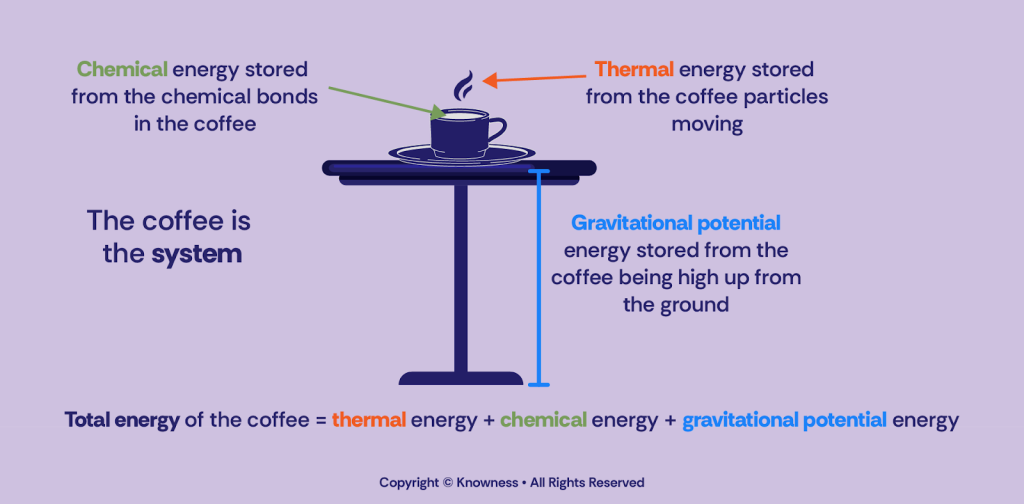
How much the total energy of a system has increased or decreased after the system has changed is called the Net energy. Net energy is calculated as the energy transferred into the system, minus the energy transferred out of the system. You can see an example of a calculation like this in Equation 1 below. The units we use to measure how much energy there is are joules (J).
\(\mathrm{Energy\ }\mathit{\color{green}{Added}}\ \mathrm{by\ the\ Change} = \color{green}{10\,\mathrm{J}}\)
\(\mathrm{Energy\ }\mathit{\color{red}{Removed}}\ \mathrm{by\ the\ Change} = \color{red}{4\,\mathrm{J}}\)
\(\mathrm{Net\ Energy} = \mathrm{Energy\ }\mathit{\color{green}{Added}}\ \mathrm{by\ the\ Change} – \mathrm{Energy\ }\mathit{\color{red}{Removed}}\ \mathrm{by\ the\ Change}\)
\(\mathrm{Net\ Energy} = \color{green}{10\,\mathrm{J}} – \color{red}{4\,\mathrm{J}}\)
\(\mathrm{Net\ Energy} = \color{blue}{6\,\mathrm{J}}\)
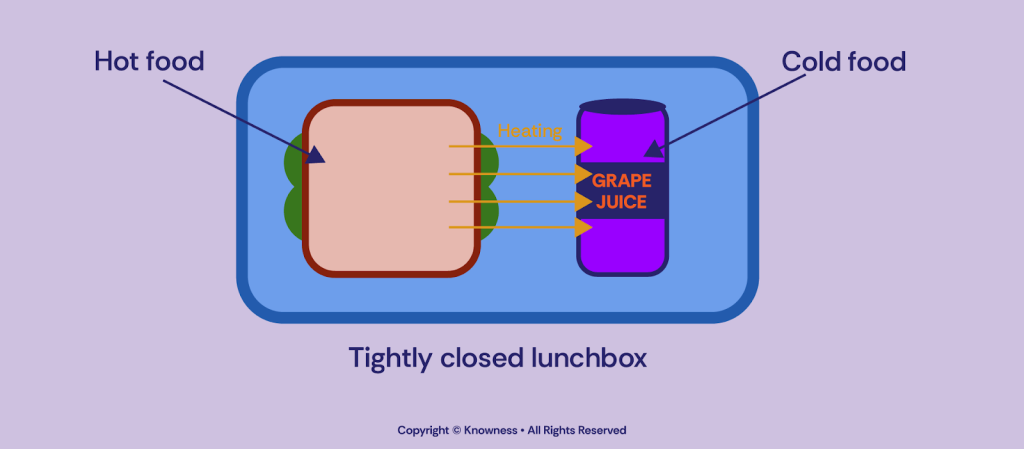
Closed systems are systems where no energy or objects can enter or leave the system, which is why we call them “closed”. This means the total energy of a closed system is always the same, since no new energy can be added or removed from a closed system. This also means the net energy of a closed system is always zero. However, energy can still move between the objects and the energy stores already inside a closed system.
Imagine you have a lunchbox that you have closed tightly and cannot open. This lunchbox acts like a closed system. Inside the lunchbox there is hot food and a cold drink. Since you cannot open the lunchbox, nothing inside the lunchbox can come out and nothing can be put inside the lunch box. Not even energy can leave or enter the lunchbox. However, energy can move between the food and the drink inside the lunchbox. For example, the hot food can move energy from its thermal energy stores to the cold drink’s thermal energy stores, heating the cold drink.Analogy
System Changes and Energy Transfers
For a change in a system to happen (e.g. for a ball that was sitting still on a table to be picked up and thrown), energy must move from one place to another. We call these movements of energy “energy transfers”. In all energy transfers, energy moves from one energy store to another energy store. This can be between energy stores of different types within the same object, or to an energy store of the same or different type in another object.
Energy can be transferred in two ways, by doing work or by heating. Doing work or work done is just another way of saying energy transferred. There are two ways in which work can be done:
- By a force moving an object. For example, a person pushing a box exerts a force on the box, the force does work causing an energy transfer which moves the box.
- By an electric current flowing.
In the example above of a person pushing a box, the work is not done by the person, the work is done by the force exerted by the person. This is the case for all situations; work is always either done by a force or an electric current flowing.Note
Heating is the name we use specifically for an energy transfer from the thermal energy store in one object, to the thermal energy store of another object. For energy transfers of all other types we say that work was done, not heating.
Don’t confuse heating with thermal energy, they are not the same thing! Thermal energy is an energy store, while heating is the energy transfer from one thermal energy store to another thermal energy store.Common Mistake
Energy Changes in Common Situations
Now we will look at some common situations where a change in a system is taking place and identify why the change is happening and what is the energy transfer.
When a Ball is Thrown Up or Falls Down
When a person throws a ball up, the force exerted by the person on the ball does work. Since work done is the same as energy transferred, this is the same as saying that the force exerted caused energy to be transferred. In this case energy is transferred from the person’s chemical energy stores to the ball’s kinetic energy stores, causing the ball to move upwards. This is shown in Figure 3 below.
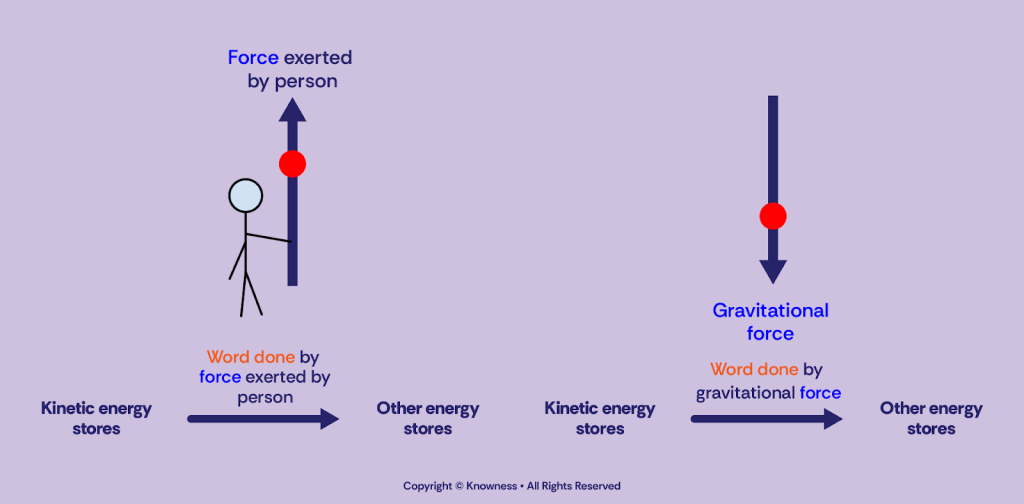
In Figure 3 above, you can also see what happens when the ball falls back down. Since the ball is above the ground it has stored gravitational potential energy. The gravitational force does work on the ball. Energy is transferred from the ball’s gravitational potential energy stores to its kinetic energy stores, causing the ball to move downwards.
Students sometimes think that a force “uses up” energy in energy stores, but this is not correct. Instead, forces do work meaning they transfer energy from one energy store to another energy store. Energy can never be “used up” or disappear, it can only be transferred from one energy store to another.Common Mistake
An Electric Kettle Bringing Water to a Boil
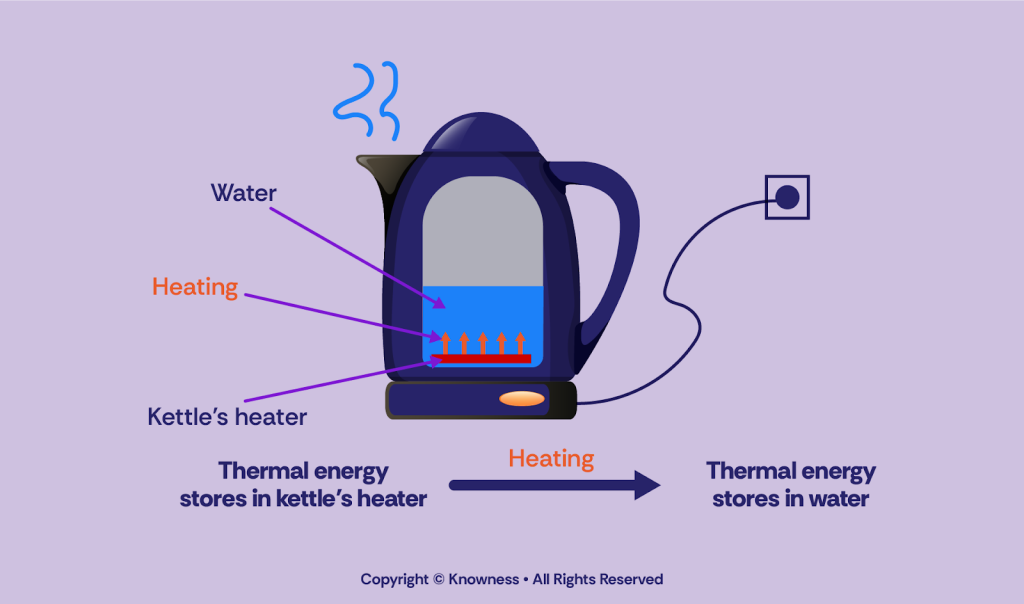
When an electric kettle brings water to a boil, heating takes place. Remember that heating is the energy transfer from one object’s thermal energy store to another object’s thermal energy store. In this case the energy is being transferred from the kettle’s heater’s thermal energy store, to the water’s thermal energy store, causing the temperature of the water to increase.
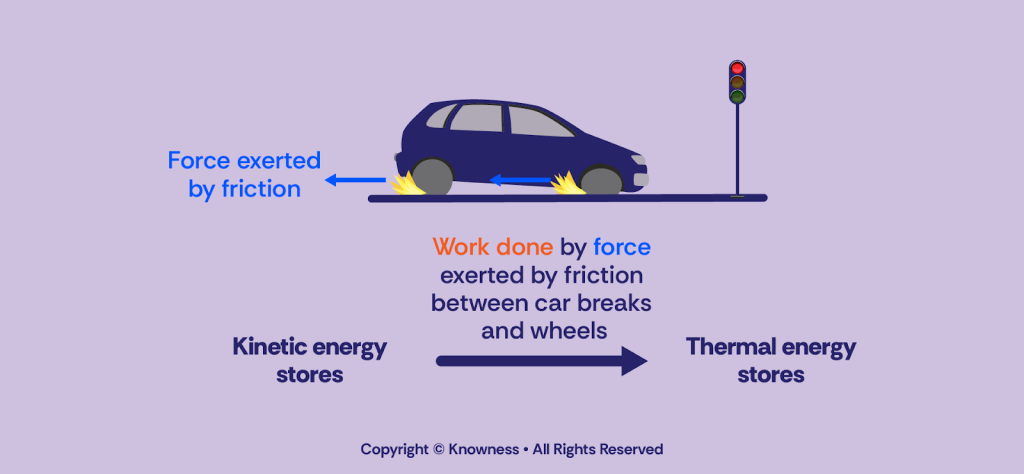
When Car Brakes Are Pressed
When a car’s brakes are pressed, friction between the car’s brakes and the wheels of the car exerts a force that does work in the opposite direction in which the car is moving. Energy is transferred from the wheels’ kinetic energy stores to the thermal energy stores of the surroundings (e.g. to the ground, air or wheels).
When a Cyclist Hits a Fence
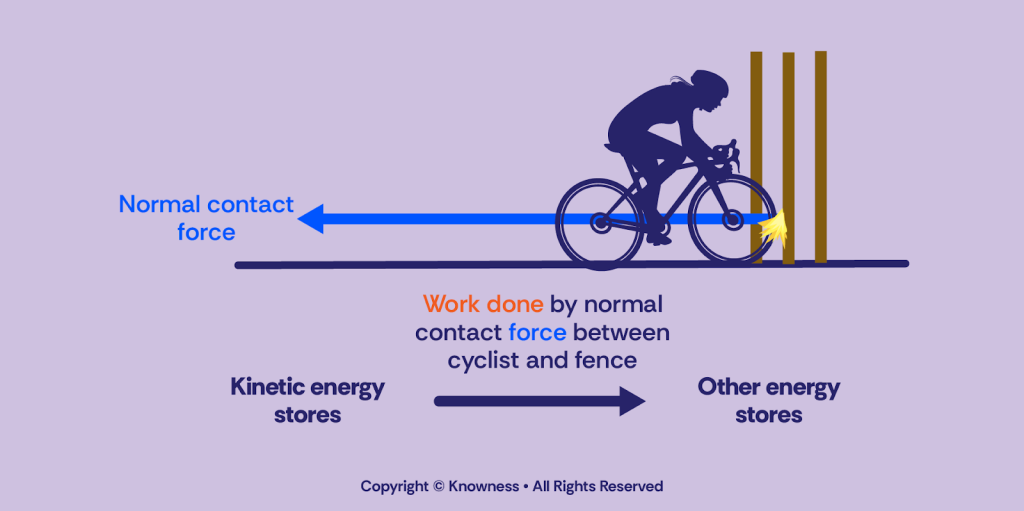
When a cyclist hits a fence the normal contact force between the cyclist and the fence does work causing the cyclist to slow down and stop. Energy is transferred from the cyclist’s kinetic energy stores to other types of energy stores in the fence and surroundings (e.g. energy will be transferred to the thermal energy stores in the fence).
System and Energy Stores
- A system is an object or a group of objects.
- Energy is what makes things happen or change.
- Energy stores are where objects keep energy.
- There are eight main types of energy stores: thermal, kinetic, gravitational potential, elastic potential, chemical, magnetic, electrostatic, nuclear.
- Thermal energy is the energy stored in an object from the movement of the particles that the object is made of.
- Kinetic energy is the energy stored in an object because it is moving.
- Gravitational potential energy is the energy stored in an object from the gravitational force pulling the object towards the Earth.
- Elastic potential energy is energy stored in an object when it is stretched out or compressed.
- Chemical energy is energy stored in an object’s chemical bonds.
- Magnetic energy is energy stored when two magnets, or a magnet and a magnetic material, are attracted or repelled.
- Electrostatic force is the energy stored when charged objects are attracted or repelled.
- Nuclear energy is the energy stored inside the nucleus of an atom and released during nuclear reactions.
Total Energy, Net Energy and Closed Systems
- The total energy of the system is the sum of all the energy in all the energy stores in the system.
- Net energy is the change in the total energy of a system.
- Net energy can be calculated as the energy transferred into the system, minus the energy transferred out of the system.
- The unit of energy is joules (J).
- Closed systems are systems where no energy or objects can enter or leave the system.
- The total energy of a closed system is always the same.
- The net energy of a closed system is always zero as no energy can enter or leave the system.
System Changes and Energy Transfers
- When a system changes, energy is always transferred.
- The movement of energy from one energy store to another is called an energy transfer.
- Energy can be transferred in two ways, by doing work or by heating.
- Work done means energy transferred.
- There are two ways work can be done, by a force being exerted or by an electrical current flowing.
- Heating is the energy transfer from one object’s thermal energy stores to another object’s thermal energy stores.
Energy Changes in Common Situations
- When a person throws a ball up, the force exerted by the person on the ball does work. Energy is transferred from the person’s chemical energy stores to the ball’s kinetic energy stores.
- When a ball falls down, the gravitational force does work on the ball. Energy is transferred from the ball’s gravitational potential energy stores to its kinetic energy stores.
- When an electric kettle brings water to a boil, heating takes place. Energy is transferred from the kettle’s heater's thermal energy store, to the water’s thermal energy.
- When car brakes are pressed, friction between the car’s brakes and the wheels of the car exerts a force that does work. Energy is transferred from the wheels’ kinetic energy stores to the thermal energy stores of the surroundings.
- When a cyclist hits a fence the normal contact force between the cyclist and the fence does work. Energy is transferred from the cyclist’s kinetic energy stores to other types of energy stores in the fence and surroundings.