

GCSE
Physics
-
Introduction to GCSE Physics (AQA) Coming soon
-
1.1 Energy Stores, Transfers and Power
-
1.2 Conservation and Dissipation of Energy Coming soon
-
1.3 National and Global Energy Resources Coming soon
-
2.1 Current, Potential Difference and Resistance Coming soon
-
2.2 Series and Parallel Circuits Coming soon
-
2.3 Domestic Uses and Safety Coming soon
-
2.4 Energy Transfers Coming soon
-
2.5 Static Electricity Coming soon
-
3.1 Changes of State and the Particle Model Coming soon
-
3.2 Internal Energy and Energy Transfers Coming soon
-
3.3 Particle Model and Pressure Coming soon
-
4.1 Atoms and Isotopes Coming soon
-
4.2 Atoms and Nuclear Radiation Coming soon
-
4.3 Hazards and Uses of Radioactive Emissions and of Background Radiation Coming soon
-
4.4 Nuclear Fission and Fusion Coming soon
-
5.1 Forces and their Interactions Coming soon
-
5.2 Work Done and Energy Transfer Coming soon
-
5.3 Forces and Elasticity Coming soon
-
5.4 Moments, Levers and Gears Coming soon
-
5.5 Pressure and Pressure Differences in Fluids Coming soon
-
5.6 Forces and Motion Coming soon
-
5.6.1 Describing Motion Along a Line
-
5.6.2 Distance and Displacement
-
5.6.3 Speed
-
5.6.4 Velocity
-
5.6.5 The Distance–Time Relationship
-
5.6.6 Acceleration
-
5.6.7 Forces, Accelerations and Newton's Laws of Motion
-
5.6.8 Newton's First Law
-
5.6.9 Newton's Second Law
-
5.6.10 Newton's Third Law
-
5.6.11 Forces and Braking
-
5.6.12 Stopping Distance
-
5.6.13 Reaction Time
-
5.6.14 Factors Affecting Braking Distance
-
5.6.1 Describing Motion Along a Line
-
5.7 Momentum [HT] Coming soon
-
6.1 Waves in Air, Fluids and Solids Coming soon
-
6.2 Electromagnetic Waves Coming soon
-
6.3 Black Body Radiation Coming soon
-
7.1 Permanent and Induced Magnetism, Magnetic Forces and Fields Coming soon
-
7.2 The Motor Effect Coming soon
-
7.3 Induced Potential, Transformers and the National Grid [HT] Coming soon
-
8.1 Solar System; Stability of Orbital Motions; Satellites Coming soon
-
8.2 Red-Shift Coming soon
-
9.1 Required Practicals Coming soon
-
9.1.1 Required Practical Activity 1
-
9.1.2 Required Practical Activity 2
-
9.1.3 Required Practical Activity 3
-
9.1.4 Required Practical Activity 4
-
9.1.5 Required Practical Activity 5
-
9.1.6 Required Practical Activity 6
-
9.1.7 Required Practical Activity 7
-
9.1.8 Required Practical Activity 8
-
9.1.9 Required Practical Activity 9
-
9.1.10 Required Practical Activity 10
-
9.1.1 Required Practical Activity 1
1. Energy
6.2.1 Types of Electromagnetic Waves
In this lesson, we will delve into the properties and classifications of electromagnetic waves. We will explore their continuous spectrum, their uniform velocity, and the different groups within the electromagnetic spectrum.
Electromagnetic Waves
Electromagnetic waves are transverse waves, meaning their oscillations occur perpendicular to the direction of wave propagation. They can transfer energy from their source to an absorber without the need for a physical medium.
All electromagnetic waves travel at the same velocity through a vacuum or air, which is approximately 3 x 10⁸ metres per second, often denoted as 'c' in equations.
Electromagnetic Spectrum
The electromagnetic spectrum is a continuum of all possible electromagnetic waves, grouped based on their wavelength and frequency.
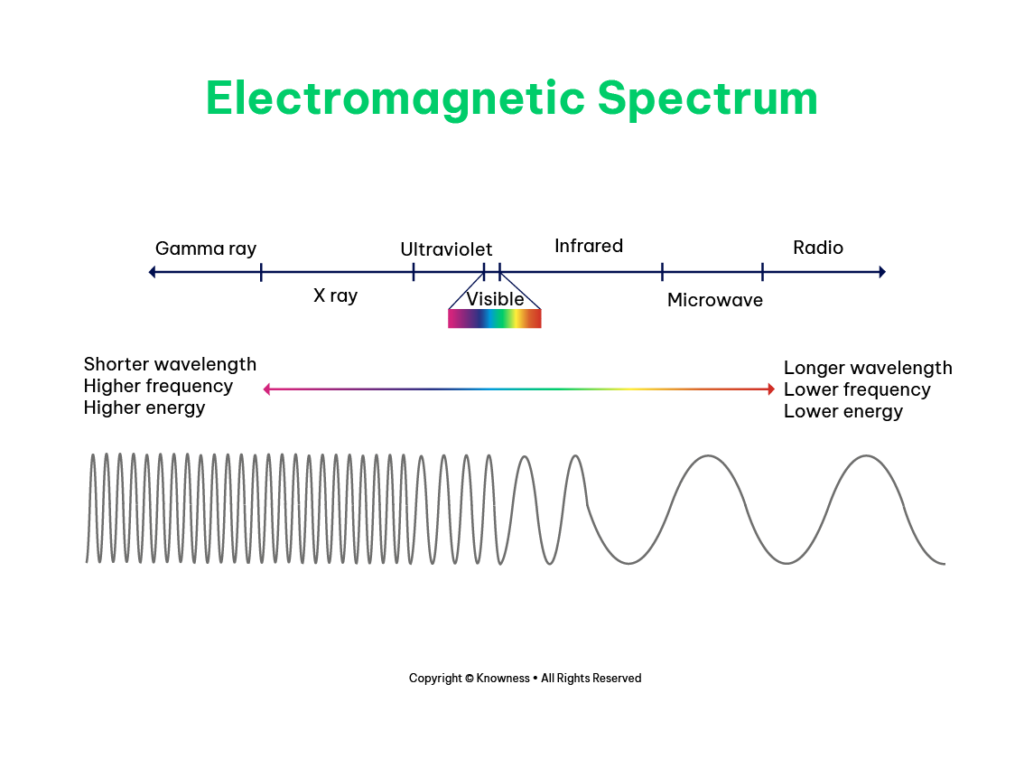
Going from long to short wavelength (or low to high frequency), the groups within the electromagnetic spectrum are:
- Radio Waves: Longest wavelength, lowest frequency electromagnetic waves. They are used in communication systems, such as radio broadcasting and mobile phones.
- Microwaves: Slightly shorter wavelength and higher frequency than radio waves. Microwaves are utilised in cooking, radar systems, and satellite communications.
- Infrared Waves: Longer wavelength and lower frequency than visible light. Infrared waves are associated with heat, used in night vision devices, and have applications in remote controls and thermal imaging.
- Visible Light: The narrow range of electromagnetic waves that our eyes can detect. Visible light spans from red (longest wavelength) to violet (shortest wavelength). It enables us to perceive the world around us and plays a significant role in optical technologies.
- Ultraviolet (UV) Waves: Higher frequency and shorter wavelength than visible light. UV waves have applications in sterilisationProcess through which any trace of life is removed. Essential in preparing fermentation vessels to avoid contamination., fluorescence, and tanning, but prolonged exposure can be harmful.
- X-rays: Shorter wavelength and higher frequency than UV waves. X-rays are commonly used in medical imaging, security screening, and materials testing.
- Gamma Rays: Shortest wavelength and highest frequency electromagnetic waves. They are produced by nuclear processes and have applications in medical imaging, cancer treatment, and scientific research.
Limited Range of Human Vision
Our eyes can only detect a limited range of electromagnetic waves, specifically the portion within the visible light spectrum.
- Visible light consists of various wavelengths that correspond to different colours, from red to violet.
- Although we are unable to directly perceive other types of electromagnetic waves, we have developed technologies to detect and utilise them for various purposes.
Examples of Energy Transfer by Electromagnetic Waves
Examples of energy transfer by electromagnetic waves include:
- Sunlight providing energy to plants through the process of photosynthesisThe process by which plants use light energy to produce glucose..
- Radio waves transmitting signals from a broadcasting station to a radio receiver.
- X-rays used in medical imaging to visualise bones and tissues.
- Microwaves transferring energy to food, resulting in heating during cooking.
- Infrared waves emitted by our bodies being detected by thermal cameras.
Conclusion
Electromagnetic waves are an integral part of our understanding of energy and the universe. They form a continuous spectrum and all travel at the same velocity through a vacuum or air. The electromagnetic spectrum encompasses radio waves, microwaves, infrared waves, visible light, ultraviolet waves, X-rays, and gamma rays. While our eyes can only detect visible light, we have harnessed other types of electromagnetic waves for various applications.
Continue the lesson
This section is available to learners with course access. Continue learning with Knowness to unlock the full explanation, examples, revision tools, and progress tracking.
The remaining lesson content includes further guided explanation, important learning points, and supporting interactive material designed to help you understand and revise this topic.
Unlock this topic to view the full activity, worked examples, common mistakes, and additional revision support.
More content available
Knowness lessons are structured to build understanding step by step. Create an account or upgrade your access to continue from this point.
This preview does not include the hidden lesson text, answers, explanations, or embedded interactions.
Continue learning with Knowness
Sign up to access the full lesson, predicted grades, revision tools, progress tracking, and more.
Create a free account