

GCSE
Physics
-
Introduction to GCSE Physics (AQA) Coming soon
-
1.1 Energy Stores, Transfers and Power
-
1.2 Conservation and Dissipation of Energy Coming soon
-
1.3 National and Global Energy Resources Coming soon
-
2.1 Current, Potential Difference and Resistance Coming soon
-
2.2 Series and Parallel Circuits Coming soon
-
2.3 Domestic Uses and Safety Coming soon
-
2.4 Energy Transfers Coming soon
-
2.5 Static Electricity Coming soon
-
3.1 Changes of State and the Particle Model Coming soon
-
3.2 Internal Energy and Energy Transfers Coming soon
-
3.3 Particle Model and Pressure Coming soon
-
4.1 Atoms and Isotopes Coming soon
-
4.2 Atoms and Nuclear Radiation Coming soon
-
4.3 Hazards and Uses of Radioactive Emissions and of Background Radiation Coming soon
-
4.4 Nuclear Fission and Fusion Coming soon
-
5.1 Forces and their Interactions Coming soon
-
5.2 Work Done and Energy Transfer Coming soon
-
5.3 Forces and Elasticity Coming soon
-
5.4 Moments, Levers and Gears Coming soon
-
5.5 Pressure and Pressure Differences in Fluids Coming soon
-
5.6 Forces and Motion Coming soon
-
5.6.1 Describing Motion Along a Line
-
5.6.2 Distance and Displacement
-
5.6.3 Speed
-
5.6.4 Velocity
-
5.6.5 The Distance–Time Relationship
-
5.6.6 Acceleration
-
5.6.7 Forces, Accelerations and Newton's Laws of Motion
-
5.6.8 Newton's First Law
-
5.6.9 Newton's Second Law
-
5.6.10 Newton's Third Law
-
5.6.11 Forces and Braking
-
5.6.12 Stopping Distance
-
5.6.13 Reaction Time
-
5.6.14 Factors Affecting Braking Distance
-
5.6.1 Describing Motion Along a Line
-
5.7 Momentum [HT] Coming soon
-
6.1 Waves in Air, Fluids and Solids Coming soon
-
6.2 Electromagnetic Waves Coming soon
-
6.3 Black Body Radiation Coming soon
-
7.1 Permanent and Induced Magnetism, Magnetic Forces and Fields Coming soon
-
7.2 The Motor Effect Coming soon
-
7.3 Induced Potential, Transformers and the National Grid [HT] Coming soon
-
8.1 Solar System; Stability of Orbital Motions; Satellites Coming soon
-
8.2 Red-Shift Coming soon
-
9.1 Required Practicals Coming soon
-
9.1.1 Required Practical Activity 1
-
9.1.2 Required Practical Activity 2
-
9.1.3 Required Practical Activity 3
-
9.1.4 Required Practical Activity 4
-
9.1.5 Required Practical Activity 5
-
9.1.6 Required Practical Activity 6
-
9.1.7 Required Practical Activity 7
-
9.1.8 Required Practical Activity 8
-
9.1.9 Required Practical Activity 9
-
9.1.10 Required Practical Activity 10
-
9.1.1 Required Practical Activity 1
1. Energy
4.1.3 The Development of the Model of the Atom
In this lesson, we will explore how scientific models of the atom have evolved over time based on new experimental evidence. We will discuss the pre-electron model, the plum pudding model, the nuclear model, Bohr's model, and the discovery of protons and neutrons.
Pre-Electron Model
Before the discovery of the electron, atoms were believed to be tiny spheres that could not be divided. At that time, the internal structure of atoms was not well understood. Scientists thought that atoms were the fundamental building blocks of matter and were indivisible.
Plum Pudding Model
In the late 19th century, the discovery of the electron by J.J. Thomson revolutionised our understanding of the atom. The plum pudding model, proposed by Thomson, suggested that the atom is a ball of positive charge with negatively charged electrons embedded within it.
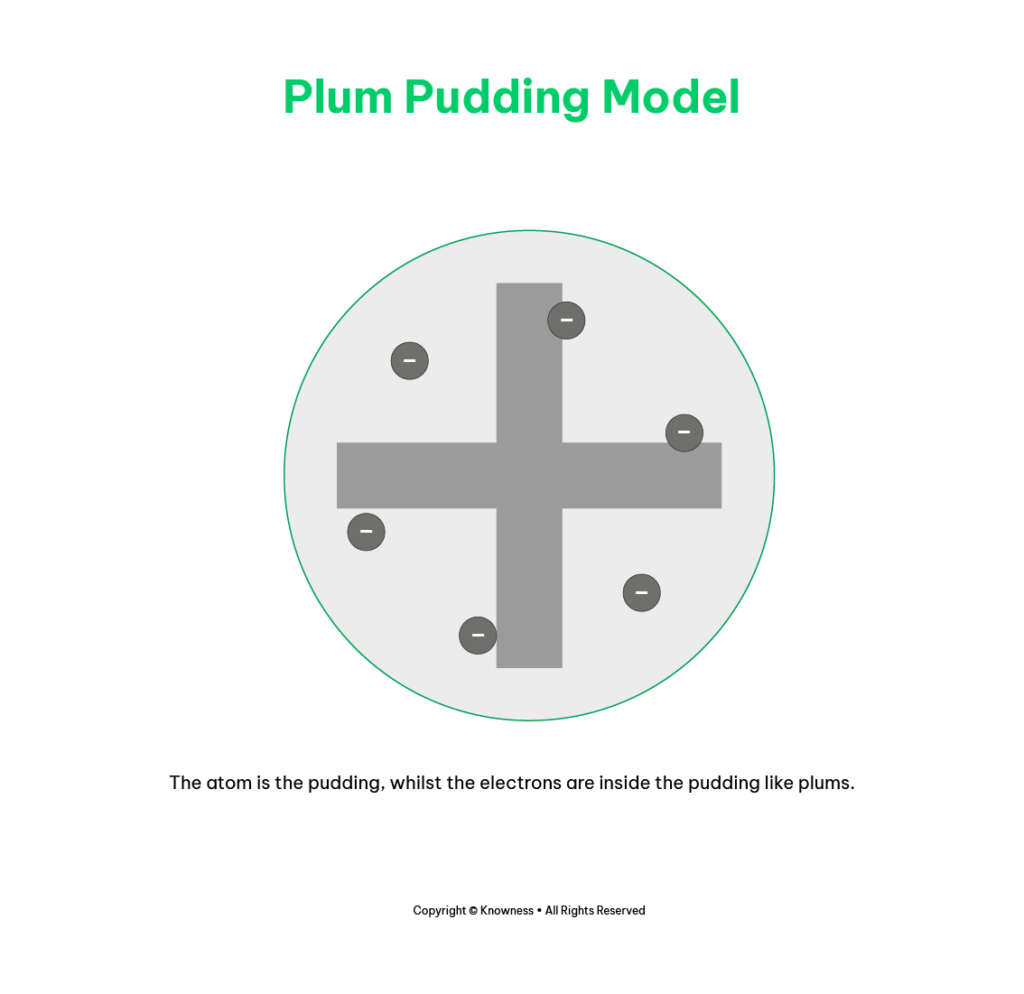
According to this model, the electrons were scattered throughout the atom, like plums in a pudding, within a positively charged matrixUsed in mathematics, this is an arrangement of numbers, symbols, or expressions arranged into rows and columns..
Nuclear Model
In 1909, Ernest Rutherford conducted the famous alpha particle scattering experiment. Alpha particles were directed at a thin gold foil. Most alpha particles passed through, but some were deflected at large angles, and a few even bounced back.
The unexpected deflections and rebounds of alpha particles indicated that the mass of an atom was concentrated in a small, dense, and positively charged region called the nucleusA membrane-bound organelle in eukaryotic cells that contains DNA.. Rutherford's experiment provided evidence that the nucleus carried a positive charge.
Bohr's Model
In 1913, Niels Bohr proposed a model that added more structure to the atom.
- Quantum Theory: Bohr incorporated the principles of quantum theory and suggested that electrons orbit the nucleus at specific distances or energy levels.
- Energy Transitions: According to Bohr's model, electrons can move between these energy levels by absorbing or emitting energy in discrete packets or quanta.
- Agreement with Observations: Bohr's theoretical calculations agreed with experimental observations, providing further support for the model.
Protons and Neutrons
In the 1910s, further experiments revealed that the positive charge of any nucleus could be subdivided into smaller particles, each carrying the same amount of positive charge. These positively charged particles were named protons.
In 1932, James Chadwick conducted experiments that led to the discovery of neutrons. The discovery of neutrons provided additional evidence supporting the nuclear model and the existence of a dense, positively charged nucleus.
Difference between the Plum Pudding Model and the Nuclear Model
Plum Pudding Model:
- Structure: The plum pudding model proposed that the atom is a ball of positive charge with negatively charged electrons embedded within it.
- Distribution of Charge: According to this model, the positive charge and the negative charge of the electrons are spread uniformly throughout the atom.
- No Concentrated Nucleus: The plum pudding model suggests that there is no concentrated centre or nucleus within the atom.
- Lack of Subatomic Particles: This model did not account for the presence of protons and neutrons in the atomic structure.
Nuclear Model:
- Structure: The nuclear model, proposed as a result of the alpha particle scattering experiment by Ernest Rutherford, suggests a different structure for the atom.
- Concentrated Nucleus: In the nuclear model, the atom is depicted as having a small, dense, and positively charged nucleus at the centre.
- Electrons in Orbit: Electrons are shown to orbit the nucleus in specific energy levels or orbits.
- Majority of Mass in Nucleus: The nuclear model acknowledges that most of the mass of an atom is concentrated in the nucleus.
- Protons and Neutrons: The presence of protons, which carry a positive charge, and neutrons, which are electrically neutral, is accounted for within the nucleus.
Conclusion
We explored the development of the model of the atom based on new experimental evidence. The pre-electron model was replaced by the plum pudding model, which was later replaced by the nuclear model based on the results of the alpha particle scattering experiment. Niels Bohr's model introduced electron orbits and quantum transitions. Subsequent experiments led to the discovery of protons and neutrons within the nucleus.
Continue the lesson
This section is available to learners with course access. Continue learning with Knowness to unlock the full explanation, examples, revision tools, and progress tracking.
The remaining lesson content includes further guided explanation, important learning points, and supporting interactive material designed to help you understand and revise this topic.
Unlock this topic to view the full activity, worked examples, common mistakes, and additional revision support.
More content available
Knowness lessons are structured to build understanding step by step. Create an account or upgrade your access to continue from this point.
This preview does not include the hidden lesson text, answers, explanations, or embedded interactions.
Continue learning with Knowness
Sign up to access the full lesson, predicted grades, revision tools, progress tracking, and more.
Create a free account