

GCSE
Physics
-
Introduction to GCSE Physics (AQA) Coming soon -
1.1 Energy Stores, Transfers and Power -
1.2 Conservation and Dissipation of Energy Coming soon -
1.3 National and Global Energy Resources Coming soon -
2.1 Current, Potential Difference and Resistance Coming soon -
2.2 Series and Parallel Circuits Coming soon -
2.3 Domestic Uses and Safety Coming soon -
2.4 Energy Transfers Coming soon -
2.5 Static Electricity Coming soon -
3.1 Changes of State and the Particle Model Coming soon -
3.2 Internal Energy and Energy Transfers Coming soon -
3.3 Particle Model and Pressure Coming soon -
4.1 Atoms and Isotopes Coming soon -
4.2 Atoms and Nuclear Radiation Coming soon -
4.3 Hazards and Uses of Radioactive Emissions and of Background Radiation Coming soon -
4.4 Nuclear Fission and Fusion Coming soon -
5.1 Forces and their Interactions Coming soon -
5.2 Work Done and Energy Transfer Coming soon -
5.3 Forces and Elasticity Coming soon -
5.4 Moments, Levers and Gears Coming soon -
5.5 Pressure and Pressure Differences in Fluids Coming soon -
5.6 Forces and Motion Coming soon-
5.6.1 Describing Motion Along a Line -
5.6.2 Distance and Displacement -
5.6.3 Speed -
5.6.4 Velocity -
5.6.5 The Distance–Time Relationship -
5.6.6 Acceleration -
5.6.7 Forces, Accelerations and Newton's Laws of Motion -
5.6.8 Newton's First Law -
5.6.9 Newton's Second Law -
5.6.10 Newton's Third Law -
5.6.11 Forces and Braking -
5.6.12 Stopping Distance -
5.6.13 Reaction Time -
5.6.14 Factors Affecting Braking Distance
-
-
5.7 Momentum [HT] Coming soon -
6.1 Waves in Air, Fluids and Solids Coming soon -
6.2 Electromagnetic Waves Coming soon -
6.3 Black Body Radiation Coming soon -
7.1 Permanent and Induced Magnetism, Magnetic Forces and Fields Coming soon -
7.2 The Motor Effect Coming soon -
7.3 Induced Potential, Transformers and the National Grid [HT] Coming soon -
8.1 Solar System; Stability of Orbital Motions; Satellites Coming soon -
8.2 Red-Shift Coming soon -
9.1 Required Practicals Coming soon-
9.1.1 Required Practical Activity 1 -
9.1.2 Required Practical Activity 2 -
9.1.3 Required Practical Activity 3 -
9.1.4 Required Practical Activity 4 -
9.1.5 Required Practical Activity 5 -
9.1.6 Required Practical Activity 6 -
9.1.7 Required Practical Activity 7 -
9.1.8 Required Practical Activity 8 -
9.1.9 Required Practical Activity 9 -
9.1.10 Required Practical Activity 10
-
1. Energy
1.1.3 Specific Heat Capacity
In this lesson, you will learn what specific heat capacity is, how it affects how substances and materials heat and cool down, and how knowing the specific heat capacity of a material allows us to calculate how much energy the material has gained or lost (or the change in energy) when heated up or cooled down.
What is Specific Heat Capacity?
Some materials or substances are more difficult to heat up than others. Remember that heating is the transfer of energy from one object’s thermal energy stores to another object’s thermal energy stores. The reason some objects are harder to heat up than others is because some materials need more energy transferred into their thermal energy stores to go up in temperature than others.
For example, the energy needed to increase the temperature of 1 kg of water by 1 °C is 4,200 J, while the energy needed to increase the temperature of 1 kg of mercury by 1 °C is only 140 J.
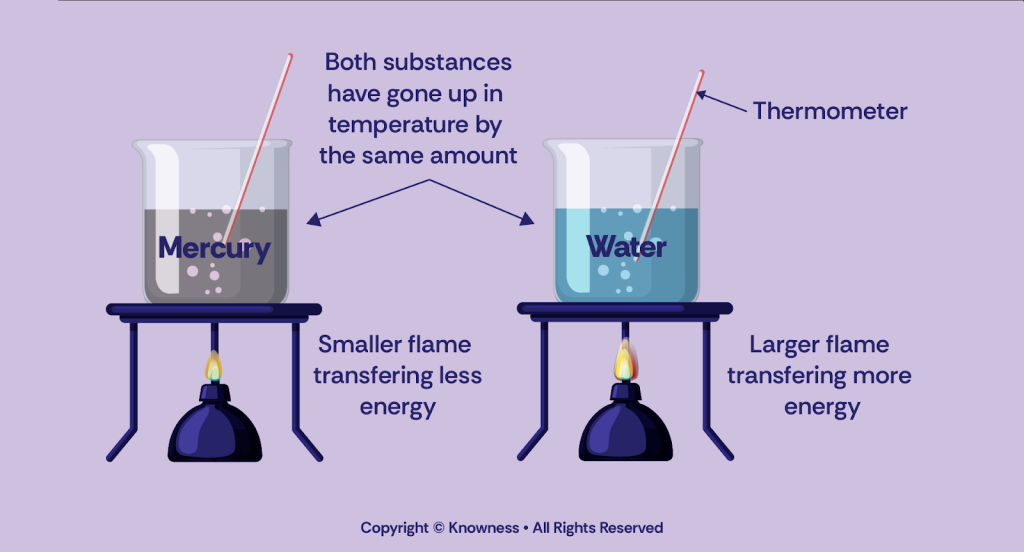
The energy required to increase the temperature of 1 kg of any substance by 1 °C is called the specific heat capacity. In the water and mercury example, you found out that water has a specific heat capacity of 4,200 J and mercury has a specific heat capacity of 140 J.
The greater the specific heat capacity of a material, the more energy needs to be transferred to the material for it to go up in temperature. Also, the greater the specific heat capacity of a material, the more energy the material will release when it cools down, since it stored more energy when it was being heated up. One way of thinking about it is that materials with with a larger specific heat capacity can store more energy.
Think of different materials and substances like different-sized buckets. A smaller bucket (like mercury) fills up quickly with energy, meaning it heats up fast. A larger bucket (like water) needs much more energy to fill up, so its temperature rises slowly. Also, a smaller bucket cannot hold as much energy as a larger bucket, so the smaller bucket will release less energy when emptied compared to a larger bucket.Analogy
Calculating Specific Heat Capacity
A useful thing that knowing the specific heat capacity of a material lets us work out is how much energy the material has gained when heated up or lost when cooled down. We can calculate this amount of energy stored in or released from a system as its temperature changes using Equation 5 shown below.
\(\Delta E=mc\Delta \theta\)
or
\( \text{change in thermal energy} = \text{mass}\times\text{specific heat capacity}\times\text{temperature change}\)
The formula for the change in thermal energy as the temperature of a material changes has four components:
- \(\Delta E\) is the change in thermal energy of the material or substance. This change can either be an increase or a decrease in energy. \(\Delta E\) has units of joules (J).
- \(m\) is the mass of the material or substance. \(m\) must always have units of kilograms (kg) when used in this formula.
- \(c\) is the specific heat capacity of the material or substance. \(c\) has units of joules per kilogram per degree Celsius (J/kg °C).
- \(\Delta \theta\) is the change in temperature of the material or substance. This change can either be an increase or a decrease in temperature. \(\Delta \theta\) has units of degrees Celsius (°C).
Imagine you have been asked to calculate the change in thermal energy of 2 kg of iron which has been heated and its temperature raised by 10 °C. The specific heat capacity of iron is 450 J/kg °C. To calculate the change in thermal energy of the iron, you will need to use the formula you have just learned about: \(\Delta E = m \times c \times \Delta \theta\) Then substitute the variables with the values given to you in the question: \(\Delta E = 2 \times 450 \times 10\) Finally, carry out the calculations to get the change in energy of the iron: \(\Delta E = 2 \times 450 \times 10\) \(\Delta E = 9000J\) Therefore, we just calculated that 2 kg of iron’s thermal energy stores increased by 9000 J when the iron’s temperature was raised by 10 °C.Example
The symbol delta (\(\Delta \)), for example in \(\Delta E\) or \(\Delta \theta \), just means change.Note
What is Specific Heat Capacity?
- The specific heat capacity of a substance is the amount of energy required to raise the temperature of 1 kg of the substance by 1 °C.
- Specific heat capacity tells us how much energy is needed to increase the temperature of a substance.
- The larger the specific heat capacity of a material, the more energy needs to be transferred to the material’s thermal energy stores for the material to heat up.
- The larger the specific heat capacity of a material, the more energy is transferred out of the material’s thermal energy stores when the material is cooled down.
Calculating Specific Heat Capacity
- The amount of energy stored in or released from a system as its temperature changes can be calculated using the equation: \(\Delta E=mc\Delta \theta\)
- \(\Delta E\) is the change in thermal energy and is measured in joules (J).
- \(m\) is the mass of the substance and is measured in kilograms (kg).
- \(c\) is the specific heat capacity of the substance and is measured in joules per kilogram per degree Celsius (J/kg °C).
- \(\Delta \theta\) is the change in temperature of the substance and is measured in degrees Celsius (°C).