

GCSE
Chemistry
-
Introduction to GCSE Chemistry (AQA) Coming soon
-
1.1 Atomic Structure, Elements, Compounds, and Mixtures
-
1.2 The Periodic Table Coming soon
-
2.1 Chemical Bonds, Ionic, Covalent and Metallic Coming soon
-
2.2 How Bonding and Structure are Related to the Properties of Substances Coming soon
-
2.3 Structure and Bonding of Carbon Coming soon
-
2.4 Bulk and Surface Properties of Matter including Nanoparticles Coming soon
-
3.1 Chemical Measurements, Conservation of Mass and the Quantitative Interpretation of Chemical Equations Coming soon
-
3.2 Use of Amount of Substance in Relation to Masses of Pure Substances Coming soon
-
3.3 Yield and Atom Economy of Chemical Reactions Coming soon
-
3.4 Using Concentrations of Solutions in mol/dm³ [HT] Coming soon
-
3.5 Use of Amount of Substance in Relation to Volumes of Gases [HT] Coming soon
-
4.1 Reactivity of Metals Coming soon
-
4.2 Reactions of Acids Coming soon
-
4.3 Electrolysis Coming soon
-
5.1 Exothermic and Endothermic Reactions Coming soon
-
5.2 Chemical Cells and Fuel Cells Coming soon
-
6.1 Rate of Reaction Coming soon
-
6.2 Reversible Reactions and Dynamic Equilibrium Coming soon
-
6.2.1 Reversible Reactions
-
6.2.2 Energy Changes and Reversible Reactions
-
6.2.3 Equilibrium
-
6.2.4 The Effect of Changing Conditions on Equilibrium (HT only)
-
6.2.5 The Effect of Changing Concentration (HT only)
-
6.2.6 The Effect of Temperature Changes on Equilibrium (HT only)
-
6.2.7 The Effect of Pressure Changes on Equilibrium (HT only)
-
6.2.1 Reversible Reactions
-
7.1 Carbon Compounds as Fuels and Feedstock Coming soon
-
7.2 Reactions of Alkenes and Alcohols Coming soon
-
7.3 Synthetic and Naturally Occurring Polymers Coming soon
-
8.1 Purity, Formulations and Chromatography Coming soon
-
8.2 Identification of Common Gases Coming soon
-
8.3 Identification of Ions by Chemical and Spectroscopic Means Coming soon
-
9.1 The Composition and Evolution of the Earth's Atmosphere Coming soon
-
9.2 Carbon Dioxide and Methane as Greenhouse Gases Coming soon
-
9.3 Common Atmospheric Pollutants and their Sources Coming soon
-
10.1 Using the Earth's Resources and Obtaining Potable Water Coming soon
-
10.2 Life Cycle Assessment and Recycling Coming soon
-
10.3 Using Materials Coming soon
-
10.4 The Haber Process and the use of NPK Fertilisers Coming soon
1. Atomic Structure and the Periodic Table
8.1.3 Chromatography
ChromatographyThe separation of compounds using a stationary and mobile phase. is a technique used to separate complex mixtures and provide valuable information for the identification of substances. It involves the use of a stationary phase (a solid or a liquid immobilised on a solid support) and a mobile phase (a liquid or a gas) that moves through the stationary phase. The separation of substances in chromatography relies on the different distribution and interaction of each component between the stationary and mobile phases.
One commonly used type of chromatography is paper chromatography. In paper chromatography, a strip of specialised paper is used as the stationary phase, and a liquid solvent is used as the mobile phase. The mixture to be separated is spotted onto the paper, and when the solvent is allowed to travel up the paper by capillary action, the different components of the mixture will move at different rates. This occurs because each component interacts differently with the paper and the solvent, leading to varying degrees of attraction and movement.
To analyse the results of chromatography, the Rf (retention factor) value is calculated for each compound. The Rf value is the ratio of the distance moved by a compound (measured from the centre of the spot to the origin) to the distance moved by the solvent. It is expressed as:
Rf = distance moved by substance / distance moved by solvent
Each compound has a unique Rf value in a particular solvent system, and this value can be used to help identify the compounds in the mixture. By comparing the Rf values obtained from experimental chromatograms to the Rf values of known compounds, the substances in an unknown mixture can be identified.
Different solvents may yield different separation patterns for a mixture, resulting in different Rf values. However, pure compounds will produce a single spot regardless of the solvent used, as they consist of a single chemical entity.
The stationary phase refers to the solid or liquid immobilised on a solid support, such as the specialised paper used in paper chromatography. It acts as a surface on which the components of the mixture can interact. The mobile phase, on the other hand, is the liquid or gas that carries the mixture through the stationary phase. The mobile phase moves along the stationary phase, driven by capillary action or an external force.
Different compounds in the mixture interact differently with the stationary and mobile phases, leading to their separation. These interactions can include differences in polarity, charge, size, and other chemical properties. For example, a compound that is more attracted to the stationary phase will move more slowly, while a compound that is less attracted will move faster through the system. This differential movement allows for the separation of the components based on their unique characteristics.
A chromatogram is a visual representation of the separation obtained in chromatography. It shows the distinct spots or bands formed by the separated components of the mixture.
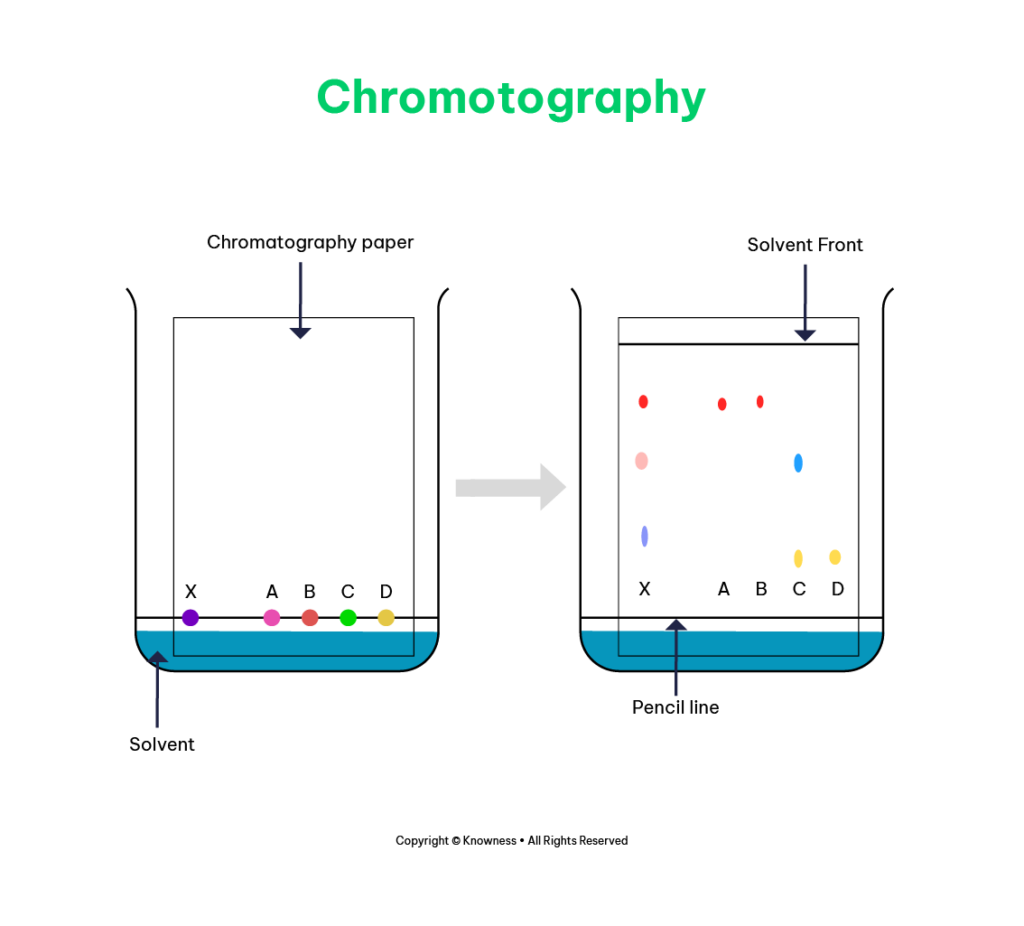
Calculating the Rf values is an important step in chromatographic analysis. Rf values provide a quantitative measure of how far each component of the mixture has travelled compared to the solvent front. By dividing the distance moved by a substance by the distance moved by the solvent, the Rf value is obtained. These values are unique to each compound and can be used as a characteristic identifier.
Continue the lesson
This section is available to learners with course access. Continue learning with Knowness to unlock the full explanation, examples, revision tools, and progress tracking.
The remaining lesson content includes further guided explanation, important learning points, and supporting interactive material designed to help you understand and revise this topic.
Unlock this topic to view the full activity, worked examples, common mistakes, and additional revision support.
More content available
Knowness lessons are structured to build understanding step by step. Create an account or upgrade your access to continue from this point.
This preview does not include the hidden lesson text, answers, explanations, or embedded interactions.
Continue learning with Knowness
Sign up to access the full lesson, predicted grades, revision tools, progress tracking, and more.
Create a free account