

GCSE
Chemistry
-
Introduction to GCSE Chemistry (AQA) Coming soon
-
1.1 Atomic Structure, Elements, Compounds, and Mixtures
-
1.2 The Periodic Table Coming soon
-
2.1 Chemical Bonds, Ionic, Covalent and Metallic Coming soon
-
2.2 How Bonding and Structure are Related to the Properties of Substances Coming soon
-
2.3 Structure and Bonding of Carbon Coming soon
-
2.4 Bulk and Surface Properties of Matter including Nanoparticles Coming soon
-
3.1 Chemical Measurements, Conservation of Mass and the Quantitative Interpretation of Chemical Equations Coming soon
-
3.2 Use of Amount of Substance in Relation to Masses of Pure Substances Coming soon
-
3.3 Yield and Atom Economy of Chemical Reactions Coming soon
-
3.4 Using Concentrations of Solutions in mol/dm³ [HT] Coming soon
-
3.5 Use of Amount of Substance in Relation to Volumes of Gases [HT] Coming soon
-
4.1 Reactivity of Metals Coming soon
-
4.2 Reactions of Acids Coming soon
-
4.3 Electrolysis Coming soon
-
5.1 Exothermic and Endothermic Reactions Coming soon
-
5.2 Chemical Cells and Fuel Cells Coming soon
-
6.1 Rate of Reaction Coming soon
-
6.2 Reversible Reactions and Dynamic Equilibrium Coming soon
-
6.2.1 Reversible Reactions
-
6.2.2 Energy Changes and Reversible Reactions
-
6.2.3 Equilibrium
-
6.2.4 The Effect of Changing Conditions on Equilibrium (HT only)
-
6.2.5 The Effect of Changing Concentration (HT only)
-
6.2.6 The Effect of Temperature Changes on Equilibrium (HT only)
-
6.2.7 The Effect of Pressure Changes on Equilibrium (HT only)
-
6.2.1 Reversible Reactions
-
7.1 Carbon Compounds as Fuels and Feedstock Coming soon
-
7.2 Reactions of Alkenes and Alcohols Coming soon
-
7.3 Synthetic and Naturally Occurring Polymers Coming soon
-
8.1 Purity, Formulations and Chromatography Coming soon
-
8.2 Identification of Common Gases Coming soon
-
8.3 Identification of Ions by Chemical and Spectroscopic Means Coming soon
-
9.1 The Composition and Evolution of the Earth's Atmosphere Coming soon
-
9.2 Carbon Dioxide and Methane as Greenhouse Gases Coming soon
-
9.3 Common Atmospheric Pollutants and their Sources Coming soon
-
10.1 Using the Earth's Resources and Obtaining Potable Water Coming soon
-
10.2 Life Cycle Assessment and Recycling Coming soon
-
10.3 Using Materials Coming soon
-
10.4 The Haber Process and the use of NPK Fertilisers Coming soon
1. Atomic Structure and the Periodic Table
2.2.1 The Three States of Matter
In this lesson, we will explore the properties and transformations of matter as it changes between the three states: solid, liquid, and gas. We will also discuss the limitations of a simple particle model used to represent these states.
The Three States of Matter
The three states of matter are solid, liquid, and gas. In the solid state, particles are closely packed together and have a fixed shape and volume. In the liquid state, particles are still in close contact but can flow and take the shape of their container. In the gas state, particles are widely spaced and have no fixed shape or volume.
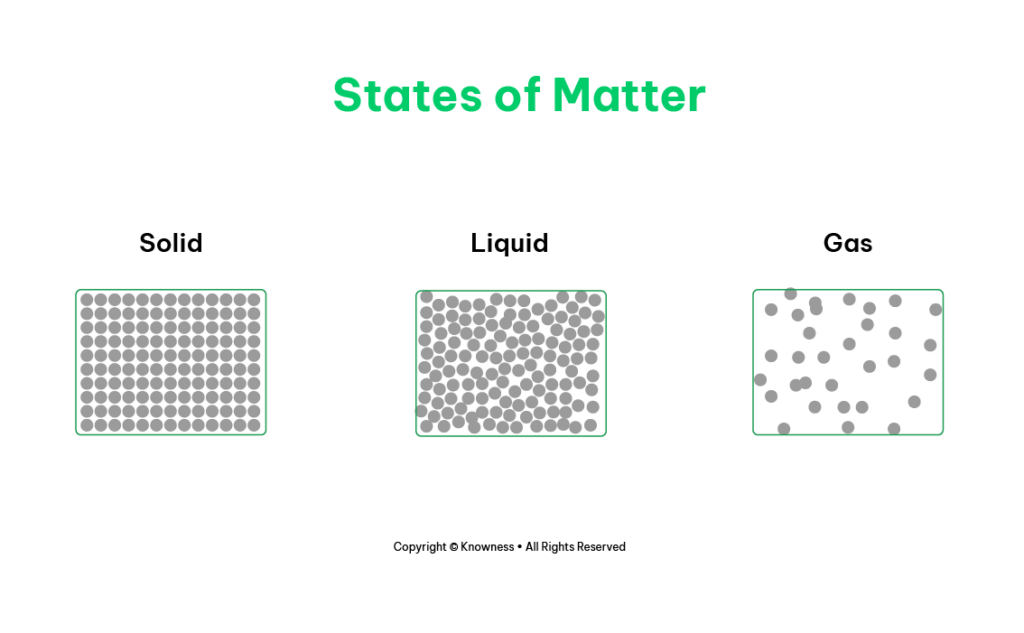
Changes of State
Melting and freezing occur at the melting point, which is the temperature at which a solid changes into a liquid and vice versa. Boiling and condensing occur at the boiling point, which is the temperature at which a liquid changes into a gas and vice versa.
Particle Theory
Particle theory helps explain the behaviour of matter during changes of state. According to this theory, matter is composed of particles (atoms, molecules, or ions) that are in constant motion. During melting, the particles gain enough energy to overcome the forces holding them in a solid arrangement, resulting in the transition to a liquid state. Similarly, during boiling, particles gain sufficient energy to break the intermolecular forces and escape as a gas.
Energy and Forces between Particles
The amount of energy required to change state depends on the strength of the forces between the particles. In a solid, the forces are strong, requiring more energy to break the bonds and transition to a liquid or gas state. The nature of the particles involved, such as the type of bonding and the structure of the substance, also affects the energy needed for state changes. Substances with stronger intermolecular forces tend to have higher melting and boiling points.
Limitations of the Simple Particle Model (HT only)
While the simple particle model is useful, it has limitations that should be recognised. Firstly, it does not consider the forces between particles, which play a significant role in determining the behaviour of matter. Additionally, the model represents particles as solid spheres, neglecting their true atomic or molecular structure. Finally, the model assumes that all particles are identical spheres, disregarding their individual characteristics.
Predicting States of Substances
By considering the melting point and boiling point of a substance, as well as the given temperature, you can determine whether the substance would exist as a solid, liquid, or gas.
Energy Transfers and Types of Bonding
Changes of state occur due to energy transfers and the types of bonding present in a substance. When heat energy is added to a substance, it increases the kinetic energy of its particles. During melting, the particles gain enough energy to break the intermolecular forces and transition to a liquid state. Similarly, during boiling, the particles gain sufficient energy to break the forces and transition to a gaseous state. Different types of bonding, such as ionic, covalent, or metallic bonding, determine the strength of the forces holding the particles together and influence the temperature at which changes of state occur.
Atoms and Bulk Properties
It is important to recognise that individual atoms themselves do not possess the bulk properties of materials. Rather, it is the arrangement and interactions of particles on a larger scale that give rise to the observable properties of solids, liquids, and gases. The behaviour of matter is determined by the collective behaviour of a large number of particles.
Limitations of the Particle Theory (HT only)
The particle theory, which represents particles as solid inelastic spheres with no forces between them, has limitations when applied to changes of state. In reality, particles have forces of attraction or repulsion between them, and these forces play a crucial role in determining the behaviour of matter. The particle theory also oversimplifies the atomic or molecular structure of particles, neglecting their true complexity.
Conclusion
In conclusion, the three states of matter - solid, liquid, and gas - can be represented by a simple particle model. Understanding the behaviour of matter during state changes involves considering energy requirements, forces between particles, and the nature of the particles themselves. However, it is important to recognise the limitations of the simple model, including the absence of forces, the uniform representation of particles as spheres, and the assumption that the spheres are solid.
Continue the lesson
This section is available to learners with course access. Continue learning with Knowness to unlock the full explanation, examples, revision tools, and progress tracking.
The remaining lesson content includes further guided explanation, important learning points, and supporting interactive material designed to help you understand and revise this topic.
Unlock this topic to view the full activity, worked examples, common mistakes, and additional revision support.
More content available
Knowness lessons are structured to build understanding step by step. Create an account or upgrade your access to continue from this point.
This preview does not include the hidden lesson text, answers, explanations, or embedded interactions.
Continue learning with Knowness
Sign up to access the full lesson, predicted grades, revision tools, progress tracking, and more.
Create a free account