

GCSE
Chemistry
-
Introduction to GCSE Chemistry (AQA) Coming soon
-
1.1 Atomic Structure, Elements, Compounds, and Mixtures
-
1.2 The Periodic Table Coming soon
-
2.1 Chemical Bonds, Ionic, Covalent and Metallic Coming soon
-
2.2 How Bonding and Structure are Related to the Properties of Substances Coming soon
-
2.3 Structure and Bonding of Carbon Coming soon
-
2.4 Bulk and Surface Properties of Matter including Nanoparticles Coming soon
-
3.1 Chemical Measurements, Conservation of Mass and the Quantitative Interpretation of Chemical Equations Coming soon
-
3.2 Use of Amount of Substance in Relation to Masses of Pure Substances Coming soon
-
3.3 Yield and Atom Economy of Chemical Reactions Coming soon
-
3.4 Using Concentrations of Solutions in mol/dm³ [HT] Coming soon
-
3.5 Use of Amount of Substance in Relation to Volumes of Gases [HT] Coming soon
-
4.1 Reactivity of Metals Coming soon
-
4.2 Reactions of Acids Coming soon
-
4.3 Electrolysis Coming soon
-
5.1 Exothermic and Endothermic Reactions Coming soon
-
5.2 Chemical Cells and Fuel Cells Coming soon
-
6.1 Rate of Reaction Coming soon
-
6.2 Reversible Reactions and Dynamic Equilibrium Coming soon
-
6.2.1 Reversible Reactions
-
6.2.2 Energy Changes and Reversible Reactions
-
6.2.3 Equilibrium
-
6.2.4 The Effect of Changing Conditions on Equilibrium (HT only)
-
6.2.5 The Effect of Changing Concentration (HT only)
-
6.2.6 The Effect of Temperature Changes on Equilibrium (HT only)
-
6.2.7 The Effect of Pressure Changes on Equilibrium (HT only)
-
6.2.1 Reversible Reactions
-
7.1 Carbon Compounds as Fuels and Feedstock Coming soon
-
7.2 Reactions of Alkenes and Alcohols Coming soon
-
7.3 Synthetic and Naturally Occurring Polymers Coming soon
-
8.1 Purity, Formulations and Chromatography Coming soon
-
8.2 Identification of Common Gases Coming soon
-
8.3 Identification of Ions by Chemical and Spectroscopic Means Coming soon
-
9.1 The Composition and Evolution of the Earth's Atmosphere Coming soon
-
9.2 Carbon Dioxide and Methane as Greenhouse Gases Coming soon
-
9.3 Common Atmospheric Pollutants and their Sources Coming soon
-
10.1 Using the Earth's Resources and Obtaining Potable Water Coming soon
-
10.2 Life Cycle Assessment and Recycling Coming soon
-
10.3 Using Materials Coming soon
-
10.4 The Haber Process and the use of NPK Fertilisers Coming soon
1. Atomic Structure and the Periodic Table
In this lesson, we will explore the structure and properties of graphite, a unique form of carbon. We will examine how the arrangement of carbon atoms in graphite's layered structure and the presence of delocalised electrons contribute to its properties.
Structure of Graphite
Graphite is composed of carbon atoms arranged in layers of hexagonal rings. Each carbon atom forms three covalent bonds with three neighbouring carbon atoms within a layer, resulting in a flat, two-dimensional sheet. These layers are stacked on top of each other, with weak van der Waals forces acting between the layers. Unlike in diamond, there are no covalent bonds between the layers of graphite.
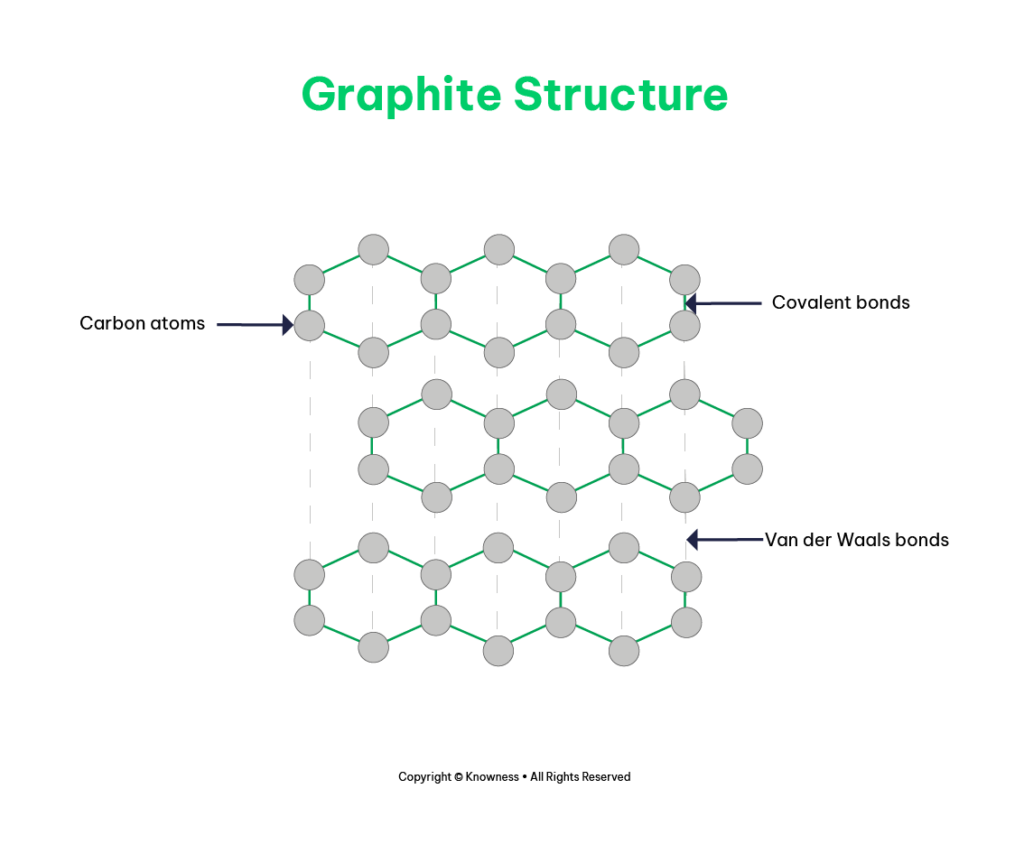
Delocalised Electrons
In graphite, one electron from each carbon atom remains unutilised in the covalent bonds, resulting in delocalised electrons within the structure. These delocalised electrons are not confined to specific carbon atoms or layers but are free to move throughout the entire graphite structure. The presence of these delocalised electrons gives graphite some metal-like properties.
Properties of Graphite
- Lubricating and Slippery: The layered structure of graphite allows the layers to slide over one another with ease. This property makes graphite an effective lubricant, reducing friction between moving parts.
- Electrical Conductivity: Similar to metals, graphite is a good conductor of electricity. The presence of delocalised electrons allows for the movement of electrical charge through the layers of graphite. This makes graphite useful in various electrical and electronic applications.
- High Melting Point: The strong covalent bonds within each layer of graphite contribute to its high melting point. However, the weak van der Waals forces between the layers result in a relatively lower melting point compared to diamond.
- Soft and Brittle: Although graphite is made up of layers of covalently bonded carbon atoms, the weak forces between the layers make graphite relatively soft and brittle. This is in contrast to the exceptional hardness of diamond.
Conclusion
The properties of graphite can be explained by its unique structure and bonding. The layers of hexagonal rings, with three covalent bonds per carbon atom, give graphite its layered structure and slippery nature. The presence of delocalised electrons allows graphite to exhibit electrical conductivity, similar to metals.
Continue the lesson
This section is available to learners with course access. Continue learning with Knowness to unlock the full explanation, examples, revision tools, and progress tracking.
The remaining lesson content includes further guided explanation, important learning points, and supporting interactive material designed to help you understand and revise this topic.
Unlock this topic to view the full activity, worked examples, common mistakes, and additional revision support.
More content available
Knowness lessons are structured to build understanding step by step. Create an account or upgrade your access to continue from this point.
This preview does not include the hidden lesson text, answers, explanations, or embedded interactions.
Continue learning with Knowness
Sign up to access the full lesson, predicted grades, revision tools, progress tracking, and more.
Create a free account