

GCSE
Chemistry
-
Introduction to GCSE Chemistry (AQA) Coming soon
-
1.1 Atomic Structure, Elements, Compounds, and Mixtures
-
1.2 The Periodic Table Coming soon
-
2.1 Chemical Bonds, Ionic, Covalent and Metallic Coming soon
-
2.2 How Bonding and Structure are Related to the Properties of Substances Coming soon
-
2.3 Structure and Bonding of Carbon Coming soon
-
2.4 Bulk and Surface Properties of Matter including Nanoparticles Coming soon
-
3.1 Chemical Measurements, Conservation of Mass and the Quantitative Interpretation of Chemical Equations Coming soon
-
3.2 Use of Amount of Substance in Relation to Masses of Pure Substances Coming soon
-
3.3 Yield and Atom Economy of Chemical Reactions Coming soon
-
3.4 Using Concentrations of Solutions in mol/dm³ [HT] Coming soon
-
3.5 Use of Amount of Substance in Relation to Volumes of Gases [HT] Coming soon
-
4.1 Reactivity of Metals Coming soon
-
4.2 Reactions of Acids Coming soon
-
4.3 Electrolysis Coming soon
-
5.1 Exothermic and Endothermic Reactions Coming soon
-
5.2 Chemical Cells and Fuel Cells Coming soon
-
6.1 Rate of Reaction Coming soon
-
6.2 Reversible Reactions and Dynamic Equilibrium Coming soon
-
6.2.1 Reversible Reactions
-
6.2.2 Energy Changes and Reversible Reactions
-
6.2.3 Equilibrium
-
6.2.4 The Effect of Changing Conditions on Equilibrium (HT only)
-
6.2.5 The Effect of Changing Concentration (HT only)
-
6.2.6 The Effect of Temperature Changes on Equilibrium (HT only)
-
6.2.7 The Effect of Pressure Changes on Equilibrium (HT only)
-
6.2.1 Reversible Reactions
-
7.1 Carbon Compounds as Fuels and Feedstock Coming soon
-
7.2 Reactions of Alkenes and Alcohols Coming soon
-
7.3 Synthetic and Naturally Occurring Polymers Coming soon
-
8.1 Purity, Formulations and Chromatography Coming soon
-
8.2 Identification of Common Gases Coming soon
-
8.3 Identification of Ions by Chemical and Spectroscopic Means Coming soon
-
9.1 The Composition and Evolution of the Earth's Atmosphere Coming soon
-
9.2 Carbon Dioxide and Methane as Greenhouse Gases Coming soon
-
9.3 Common Atmospheric Pollutants and their Sources Coming soon
-
10.1 Using the Earth's Resources and Obtaining Potable Water Coming soon
-
10.2 Life Cycle Assessment and Recycling Coming soon
-
10.3 Using Materials Coming soon
-
10.4 The Haber Process and the use of NPK Fertilisers Coming soon
1. Atomic Structure and the Periodic Table
5.1.2 Reaction Profiles
Chemical reactions require the collision of reacting particles with both sufficient energy and proper orientation. The minimum energy required for a reaction to occur is called the activation energyMinimum amount of energy available for reactants to enable a chemical reaction to occur.. Without reaching this energy threshold, the reaction does not proceed.
Reaction Profiles
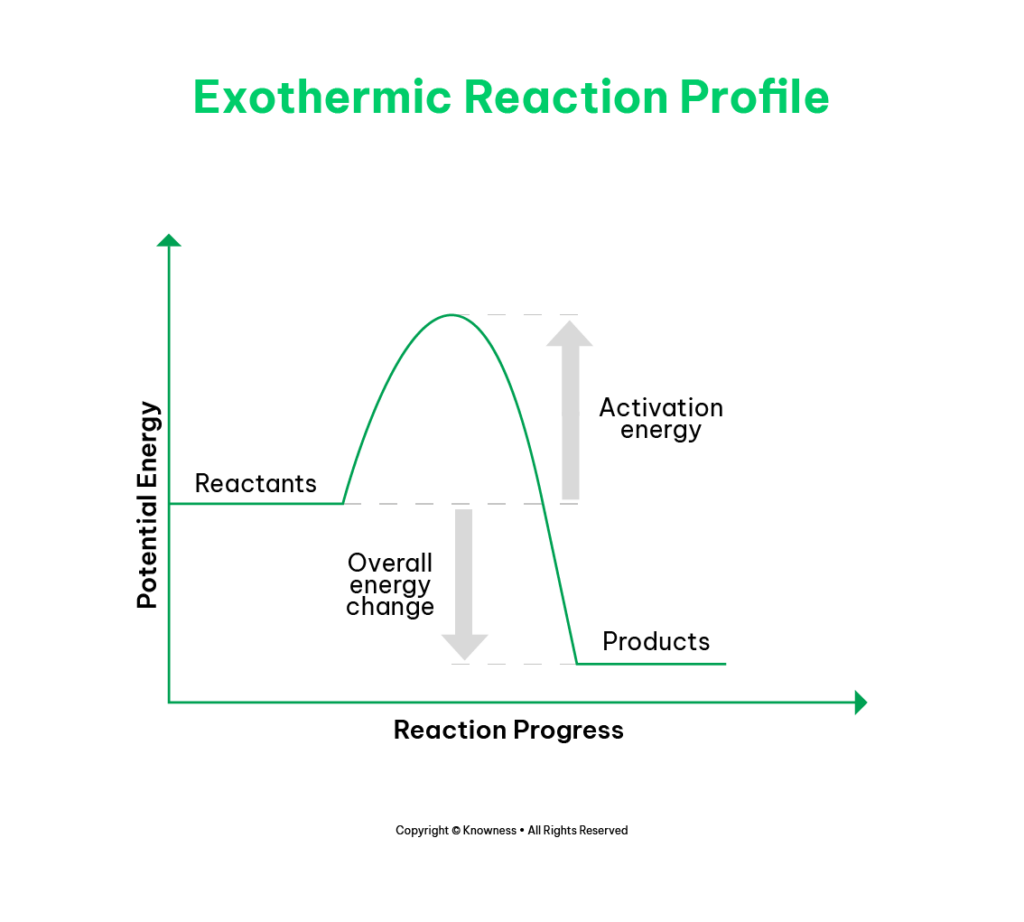
To visualise and analyse the energy changes that occur during a chemical reaction, scientists use reaction profiles. A reaction profile is a graph that represents the relative energies of the reactants and products, as well as the activation energy and the overall energy change of the reaction.
The vertical axis of a reaction profile represents the energy level, while the horizontal axis represents the progress of the reaction from reactants to products. The reactants are situated on the left side of the graph, and the products are on the right side. The relative energy of the species is indicated by the height of their respective positions on the graph.
The reaction profile shows the energy changes that occur during the reaction. The difference in energy between the reactants and products represents the overall energy change, which can be exothermicA reaction that releases heat, where the products have less energy than the reactants. (releasing energy) or endothermicA reaction that ‘absorbs’ heat, where the products have greater energy than the reactants. (absorbing energy).
Exothermic Reaction
For an exothermic reaction, the reactants start with a higher energy level compared to the products. The reaction profile will show a downward slope from left to right, indicating that energy is released to the surroundings. The overall energy change is negative, and the products have a lower energy level than the reactants.
Endothermic Reaction
In contrast, an endothermic reaction involves the absorption of energy from the surroundings. The energy of the products is higher than that of the reactants. As a result, the reaction profile will have an upward slope from left to right, indicating the increase in energy. The overall energy change is positive.
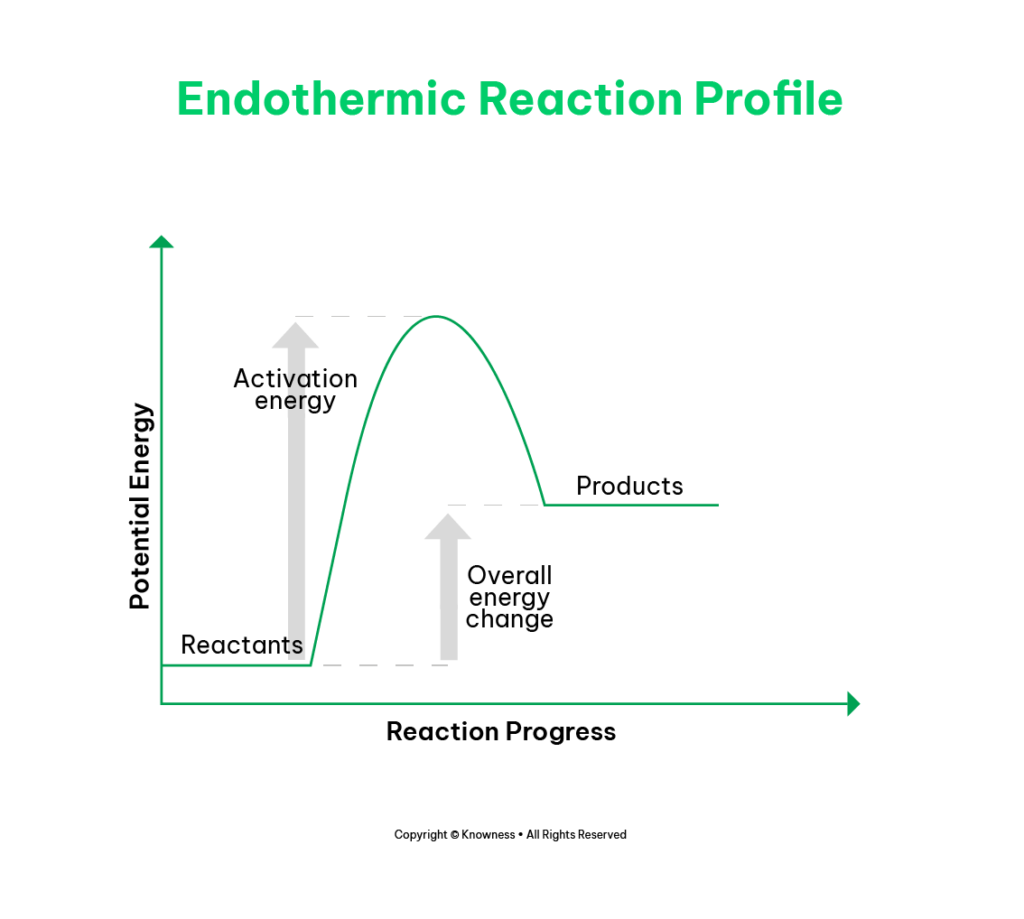
On the reaction profile, the activation energy is represented by the peak or highest point. It is the minimum amount of energy required for reactant particles to overcome the energy barrier and proceed to the transition stateRefers to any structure which corresponds to a bond being broken/formed. Mathematically this corresponds to a maxima on the energy profile of the molecule. TS are generally unstable and short lived. Reactions have to proceed through TS to occur.. The activation energy is essential for a reaction to occur.
Conclusion
By examining the reaction profile, scientists can gain insights into the energy changes that occur during a chemical reaction. They can analyse the stability of reactants and products, determine the activation energy required for the reaction, and assess the overall energy change. Understanding reaction profiles helps in studying the factors that affect reaction rates, such as temperature, concentration, and catalysts. It also provides a visual representation of the energy considerations involved in chemical reactions, which aids in explaining reaction mechanisms and predicting the feasibility of reactions.
Continue the lesson
This section is available to learners with course access. Continue learning with Knowness to unlock the full explanation, examples, revision tools, and progress tracking.
The remaining lesson content includes further guided explanation, important learning points, and supporting interactive material designed to help you understand and revise this topic.
Unlock this topic to view the full activity, worked examples, common mistakes, and additional revision support.
More content available
Knowness lessons are structured to build understanding step by step. Create an account or upgrade your access to continue from this point.
This preview does not include the hidden lesson text, answers, explanations, or embedded interactions.
Continue learning with Knowness
Sign up to access the full lesson, predicted grades, revision tools, progress tracking, and more.
Create a free account