

GCSE
Chemistry
-
Introduction to GCSE Chemistry (AQA) Coming soon
-
1.1 Atomic Structure, Elements, Compounds, and Mixtures
-
1.2 The Periodic Table Coming soon
-
2.1 Chemical Bonds, Ionic, Covalent and Metallic Coming soon
-
2.2 How Bonding and Structure are Related to the Properties of Substances Coming soon
-
2.3 Structure and Bonding of Carbon Coming soon
-
2.4 Bulk and Surface Properties of Matter including Nanoparticles Coming soon
-
3.1 Chemical Measurements, Conservation of Mass and the Quantitative Interpretation of Chemical Equations Coming soon
-
3.2 Use of Amount of Substance in Relation to Masses of Pure Substances Coming soon
-
3.3 Yield and Atom Economy of Chemical Reactions Coming soon
-
3.4 Using Concentrations of Solutions in mol/dm³ [HT] Coming soon
-
3.5 Use of Amount of Substance in Relation to Volumes of Gases [HT] Coming soon
-
4.1 Reactivity of Metals Coming soon
-
4.2 Reactions of Acids Coming soon
-
4.3 Electrolysis Coming soon
-
5.1 Exothermic and Endothermic Reactions Coming soon
-
5.2 Chemical Cells and Fuel Cells Coming soon
-
6.1 Rate of Reaction Coming soon
-
6.2 Reversible Reactions and Dynamic Equilibrium Coming soon
-
6.2.1 Reversible Reactions
-
6.2.2 Energy Changes and Reversible Reactions
-
6.2.3 Equilibrium
-
6.2.4 The Effect of Changing Conditions on Equilibrium (HT only)
-
6.2.5 The Effect of Changing Concentration (HT only)
-
6.2.6 The Effect of Temperature Changes on Equilibrium (HT only)
-
6.2.7 The Effect of Pressure Changes on Equilibrium (HT only)
-
6.2.1 Reversible Reactions
-
7.1 Carbon Compounds as Fuels and Feedstock Coming soon
-
7.2 Reactions of Alkenes and Alcohols Coming soon
-
7.3 Synthetic and Naturally Occurring Polymers Coming soon
-
8.1 Purity, Formulations and Chromatography Coming soon
-
8.2 Identification of Common Gases Coming soon
-
8.3 Identification of Ions by Chemical and Spectroscopic Means Coming soon
-
9.1 The Composition and Evolution of the Earth's Atmosphere Coming soon
-
9.2 Carbon Dioxide and Methane as Greenhouse Gases Coming soon
-
9.3 Common Atmospheric Pollutants and their Sources Coming soon
-
10.1 Using the Earth's Resources and Obtaining Potable Water Coming soon
-
10.2 Life Cycle Assessment and Recycling Coming soon
-
10.3 Using Materials Coming soon
-
10.4 The Haber Process and the use of NPK Fertilisers Coming soon
1. Atomic Structure and the Periodic Table
Alcohols contain the functional group -OH and are characterised by the general formula R-OH, where R represents a hydrocarbon group. The first four members of the homologous series of alcohols are methanol, ethanol, propanol, and butanol.
Alcohols, such as ethanol, can be represented either by their molecular formula (CH3CH2OH), or in the following form:
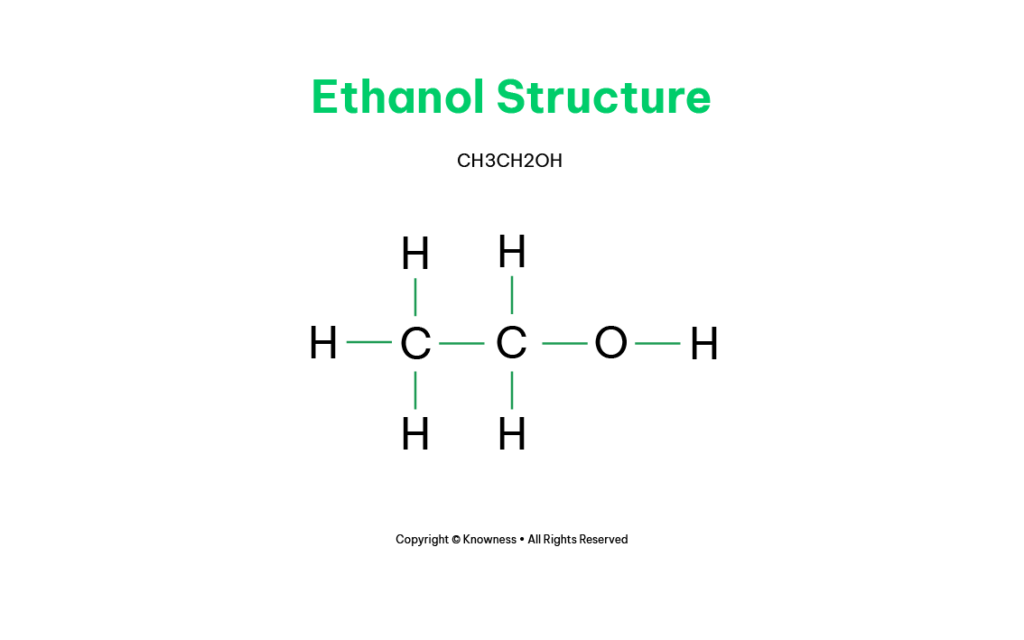
When alcohols react with sodium, a displacementThe forced removal of people from their land. reaction occurs where hydrogen gas is evolved, and sodium alkoxide is formed. For example, with ethanol (CH3CH2OH):
2CH3CH2OH + 2Na → 2CH3CH2ONa + H2
When alcohols burn in air, they undergo combustion reactions, similar to other hydrocarbons. The alcohol is oxidised to produce carbon dioxide and water. For example, with ethanol:
CH3CH2OH + 3O2 → 2CO2 + 3H2O
Alcohols can be added to water, forming a homogeneous mixture. This process is called solvation or hydration. The alcohol molecules interact with water molecules through hydrogen bonding.
When alcohols react with oxidising agents, they can be oxidised to produce various products. The specific products depend on the oxidising agent used. For example, ethanol can be oxidised to ethanal (acetaldehyde) by mild oxidising agents like acidified potassium dichromate (K2Cr2O7) or to ethanoic acid by stronger oxidising agents like acidified potassium permanganate (KMnO4).
The main uses of these alcohols include:
- Methanol: Used as a solvent, antifreeze, and in the production of formaldehyde and other chemicals.
- Ethanol: Used as a solvent, fuel additive, in the production of alcoholic beverages, and in many industrial processes.
- Propanol: Used as a solvent, intermediateAny structure in the reaction profile which is connected by two transition states and is an energy minima. Although intermediates are energetically disfavoured they are stable and can sometimes be isolated. in chemical synthesisCombining information from more than one text to show comparison., and in cosmetics and personal care products.
- Butanol: Used as a solvent, fuel additive, and in the production of butyl rubber and other chemicals.
Aqueous solutions of ethanol are produced through the process of fermentation. Fermentation occurs when sugar solutions, such as those derived from fruits or grains, are exposed to yeast. The yeast converts the sugars into ethanol and carbon dioxide through anaerobic respiration.
Continue the lesson
This section is available to learners with course access. Continue learning with Knowness to unlock the full explanation, examples, revision tools, and progress tracking.
The remaining lesson content includes further guided explanation, important learning points, and supporting interactive material designed to help you understand and revise this topic.
Unlock this topic to view the full activity, worked examples, common mistakes, and additional revision support.
More content available
Knowness lessons are structured to build understanding step by step. Create an account or upgrade your access to continue from this point.
This preview does not include the hidden lesson text, answers, explanations, or embedded interactions.
Continue learning with Knowness
Sign up to access the full lesson, predicted grades, revision tools, progress tracking, and more.
Create a free account