6.1 The Lower Palaeolithic
This lesson provides a brief basis for the story of NeanderthalsAn extinct human species adapted to cold environments, known for their robust build, tool use, symbolic behaviour, and interbreeding with Homo sapiens., introducing the lower (oldest) palaeolithic that laid the groundwork for the middle palaeolithicA phase of the Stone Age characterized by the rise and dominance of Neanderthals in Eurasia, dating from ~300,000 to 40,000 years ago. of the Neanderthals.
The Lower Palaeolithic
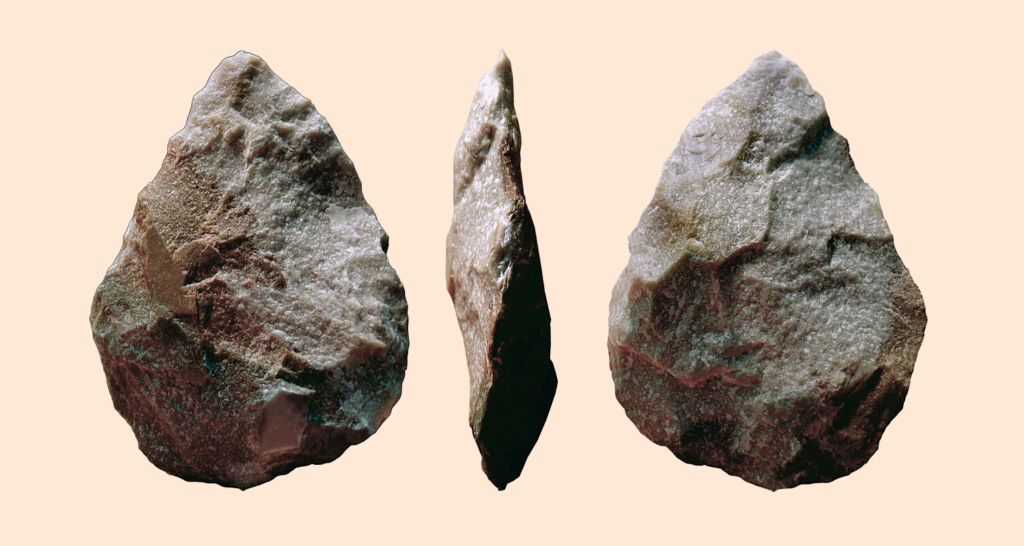
The longest chapter of the longest part of our history, the lower palaeolithicThe earliest and longest phase of the Stone Age, beginning with the first use of tools around 3.3 million years ago. begins with the earliest tool used by hominins. This places the (current) start of the lower palaeolithic at 3.3 million years ago, when early AustralopithecinesAn extinct group of early hominins from Africa, known for being among the first to use tools and walk upright. processed stone to be used as tools in what is now Kenya. The Australopithecus family once had many branches, with early hominins using tools and establishing themselves throughout much of Africa. After 3.3 million years, we are the only ones left.
We have so few skeletal remains from this time that fully charting the evolution of Homo sapiensThe species name for modern humans. may be impossible, however we do know that gradually every one of our early relatives became extinct. This extinction should not be considered a failing of our relatives, rather as a fact of life. We don’t know exactly why the other hominidsA family of primates that includes modern humans, our ancestors, and other extinct relatives like Neanderthals and Australopithecines. disappeared but it is likely to do with a combination of the changing environment and the pressures of competition - with most of us looking to carve out a scavenger-hunter-gatherer niche. This placed hominids at odds with the shifting environments of the ice age, one another, and dangerous animals like hyenas and wolves. The extinction was far from quick either, and over the millions of years our ancestors and their relatives walked the earth, they developed tool industries and, ultimately, Homo emerged and some became, eventually, us.
The genus Homo, our most direct relatives and from whom we evolved, originated around 2.8 million years ago in Africa. Some of the most important evolutionary changes throughout early prehistory involve Homo’s ability to interact socially. Tool use provided significant advantages over potential competitors, allowing effective competition against other animals for food. Gradually a successful gatherer-scavenger niche was carved out for early hominins. The use of tools expedites the ability to dig for roots, process food, and chop through tough material. As such, more food could be gathered with less energy expenditure.
Throughout the lower palaeolithic we can chart an uneven, but gradual, progress towards larger bodies, bigger brains, and more gracileDescribes a slender body build, often used in contrast with robust to describe anatomical features of different hominin species. body plans in our ancestors. The success of tool use and greater social cohesion meant a more efficient use of time and energy - allowing energy intensive brains to develop. Some archaeologists and anthropologists have theorised that as the brain expanded the frontal cortex - where much of our language and interpersonal processing resides - provided the basis of bigger and more complex social groups to form. It is these social groups that form the societies of the lower palaeolithic.
Although they have been labelled simple and “brutish” in the past, these societies were extremely effective and, as early as 2 million years ago, were pushing out of Africa to establish effective groups elsewhere. Windows of opportunity would open in different climatic periods, and in warmer points the savannahs that our ancestors became so successful in expanded north and south. It was in one of these periods one of our ancestors, Homo erectusAn extinct species of early human that was one of the first to leave Africa and use more advanced tools., made it as far as what is now China (as early as 2.1 million years ago). Various cycles of migration, occupation, and retreat occurred throughout the palaeolithic with numerous ancestors and relatives carving out footholds in different parts of the world. By the end of the Lower Palaeolithic numerous Hominids had made it out of Africa, including the progenitors of the Neanderthals.