

University Taster
Archaeology – University Taster
5.4 Ancient DNA
This lesson introduces how and why we use ancient DNA analysis in archaeology, touching on the basics of the method and what it can show us. A quick note is required here to categorically state that sex is not the same as gender.
What is DNA?
DNA (deoxyribonucleic acid)The molecule carrying genetic instructions used in the growth, development, functioning, and reproduction of all living organisms. forms the building blocks of living things. It is a kind of biological polymer that resides in the body as very large molecules, housed in the nuclei and mitochondria of our cells. We won’t delve into the depths of DNA and how it works in this introductory lesson, focusing instead on the bread and butter of DNA analysis in archaeology – base pairs, single-nucleotide polymorphisms, and investigating haplogroups.
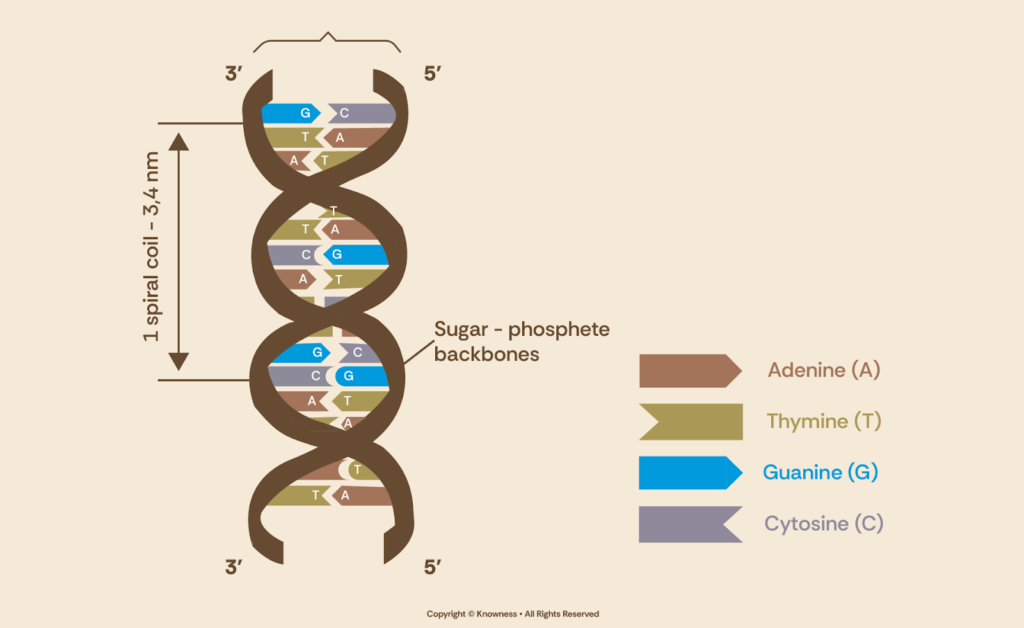
The large molecules that DNA exist as take the form of a double helix; two long strands chained together in a twisting corkscrew shape. These strands are organised into chromosomes, which contain the majority of our genetic code and are copied into new cells the body creates. The two strands themselves are paired up with opposing nucleotides in the form of a base pair.
Nucleotides are composed of a deoxyribose (sugar), phosphate group, and a nucleotideThe basic building block of DNA and RNA, consisting of a sugar, phosphate, and base (A, T, G, or C). base. These bases are guanine (G), cytosine (C), adenine (A), and thymine (T). Between the two strands of DNA these bases form a base pair, with guanine matching cytosine and adenine matching thymine. Thus a strand of DNA containing the sequence GAATTC would be paired with a strand containing CTTAAG.
These combinations of base pairs are genetic information, and are either coding or non-coding – although all are functional and valuable. Among other differences, coding sections provide some of the information necessary to create proteins while non-coding DNA does not. In archaeology, however, some of our most common DNA investigations are more interested in the sequence of DNA than what it actually does – it is this kind of investigation we are discussing here.
Continue the lesson
This section is available to learners with course access. Continue learning with Knowness to unlock the full explanation, examples, revision tools, and progress tracking.
The remaining lesson content includes further guided explanation, important learning points, and supporting interactive material designed to help you understand and revise this topic.
Unlock this topic to view the full activity, worked examples, common mistakes, and additional revision support.
More content available
Knowness lessons are structured to build understanding step by step. Create an account or upgrade your access to continue from this point.
This preview does not include the hidden lesson text, answers, explanations, or embedded interactions.
Continue learning with Knowness
Sign up to access the full lesson, predicted grades, revision tools, progress tracking, and more.
Create a free account