

GCSE
Physics
-
Introduction to GCSE Physics (AQA) Coming soon
-
1.1 Energy Stores, Transfers and Power
-
1.2 Conservation and Dissipation of Energy Coming soon
-
1.3 National and Global Energy Resources Coming soon
-
2.1 Current, Potential Difference and Resistance Coming soon
-
2.2 Series and Parallel Circuits Coming soon
-
2.3 Domestic Uses and Safety Coming soon
-
2.4 Energy Transfers Coming soon
-
2.5 Static Electricity Coming soon
-
3.1 Changes of State and the Particle Model Coming soon
-
3.2 Internal Energy and Energy Transfers Coming soon
-
3.3 Particle Model and Pressure Coming soon
-
4.1 Atoms and Isotopes Coming soon
-
4.2 Atoms and Nuclear Radiation Coming soon
-
4.3 Hazards and Uses of Radioactive Emissions and of Background Radiation Coming soon
-
4.4 Nuclear Fission and Fusion Coming soon
-
5.1 Forces and their Interactions Coming soon
-
5.2 Work Done and Energy Transfer Coming soon
-
5.3 Forces and Elasticity Coming soon
-
5.4 Moments, Levers and Gears Coming soon
-
5.5 Pressure and Pressure Differences in Fluids Coming soon
-
5.6 Forces and Motion Coming soon
-
5.6.1 Describing Motion Along a Line
-
5.6.2 Distance and Displacement
-
5.6.3 Speed
-
5.6.4 Velocity
-
5.6.5 The Distance–Time Relationship
-
5.6.6 Acceleration
-
5.6.7 Forces, Accelerations and Newton's Laws of Motion
-
5.6.8 Newton's First Law
-
5.6.9 Newton's Second Law
-
5.6.10 Newton's Third Law
-
5.6.11 Forces and Braking
-
5.6.12 Stopping Distance
-
5.6.13 Reaction Time
-
5.6.14 Factors Affecting Braking Distance
-
5.6.1 Describing Motion Along a Line
-
5.7 Momentum [HT] Coming soon
-
6.1 Waves in Air, Fluids and Solids Coming soon
-
6.2 Electromagnetic Waves Coming soon
-
6.3 Black Body Radiation Coming soon
-
7.1 Permanent and Induced Magnetism, Magnetic Forces and Fields Coming soon
-
7.2 The Motor Effect Coming soon
-
7.3 Induced Potential, Transformers and the National Grid [HT] Coming soon
-
8.1 Solar System; Stability of Orbital Motions; Satellites Coming soon
-
8.2 Red-Shift Coming soon
-
9.1 Required Practicals Coming soon
-
9.1.1 Required Practical Activity 1
-
9.1.2 Required Practical Activity 2
-
9.1.3 Required Practical Activity 3
-
9.1.4 Required Practical Activity 4
-
9.1.5 Required Practical Activity 5
-
9.1.6 Required Practical Activity 6
-
9.1.7 Required Practical Activity 7
-
9.1.8 Required Practical Activity 8
-
9.1.9 Required Practical Activity 9
-
9.1.10 Required Practical Activity 10
-
9.1.1 Required Practical Activity 1
1. Energy
6.1.2 Properties of Waves
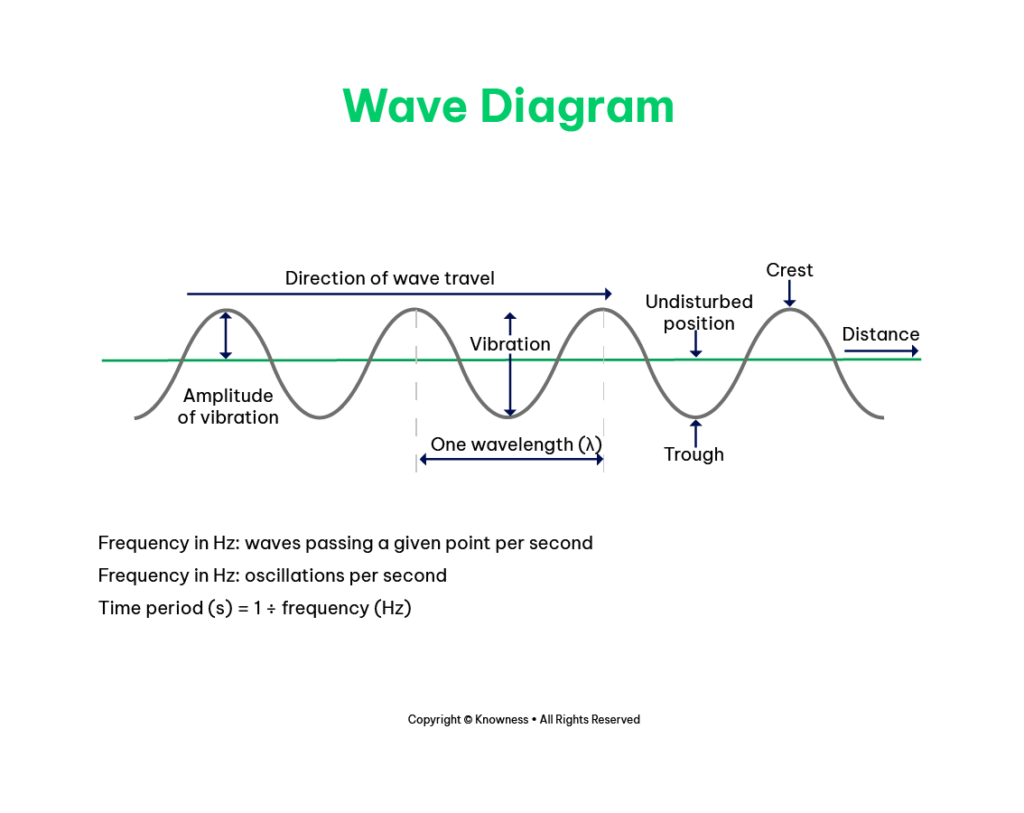
In this lesson, we will explore these properties and their definitions, learn about the wave equation, and discuss how changes in velocity, frequency, and wavelength are interrelated when waves pass from one medium to another.
Properties of Waves
Amplitude:
The amplitude of a wave is the maximum displacementThe forced removal of people from their land. of a point on the wave from its undisturbed position. The amplitude represents the intensity or strength of the wave, indicating the amount of energy carried by the wave.
Wavelength:
The wavelength of a wave is the distance from a point on one wave to the equivalent point on the adjacent wave. The wavelength determines the spatial extent of the wave and is associated with the distance between successive crests or troughs.
Frequency:
The frequency of a wave is the number of waves passing a point per second. Frequency determines the pitch of sound waves or the colour of light waves. It is measured in hertz (Hz).
Period:
The period of a wave is the time taken for one complete wave cycle. The period provides information about the time it takes for the wave to complete one oscillation.
T = 1 / f
Variables:
- T = Period in seconds, s
- f = Frequency in hertz, Hz
Wave Speed:
The wave speed is the speed at which energy is transferred or the wave moves through the medium. Wave speed represents the rate of propagation of the wave and is dependent on the medium through which the wave travels.
v = f * λ
Variables:
- v = Wave speed in metres per second, m/s
- f = Frequency in hertz, Hz
- λ = Wavelength in metres, m
Methods to Measure Wave Speed
- Speed of Sound Waves in Air: To measure the speed of sound waves in air, one methodHow a writer presents perspective or viewpoint through language/structure. is the time-of-flight technique using two distant microphones. The process involves producing a sound at a known location and measuring the time it takes for the sound wave to reach the distant microphones. By knowing the distance between the microphones and the time taken for the sound to travel that distance, we can calculate the speed of sound in air.
- Speed of Ripples on a Water Surface: To measure the speed of ripples on a water surface, a stopwatch can be used to determine the time it takes for ripples to travel a known distance. By initiating ripples at a specific point and measuring the time they take to reach a designated endpoint, the speed of the ripples can be calculated using the distance travelled and the time taken.
Interrelation of Velocity, Frequency, and Wavelength
- When waves pass from one medium to another, changes in velocity, frequency, and wavelength are interrelated.
- As waves transition from one medium to another with a different wave speed, the frequency remains constant, but the wavelength and velocity change to maintain the wave equation.
- Students should be able to explain and illustrate this relationship using examples.
Conclusion
Understanding the properties of waves, including amplitude, wavelength, frequency, period, and wave speed, allows us to describe and analyse wave behaviour. The wave equation relates the wave speed, frequency, and wavelength, providing a fundamental understanding of how waves propagate. Measuring the speed of sound waves in air and ripples on a water surface enables us to study the characteristics of different types of waves.
Continue the lesson
This section is available to learners with course access. Continue learning with Knowness to unlock the full explanation, examples, revision tools, and progress tracking.
The remaining lesson content includes further guided explanation, important learning points, and supporting interactive material designed to help you understand and revise this topic.
Unlock this topic to view the full activity, worked examples, common mistakes, and additional revision support.
More content available
Knowness lessons are structured to build understanding step by step. Create an account or upgrade your access to continue from this point.
This preview does not include the hidden lesson text, answers, explanations, or embedded interactions.
Continue learning with Knowness
Sign up to access the full lesson, predicted grades, revision tools, progress tracking, and more.
Create a free account