

GCSE
Physics
-
Introduction to GCSE Physics (AQA) Coming soon
-
1.1 Energy Stores, Transfers and Power
-
1.2 Conservation and Dissipation of Energy Coming soon
-
1.3 National and Global Energy Resources Coming soon
-
2.1 Current, Potential Difference and Resistance Coming soon
-
2.2 Series and Parallel Circuits Coming soon
-
2.3 Domestic Uses and Safety Coming soon
-
2.4 Energy Transfers Coming soon
-
2.5 Static Electricity Coming soon
-
3.1 Changes of State and the Particle Model Coming soon
-
3.2 Internal Energy and Energy Transfers Coming soon
-
3.3 Particle Model and Pressure Coming soon
-
4.1 Atoms and Isotopes Coming soon
-
4.2 Atoms and Nuclear Radiation Coming soon
-
4.3 Hazards and Uses of Radioactive Emissions and of Background Radiation Coming soon
-
4.4 Nuclear Fission and Fusion Coming soon
-
5.1 Forces and their Interactions Coming soon
-
5.2 Work Done and Energy Transfer Coming soon
-
5.3 Forces and Elasticity Coming soon
-
5.4 Moments, Levers and Gears Coming soon
-
5.5 Pressure and Pressure Differences in Fluids Coming soon
-
5.6 Forces and Motion Coming soon
-
5.6.1 Describing Motion Along a Line
-
5.6.2 Distance and Displacement
-
5.6.3 Speed
-
5.6.4 Velocity
-
5.6.5 The Distance–Time Relationship
-
5.6.6 Acceleration
-
5.6.7 Forces, Accelerations and Newton's Laws of Motion
-
5.6.8 Newton's First Law
-
5.6.9 Newton's Second Law
-
5.6.10 Newton's Third Law
-
5.6.11 Forces and Braking
-
5.6.12 Stopping Distance
-
5.6.13 Reaction Time
-
5.6.14 Factors Affecting Braking Distance
-
5.6.1 Describing Motion Along a Line
-
5.7 Momentum [HT] Coming soon
-
6.1 Waves in Air, Fluids and Solids Coming soon
-
6.2 Electromagnetic Waves Coming soon
-
6.3 Black Body Radiation Coming soon
-
7.1 Permanent and Induced Magnetism, Magnetic Forces and Fields Coming soon
-
7.2 The Motor Effect Coming soon
-
7.3 Induced Potential, Transformers and the National Grid [HT] Coming soon
-
8.1 Solar System; Stability of Orbital Motions; Satellites Coming soon
-
8.2 Red-Shift Coming soon
-
9.1 Required Practicals Coming soon
-
9.1.1 Required Practical Activity 1
-
9.1.2 Required Practical Activity 2
-
9.1.3 Required Practical Activity 3
-
9.1.4 Required Practical Activity 4
-
9.1.5 Required Practical Activity 5
-
9.1.6 Required Practical Activity 6
-
9.1.7 Required Practical Activity 7
-
9.1.8 Required Practical Activity 8
-
9.1.9 Required Practical Activity 9
-
9.1.10 Required Practical Activity 10
-
9.1.1 Required Practical Activity 1
1. Energy
5.5.2 Atmospheric Pressure
The Earth's atmosphere, a thin layer of air surrounding the planet, plays a vital role in our everyday lives. In this lesson, we will explore atmospheric pressure and its relationship with altitude.
The Earth's Atmosphere
The atmosphere is composed of various gases, primarily nitrogen (approximately 78%) and oxygen (approximately 21%), along with trace amounts of other gases such as carbon dioxide and argon. It extends from the Earth's surface up to thousands of kilometres into space. Although the atmosphere is relatively thin compared to the size of the Earth, its effects are significant.
Atmospheric Pressure and Air Molecules
Air molecules constantly move and collide with surfaces, creating what we call atmospheric pressure. The pressure exerted by the atmosphere is caused by the weight of the air above a particular surface. As you move closer to the surface of the Earth, the number of air molecules and the weight of the air above that surface increase, resulting in higher atmospheric pressure.
Relationship Between Altitude and Atmospheric Pressure
As we ascend to higher altitudes, the density of the atmosphere decreases. This decrease in density means there are fewer air molecules above a given surface compared to lower altitudes. Consequently, the weight of the air decreases, leading to a decrease in atmospheric pressure with increasing height.
Simple Model of Atmospheric Pressure
A simple model to understand atmospheric pressure is to imagine the atmosphere as a stack of thin layers of air. Each layer has its own weight, and collectively, these layers create atmospheric pressure. The weight and density of the layers decrease as we move higher in the atmosphere, resulting in lower atmospheric pressure.
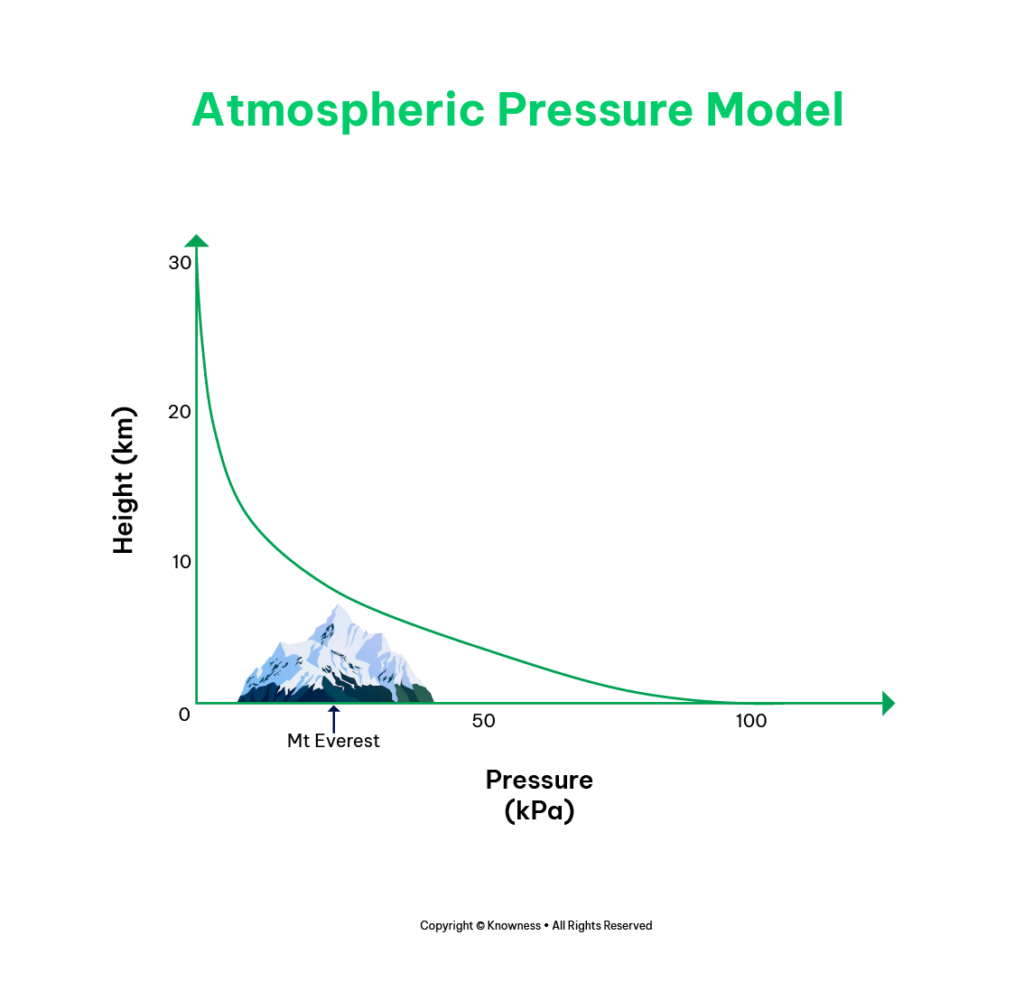
Variation of Atmospheric Pressure with Height
The decrease in atmospheric pressure with increasing height is gradual but significant. For example, at sea level, the atmospheric pressure is approximately 101.3 kilopascals (kPa). However, at higher altitudes, such as at the top of a mountain, the atmospheric pressure is noticeably lower, often measured below 100 kPa.
Conclusion
Understanding atmospheric pressure and its variation with height is essential in comprehending various phenomena related to weather, climate, and even human activities at different altitudes. By recognising that atmospheric pressure is influenced by the weight and density of the air above a surface, we can explain why atmospheric pressure decreases as we ascend to higher altitudes.
Continue the lesson
This section is available to learners with course access. Continue learning with Knowness to unlock the full explanation, examples, revision tools, and progress tracking.
The remaining lesson content includes further guided explanation, important learning points, and supporting interactive material designed to help you understand and revise this topic.
Unlock this topic to view the full activity, worked examples, common mistakes, and additional revision support.
More content available
Knowness lessons are structured to build understanding step by step. Create an account or upgrade your access to continue from this point.
This preview does not include the hidden lesson text, answers, explanations, or embedded interactions.
Continue learning with Knowness
Sign up to access the full lesson, predicted grades, revision tools, progress tracking, and more.
Create a free account