

GCSE
Chemistry
-
Introduction to GCSE Chemistry (AQA) Coming soon
-
1.1 Atomic Structure, Elements, Compounds, and Mixtures
-
1.2 The Periodic Table Coming soon
-
2.1 Chemical Bonds, Ionic, Covalent and Metallic Coming soon
-
2.2 How Bonding and Structure are Related to the Properties of Substances Coming soon
-
2.3 Structure and Bonding of Carbon Coming soon
-
2.4 Bulk and Surface Properties of Matter including Nanoparticles Coming soon
-
3.1 Chemical Measurements, Conservation of Mass and the Quantitative Interpretation of Chemical Equations Coming soon
-
3.2 Use of Amount of Substance in Relation to Masses of Pure Substances Coming soon
-
3.3 Yield and Atom Economy of Chemical Reactions Coming soon
-
3.4 Using Concentrations of Solutions in mol/dm³ [HT] Coming soon
-
3.5 Use of Amount of Substance in Relation to Volumes of Gases [HT] Coming soon
-
4.1 Reactivity of Metals Coming soon
-
4.2 Reactions of Acids Coming soon
-
4.3 Electrolysis Coming soon
-
5.1 Exothermic and Endothermic Reactions Coming soon
-
5.2 Chemical Cells and Fuel Cells Coming soon
-
6.1 Rate of Reaction Coming soon
-
6.2 Reversible Reactions and Dynamic Equilibrium Coming soon
-
6.2.1 Reversible Reactions
-
6.2.2 Energy Changes and Reversible Reactions
-
6.2.3 Equilibrium
-
6.2.4 The Effect of Changing Conditions on Equilibrium (HT only)
-
6.2.5 The Effect of Changing Concentration (HT only)
-
6.2.6 The Effect of Temperature Changes on Equilibrium (HT only)
-
6.2.7 The Effect of Pressure Changes on Equilibrium (HT only)
-
6.2.1 Reversible Reactions
-
7.1 Carbon Compounds as Fuels and Feedstock Coming soon
-
7.2 Reactions of Alkenes and Alcohols Coming soon
-
7.3 Synthetic and Naturally Occurring Polymers Coming soon
-
8.1 Purity, Formulations and Chromatography Coming soon
-
8.2 Identification of Common Gases Coming soon
-
8.3 Identification of Ions by Chemical and Spectroscopic Means Coming soon
-
9.1 The Composition and Evolution of the Earth's Atmosphere Coming soon
-
9.2 Carbon Dioxide and Methane as Greenhouse Gases Coming soon
-
9.3 Common Atmospheric Pollutants and their Sources Coming soon
-
10.1 Using the Earth's Resources and Obtaining Potable Water Coming soon
-
10.2 Life Cycle Assessment and Recycling Coming soon
-
10.3 Using Materials Coming soon
-
10.4 The Haber Process and the use of NPK Fertilisers Coming soon
1. Atomic Structure and the Periodic Table
10.4.1 The Haber Process
The Haber processThe most commonly used industrial process to produce ammonia. is a crucial industrial process used to produce ammonia (NH3), which is an essential component in the manufacturing of nitrogen-based fertilisers. This lesson will explore the key principles and conditions of the Haber process, as well as its significance in agricultural production.
Raw Materials
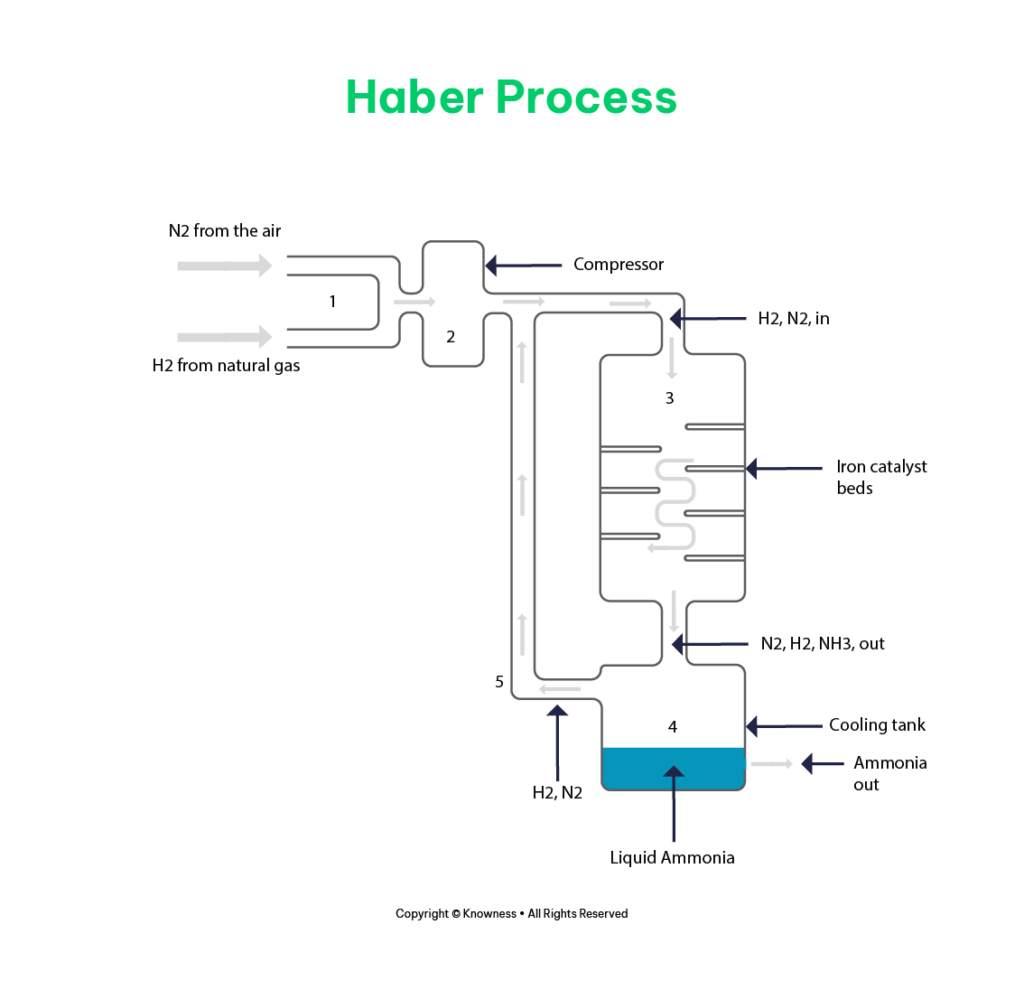
The raw materials for the Haber process are nitrogen (N2) and hydrogen (H2). Nitrogen can be sourced from the air, which is primarily composed of nitrogen gas. Hydrogen can be obtained from various sources, such as natural gas or methane. These two gases serve as the building blocks for the production of ammonia.
Reaction Conditions
In the Haber process, the purified nitrogen and hydrogen gases are passed over a catalyst made of iron. The reaction takes place at high temperature, typically around 450°C, and high pressure, approximately 200 atmospheres. Under these conditions, a portion of the hydrogen and nitrogen react to form ammonia according to the equation:
nitrogen + hydrogen ⇌ ammonia
On cooling, the ammonia liquefies and is removed. The remaining hydrogen and nitrogen are recycled.
Equilibrium and Rate of Production
The concept of dynamic equilibrium is crucial to understanding the Haber process. At equilibrium, the rate of the forward reaction (formation of ammonia) equals the rate of the reverse reaction (breakdown of ammonia). By maintaining a high pressure and temperature, the Haber process favours the production of ammonia, ensuring a reasonable rate of ammonia formation. However, not all nitrogen and hydrogen will convert to ammonia due to the reversible nature of the reaction.
Trade-off and Commercial Conditions
There is a trade-off between the rate of ammonia production and the position of equilibrium. Increasing the pressure and temperature would enhance the rate of production, but it would also shift the equilibrium towards the reactants (nitrogen and hydrogen). Therefore, the commercially used conditions for the Haber process strike a balance that allows for a reasonable rate of production while maximising the yield of ammonia.
The commercially chosen conditions consider various factors, including the availability and cost of raw materials and energy supplies. The control of the equilibrium position is crucial for maximising the ammonia yield. Additionally, the rate of reaction is also a significant consideration in terms of efficiency and production capacity.
Conclusion
The Haber process plays a vital role in the production of ammonia (NH3), which is essential for the manufacturing of nitrogen-based fertilisers. Understanding the reaction conditions, equilibrium principles, and the trade-off between rate and equilibrium position allows for efficient and sustainable ammonia production. The Haber process not only contributes to agricultural productivity but also highlights the importance of balancing scientific principles with industrial requirements for resource utilisation and economic viability.
Continue the lesson
This section is available to learners with course access. Continue learning with Knowness to unlock the full explanation, examples, revision tools, and progress tracking.
The remaining lesson content includes further guided explanation, important learning points, and supporting interactive material designed to help you understand and revise this topic.
Unlock this topic to view the full activity, worked examples, common mistakes, and additional revision support.
More content available
Knowness lessons are structured to build understanding step by step. Create an account or upgrade your access to continue from this point.
This preview does not include the hidden lesson text, answers, explanations, or embedded interactions.
Continue learning with Knowness
Sign up to access the full lesson, predicted grades, revision tools, progress tracking, and more.
Create a free account