

GCSE
Chemistry
-
Introduction to GCSE Chemistry (AQA) Coming soon
-
1.1 Atomic Structure, Elements, Compounds, and Mixtures
-
1.2 The Periodic Table Coming soon
-
2.1 Chemical Bonds, Ionic, Covalent and Metallic Coming soon
-
2.2 How Bonding and Structure are Related to the Properties of Substances Coming soon
-
2.3 Structure and Bonding of Carbon Coming soon
-
2.4 Bulk and Surface Properties of Matter including Nanoparticles Coming soon
-
3.1 Chemical Measurements, Conservation of Mass and the Quantitative Interpretation of Chemical Equations Coming soon
-
3.2 Use of Amount of Substance in Relation to Masses of Pure Substances Coming soon
-
3.3 Yield and Atom Economy of Chemical Reactions Coming soon
-
3.4 Using Concentrations of Solutions in mol/dm³ [HT] Coming soon
-
3.5 Use of Amount of Substance in Relation to Volumes of Gases [HT] Coming soon
-
4.1 Reactivity of Metals Coming soon
-
4.2 Reactions of Acids Coming soon
-
4.3 Electrolysis Coming soon
-
5.1 Exothermic and Endothermic Reactions Coming soon
-
5.2 Chemical Cells and Fuel Cells Coming soon
-
6.1 Rate of Reaction Coming soon
-
6.2 Reversible Reactions and Dynamic Equilibrium Coming soon
-
6.2.1 Reversible Reactions
-
6.2.2 Energy Changes and Reversible Reactions
-
6.2.3 Equilibrium
-
6.2.4 The Effect of Changing Conditions on Equilibrium (HT only)
-
6.2.5 The Effect of Changing Concentration (HT only)
-
6.2.6 The Effect of Temperature Changes on Equilibrium (HT only)
-
6.2.7 The Effect of Pressure Changes on Equilibrium (HT only)
-
6.2.1 Reversible Reactions
-
7.1 Carbon Compounds as Fuels and Feedstock Coming soon
-
7.2 Reactions of Alkenes and Alcohols Coming soon
-
7.3 Synthetic and Naturally Occurring Polymers Coming soon
-
8.1 Purity, Formulations and Chromatography Coming soon
-
8.2 Identification of Common Gases Coming soon
-
8.3 Identification of Ions by Chemical and Spectroscopic Means Coming soon
-
9.1 The Composition and Evolution of the Earth's Atmosphere Coming soon
-
9.2 Carbon Dioxide and Methane as Greenhouse Gases Coming soon
-
9.3 Common Atmospheric Pollutants and their Sources Coming soon
-
10.1 Using the Earth's Resources and Obtaining Potable Water Coming soon
-
10.2 Life Cycle Assessment and Recycling Coming soon
-
10.3 Using Materials Coming soon
-
10.4 The Haber Process and the use of NPK Fertilisers Coming soon
1. Atomic Structure and the Periodic Table
4.2.4 The pH Scale and Neutralisation
In aqueous solutions, acids release hydrogen ions (H+), while alkalis contain hydroxide ions (OH-). The pH scale is a numerical scale ranging from 0 to 14 that measures the acidity or alkalinity of a solution. The pH can be determined using indicators such as universal indicator or a pH probe.
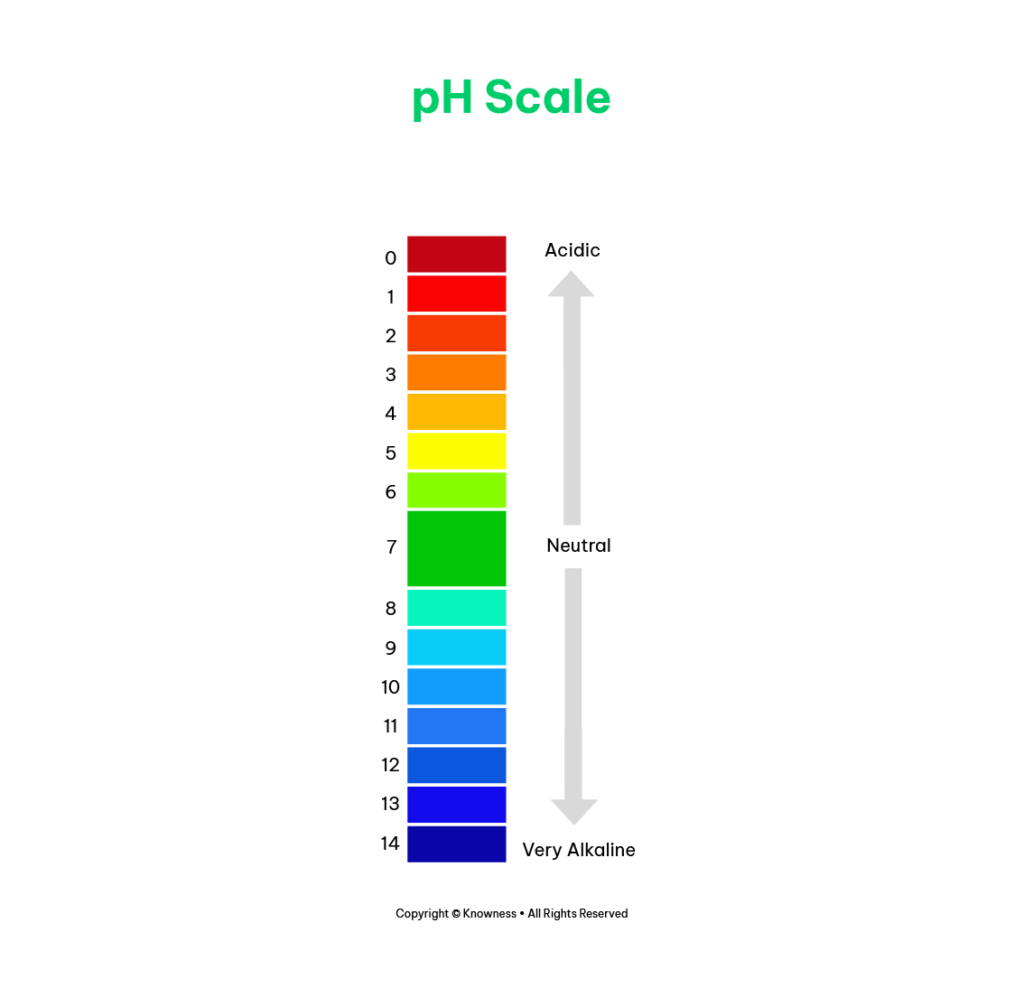
On the pH scale, a solution with a pH of 7 is considered neutral. Solutions with a pH less than 7 are acidic, while solutions with a pH greater than 7 are alkaline (basic).
During a neutralisation reaction between an acid and an alkali, hydrogen ions from the acid react with hydroxide ions from the alkali to form water. This can be represented by the following equation:
H+ (aq) + OH- (aq) → H2O (l)
Universal Indicator
Universal indicator is a mixture of several different indicators that undergo colour changes in response to different pH levels. It can be used to estimate the pH of a solution by observing the colour change that occurs when the indicator is added to the solution. Universal indicator is usually provided as a paper strip or a liquid solution.
When universal indicator is added to a solution, it changes colour depending on the pH of the solution. The colour range spans the entire pH scale, from acidic to alkaline. By comparing the observed colour to a colour chart provided with the universal indicator, one can estimate the approximate pH of the solution. The colour chart typically provides a range of colours corresponding to different pH values.
Wide range indicators function in a similar way, providing a visual indication of the pH of a solution within a broader range. They are designed to display distinct colours at specific pH values, enabling users to estimate the pH based on the observed colour.
Using the pH Scale
The pH scale is a numerical scale that measures the acidity or alkalinity of a solution. It ranges from 0 to 14, with 7 representing neutrality.
- Solutions with a pH less than 7 are considered acidic. The lower the pH value, the more acidic the solution. For example, a solution with a pH of 1 is highly acidic.
- Solutions with a pH greater than 7 are alkaline (basic). The higher the pH value, the more alkaline the solution. For example, a solution with a pH of 14 is highly alkaline.
- Solutions with a pH of 7 are neutral, meaning they are neither acidic nor alkaline. Pure water, for example, has a pH of 7 and is considered neutral.
Conclusion
By measuring the pH of a solution using pH paper, a pH metre, or indicators such as universal indicator, you can determine whether a solution is acidic, alkaline, or neutral based on its pH value.
Continue the lesson
This section is available to learners with course access. Continue learning with Knowness to unlock the full explanation, examples, revision tools, and progress tracking.
The remaining lesson content includes further guided explanation, important learning points, and supporting interactive material designed to help you understand and revise this topic.
Unlock this topic to view the full activity, worked examples, common mistakes, and additional revision support.
More content available
Knowness lessons are structured to build understanding step by step. Create an account or upgrade your access to continue from this point.
This preview does not include the hidden lesson text, answers, explanations, or embedded interactions.
Continue learning with Knowness
Sign up to access the full lesson, predicted grades, revision tools, progress tracking, and more.
Create a free account