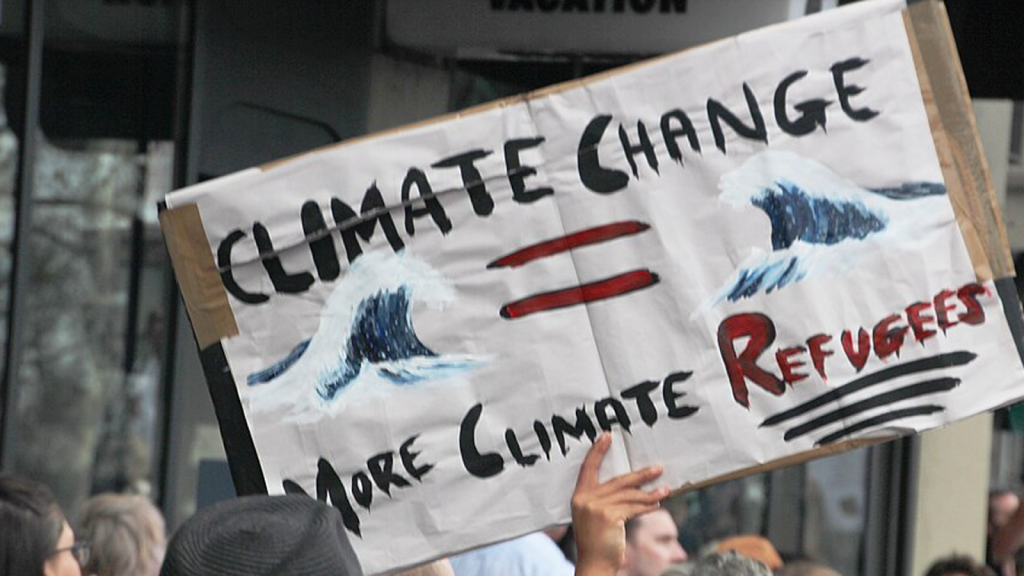
3.1 Climate Migration
Climate migration refers to the movement of people driven by changes in climate and environmental conditions. This module explores the factors contributing to climate migration, its impacts on societies and ecosystems, and the strategies required to address this growing global challenge.
Understanding Climate Migration
Climate migration refers to the temporary or permanent movement of people due to climate-related factors such as extreme weather events, sea-level rise, desertification, and resource scarcityThe situation where limited resources are not sufficient to satisfy unlimited human wants.. It can be internal (within a country) or cross-border, and can be as a result of sudden disasters such as floods or hurricanes, for example New Orleans in 2005, or a gradual build up typically caused by droughts or sea level rise, for example in Guatemala in 2019.
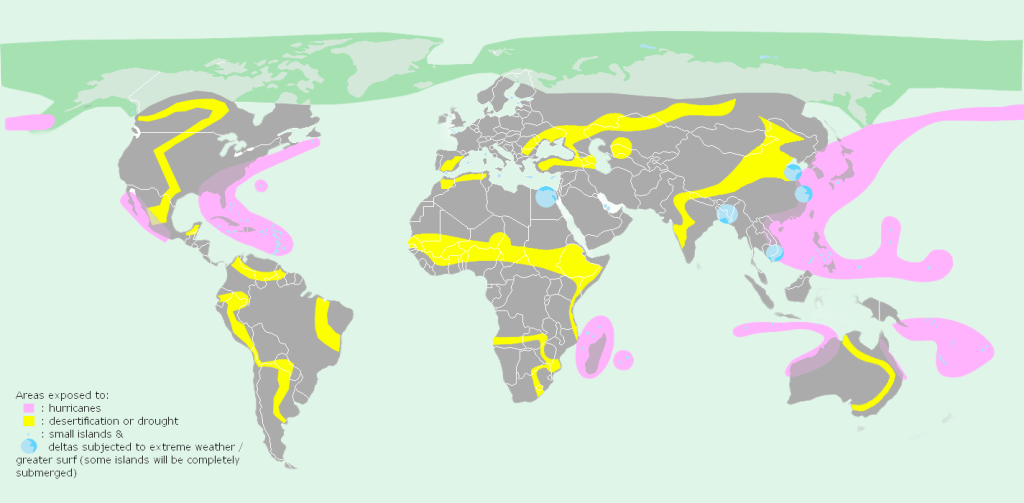
Certain communities often become disproportionately affected by climate change and therefore can become trapped due to financial, social, or physical constraints. This can lead to a competition for resourcesThe inputs used to produce goods and services, including the factors of production., oftentimes leading to conflict or alternatively migration into cities where public spending and work opportunities are typically higher.
According to Xu et al (2020), the next 50 years could see a temperature increase greater than that of the last 6,000 years combined. Subsequently, by 2070, zones labelled as ‘extremely hot’, like the Sahara, that covers less than 1% of Earth’s current landAll natural resources used in production, including soil, water, forests, minerals, oil, and other resources from nature. surface, could cover nearly 20% of the land, resulting in one in every three people being forced to move (McLeman, 2019). Even until the year 2050, an assumption of a 2°C rise, compared to the current 1.5°C rise, is estimated to increase the number of people exposed to climate-related risks and poverty by up to several hundred million (Xu et al, 2020).