

2.2 Inspection and Analysis
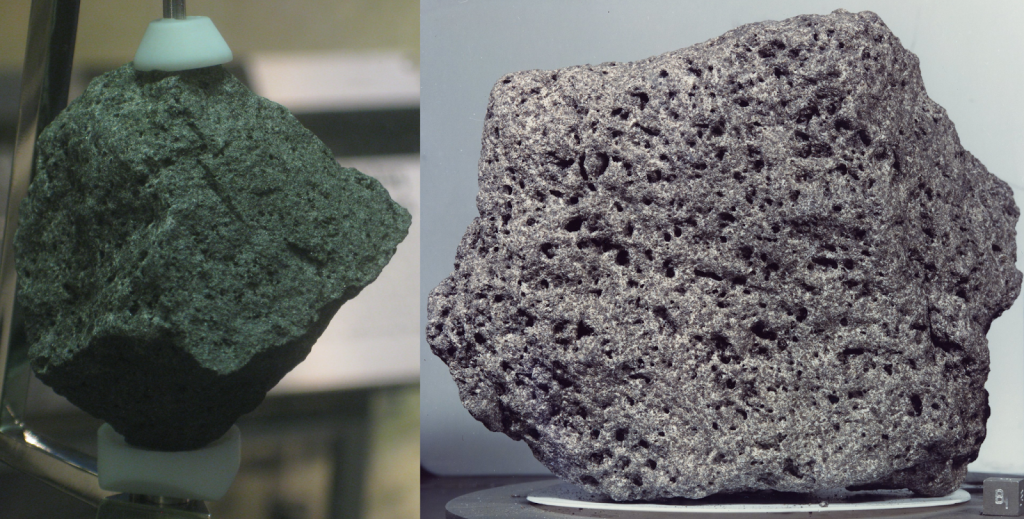
Many Universities have actual physical moon rock, which can give you insight into the similarities and differences between moon rock and rocks found on Earth. For now, here are a few images of lunar rock for you to inspect.
Radiometric Dating of Moon Rock
Radiometric dating is a fundamental technique in geochronology, allowing scientists to determine the absolute age of rocks by measuring the decay of radioactive isotopes. These isotopes, present in minerals at the time of rock formation, decay into stable daughter elements at a known and constant rate, defined by their half-lifeThe time it takes for half the atoms of a radioactive substance to decay; for carbon-14, this is approximately 5,700 years.. By analysing the ratio of parent to daughter isotopes, geologists can accurately calculate the time since the rock solidified, providing crucial insights into planetary history.
On Earth, radiometric dating has been instrumental in refining the geological timescale. Methods such as uranium-lead dating of zircon crystals provide ages for some of the oldest continental rocks, while potassium-argon dating is widely applied to volcanic deposits to reconstruct past eruptions. Carbon-14 dating, though limited to organic material younger than 50,000 years, has revolutionised archaeologyThe study of the human past through material remains such as artefacts, buildings, and landscapes.. These techniques have enabled scientists to piece together Earth’s dynamic history, from the formation of its crust to the evolution of life.
The application of radiometric dating to Moon rock has significantly enhanced our understanding of planetary evolution. Samples returned from Apollo missions, analysed using techniques such as rubidium-strontium dating, indicate that the Moon’s crust formed around 4.4 billion years ago, shortly after the solar system itself coalesced. Lunar basalts from the maria regions date between 3.1 and 3.9 billion years old, confirming prolonged volcanic activity in the Moon’s early history. Unlike Earth, where plate tectonics constantly recycle the crust, the Moon’s surface has remained geologically stable for billions of years. This preservation makes Moon rocks an unparalleled record of early planetary processes.
Furthermore, dating Moon samples has provided a reference for estimating the ages of other celestial bodies. Scientists use crater density as a relative dating tool for planetary surfaces, assuming that older surfaces accumulate more impact craters over time. By correlating crater counts with absolute ages obtained from Moon rock, researchers have improved age estimates for Mars, Mercury, and even asteroids, enriching our understanding of the history of the solar system.
Additionally, radiometric dating of lunar rocks supports the Giant Impact Hypothesis, which suggests the Moon formed from the debris of a catastrophic collision between early Earth and a Mars-sized protoplanet approximately 4.5 billion years ago. This theory helps explain why Moon rocks share similarities with Earth's mantle-derived igneous rocks while exhibiting notable chemical differences, such as a lower abundance of volatile elements.