

University Taster
Geography – University Taster
2.1 Just What is the Moon?
The study of the moon, Selenology, has been a focal point of interest for scientists throughout history. Then in 1973 the Apollo mission provided rock evidence that the moon was formed from an object colliding with Earth, proving that the moon was once part of Earth.
Formation of the Moon
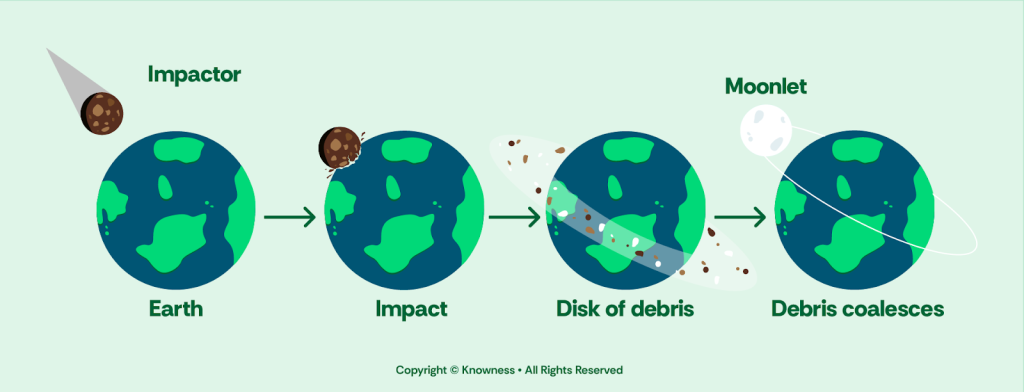
The Giant Impact Theory suggests that the Moon was formed around 4.5 billion years ago during a cataclysmic event whereby a Mars-sized body, referred to as the Theia by Halliday (2000), collided with Earth. The sheer impact ejected massive amounts of debris into orbit around Earth, each of varying shapes and sizes, which means the debris would orbit at varying speeds. Over time, the debris coalesced through a process known as accretion to form what is now known as the moon.
Lunar samples brought back from the Moon during the Apollo mission share isotopic similarities with Earth's mantle. This suggests a common origin (Mitrofanov, 2023). Further research has shown that the orbital dynamics of the Moon's size and distance align with computer-generated models of a large-impact scenario. This evidence has led to the Giant Impact Theory becoming the leading explanation for the Moon's existence.
Footnote
Sharing isotopic similarities in this instance refers to Earth’s mantle and the lunar rock samples maintaining the same number of protons, but different numbers of neutrons.
However, because this event may have occurred 4.5 billion years ago, long before observation equipment, we use proxy variables to build confidence in a theory, such as chemical composition and computer-generated models. Therefore, other hypotheses have been proposed, although much less widely accepted due to the limiting supporting evidence.
Common Mistake
Proxy variables (in this case moon rock chemical composition) should not add any additional information to what we are trying to study, but instead should be used as an alternative to the variable you are interested in (in this case the moon’s rock formation).
Example
One example is the Fission Theory, proposed by George Darwin, the son of Charles Darwin, that states the Earth was spinning so fast, molten content ejected off to form the moon. However, this theory was disproved as there is no scientific evidence of a rapid spin of Earth in the past. As well as this, there is still a difference in composition between moon rock and Earth’s mantle. This can now be explained through the Giant Impact Theory where less volatile elements like sodium, potassium, and water, would rapidly rise during intense heat of the collision, leaving the moon with a more depleted composition compared to Earth.
Continue the lesson
This section is available to learners with course access. Continue learning with Knowness to unlock the full explanation, examples, revision tools, and progress tracking.
The remaining lesson content includes further guided explanation, important learning points, and supporting interactive material designed to help you understand and revise this topic.
Unlock this topic to view the full activity, worked examples, common mistakes, and additional revision support.
More content available
Knowness lessons are structured to build understanding step by step. Create an account or upgrade your access to continue from this point.
This preview does not include the hidden lesson text, answers, explanations, or embedded interactions.
Continue learning with Knowness
Sign up to access the full lesson, predicted grades, revision tools, progress tracking, and more.
Create a free account