

2.5 The Global Weather Phenomenon Controlling the UK’s Weather
Teleconnections refer to large-scale atmospheric patterns that have global influence and can affect weather conditions thousands of miles away (Tsonis, 2008). Typically, teleconnections influence weather patterns over long periods of time at a low variability (Lübbecke et al, 2018), but on occasion has been linked to certain natural hazard events.
Teleconnections and How They Affect the UK
Oceans act as a vast heat reservoir, which influences atmospheric circulation patterns through variations in sea surface temperature (SST), which in turn drive large scale atmospheric waves (like Rossby waves) that transport weather patterns across global distances. Therefore, a change in ocean temperature can trigger changes in atmospheric pressure and wind patterns.
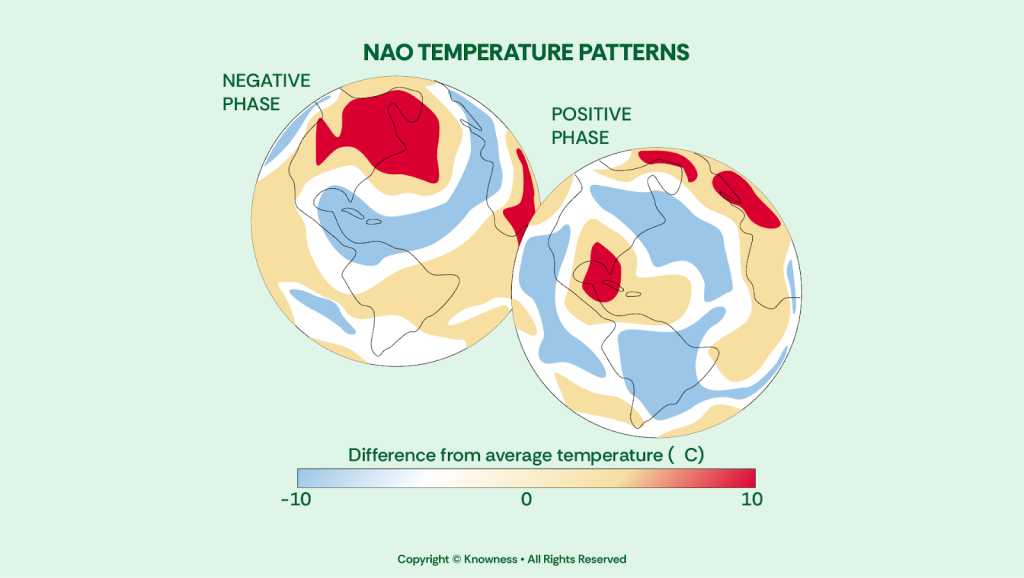
When an area of the ocean experiences a significant change in temperature, it alters the air temperature above it, influencing atmospheric convection and wind patterns. Also, major ocean currents like the Gulf Stream transport heat from the tropics towards the poles, significantly impacting regional climates and influencing atmospheric circulation patterns.
The North Atlantic Oscillation (NAO), defined as the sea level pressure difference between the Icelandic Low and the Azores High (Figure 13), is considered as the leading teleconnection for western-Europe and the UK (Hurrell & Deser, 2010). During positive phases, the UK experiences wetter and milder winters from strong westerly winds whereas the negative phase is associated with the drier winters and a higher potential for snow (NCEI, 2024).
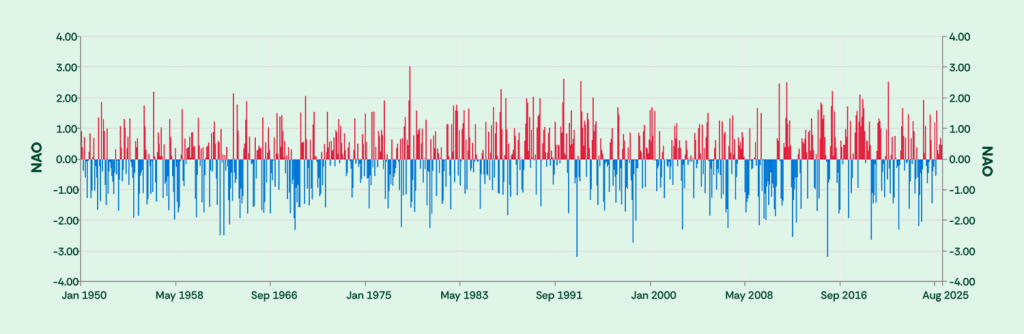
Arctic Oscillation (AO) is another large contributor to the UK’s weather conditions year-on-year, it reflects the strength of the polar vortex and the distribution of atmospheric pressure in the Arctic region. A positive phase is associated with confinement of cold air to the arctic, leading to milder conditions in the UK, whereas negative phases are associated with cold air directing southward, increasing the likelihood of cold snaps and snow (Deser, 2000).
El Niño-Southern Oscillation (ENSO) is a seesaw-like cycle of warming and cooling in the central and eastern Pacific Ocean, although multiple studies have found the range of influence to be largely centred around South-America,Oceania and South-East Asia (Glantz, 2001), but has also been linked UK heavy rainfall and subsequent flooding in 2010-2011 (Cai et al, 2014) and colder, drier winters in the UK from El Niño phases, and wetter, milder winters from La Niña phases.
There are many other teleconnections that can be analysed to see their contribution to long-term, low-variability weather, of which you can discover for another country/region in your own studies.