

University Taster
Chemical Engineering – University Taster
6.1 Purpose & Challenges of Sustainability in Engineering
Sustainability in Engineering is more than just a target set by firms to appear environmentally conscious, it empowers engineers to address real societal challenges. This lesson will describe the purpose of attempting to devise solutions to engineering problems in a sustainable way, and some of the challenges faced by this.
Sustainable Development
The United Nations defines sustainable development as “meeting the needs of the present without compromising the ability of future generations to meet their needs”. Operating as an engineer by this principle allows us to consider how we may minimise our impact on the environment, whether that be through emissions, resource use, or social impact, in achieving our goals of today.
A process can be considered “sustainable” if it satisfies the triple bottom line, shown in Figure 1 This is where a process is not seen as damaging or detrimental when considering the social, economic, and environmental impacts, bearing the three traits shown below:
- Bearable: Neither the environment nor the people impacted by the process are negatively affected.
- Equitable: The economics are not unfair, and people or groups are fairly compensated without experiencing hardship.
- Viable: It can be achieved without damaging the environment and makes economic sense, typically viewed as profitable.
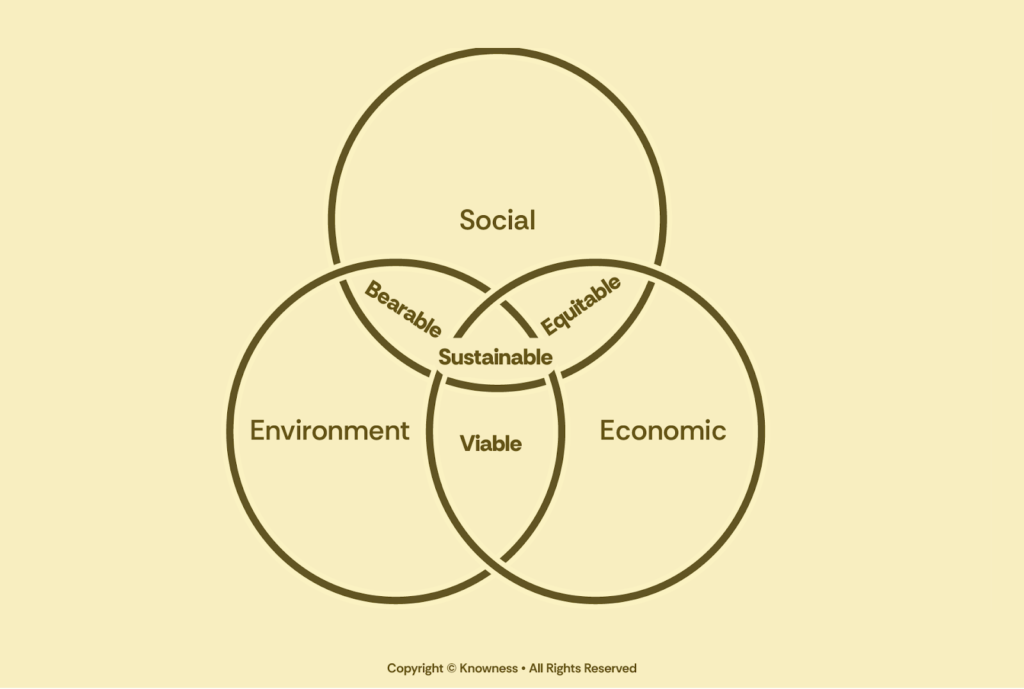
The overarching goal of sustainable engineering is to shift away from the current paradigm, which focuses on economic growth with the goal of profit prioritised (sometimes at the cost of the environment) into an ideal scenario where there are no compromises on the triple bottom line of a sustainable process. An example of this is shown in Figure 2, which relates to the energy mix and use of fossil fuels. Whilst the goal presented is an ideal vision, it is unlikely to be achieved without challenge.

Continue the lesson
This section is available to learners with course access. Continue learning with Knowness to unlock the full explanation, examples, revision tools, and progress tracking.
The remaining lesson content includes further guided explanation, important learning points, and supporting interactive material designed to help you understand and revise this topic.
Unlock this topic to view the full activity, worked examples, common mistakes, and additional revision support.
More content available
Knowness lessons are structured to build understanding step by step. Create an account or upgrade your access to continue from this point.
This preview does not include the hidden lesson text, answers, explanations, or embedded interactions.
Continue learning with Knowness
Sign up to access the full lesson, predicted grades, revision tools, progress tracking, and more.
Create a free account