4.2 Crystallisation
CrystallisationProcess of forming solid crystals from a liquid. is the process through which a liquid is solidified into a highly structured solid, where a solvent is typically evaporated to leave the crystallised solid. One area where crystallisation is used is in the process of manufacturing sugar crystals, where a thick syrup is fed into a crystallisation chamber and evaporated until a desired sugar crystal size is achieved.
Equilibria and Binary Mixtures
The process of crystallisation focuses on the solid to liquid transition, where a single substance can crystallise into as many as 7 different forms, resulting in different latticeHighly organised structure of repeating atoms/molecules that forms a crystalline structure. arrangements and therefore different properties. A polymorphic substance can form multiple crystal forms, where the rate of cooling during the crystallisation process may dictate the resulting form.
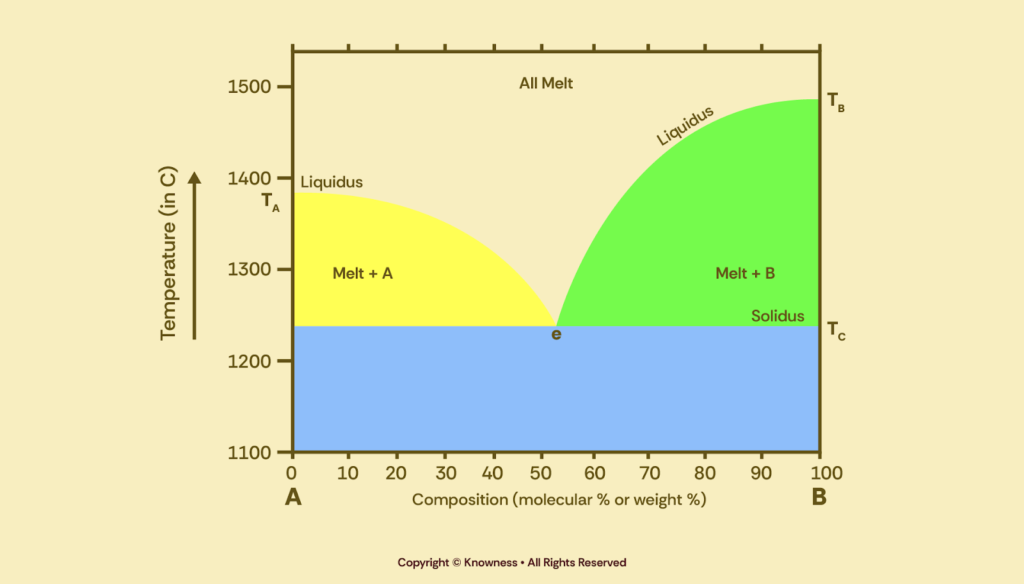
Figure 1 shows a plot of temperature against the mass fraction of two substances, ‘A’ and ‘B’. A eutectic binary mixture consists of two substances which may have different freezing points, where the eutectic pointLowest temperature point on a temperature-composition diagram where crystals of two substances in a binary exist., shown as ‘e’ on the diagram, is where both substances are crystallised at the lowest possible temperature.
SupersaturationCondition for crystallisation to occur where the concentration of a mixture is at its highest is one of three states, alongside saturated and unsaturated systems, where the concentration of a mix is at its highest and the system is beyond equilibrium, and is necessary for crystallisation to occur. Equation 1 shows the equation for the degree of supersaturation (), with Equation 2 showing the equation for the supersaturation ratio (\(S\)) and Equation 3 showing the equation for the relative supersaturation (\(\phi\)).
\(\Delta c = c - c^*\)
\(S = \frac{c}{c^*}\)
\(\phi = \frac{\Delta c}{c^*} = S-1\)
This state of supersaturation required for crystallisation can be achieved in three main ways:
- Cooling: Used in systems where the stability decreases with temperature
- Solvent removal: Used in systems where the stability is not affected by temperature and so the solvent is normally removed by evaporation
- Additional components: Used if neither cooling nor evaporation can be used, where the this additional compound might react to form an insoluble substance with the original solute via a precipitationWhere a solid forms from a liquid solution, often by the addition of another substance. reaction
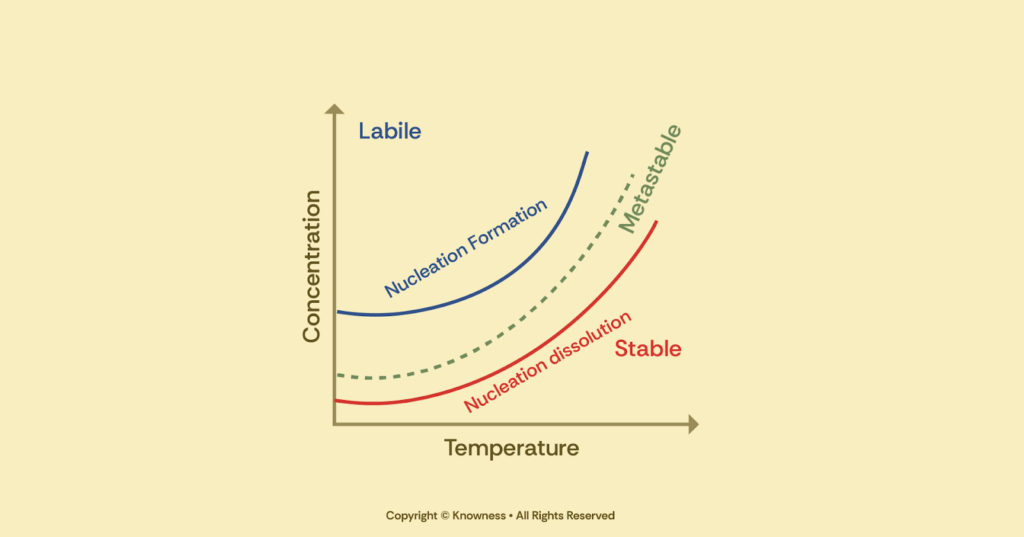
The spontaneous nucleationFormation and growth of crystals. of crystals as a result of supersaturation can be predicted using a solubility-supersolubility diagram, such as the one shown in Figure 2. The three regions are as follows:
- Stable: Crystallisation impossible here
- Metastable region: Spontaneous nucleation improbable
- Labile region: Spontaneous nucleation probable but not inevitable