4.1 Introduction to Heat Exchange in Chemical Processes
Heat exchange is relevant in all aspects of engineering, whether that be heating foods in industrial ovens, achieving extreme temperatures within hydrocrackers on a refinery, or incorporating heat recovery systems to develop an energy efficient process.
Principles of Heat Exchange
Improving energy efficiency through heat integration helps lower operating expenses by reducing utility costs. This approach forms the foundation of heat exchanger design.
Consider the diagram shown in Figure 1, with a feed and product stream at two different temperatures, as well as a heater to preheat the feed and a cooler to reduce the temperature of the products for safe handling.
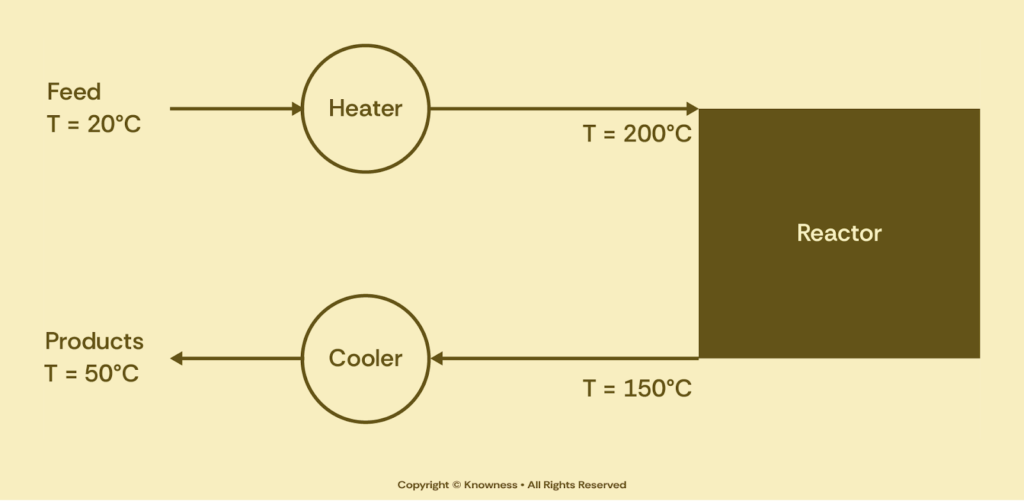
The heat content of each stream is the enthalpy, H (kW). The differential heat flow (dQ) changes this enthalpy value by a heat capacity flow rate (CP) proportional to the differential temperature change (dT). Based on the assumption that CP remains constant, the total heat provided to a stream by the heater or removed due to the cooler can be calculated using the equation shown in Equation 1. The enthalpy change value is therefore the power of the heating element or cooling required to achieve the desired temperature change.
\(Q = \int_{T_s}^{T_T} CP dT = CP(T_T - T_s) = \Delta H\)
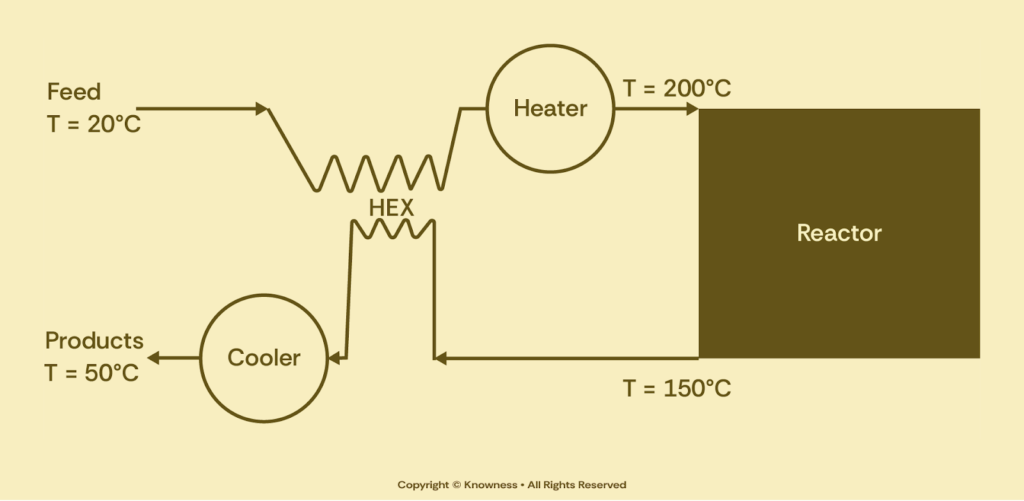
As part of heat integration, the challenge is to consider how energy consumption can be reduced. Figure 2 shows a diagram similar to Figure 1, but incorporates a heat exchanger. Whilst this may still require heating and cooling elements on the feed and product streams respectively, it will reduce the duties of these units, thus potentially providing savings in energy usage.
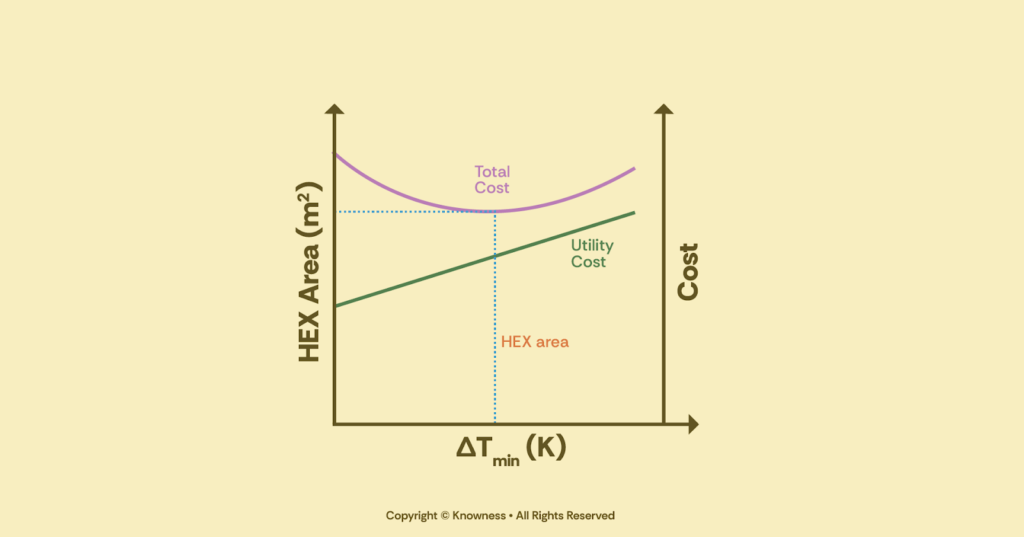
An important value in the design of heat exchanges is finding \(\Delta T_{min}\), which is the minimum temperature difference between the hot and cold streams. It is a crucial value that balances the trade-off between energy recovery and capital expenditure (CAPEXCapital Expenditure, referring to high value investments expected to have a payback.). Larger \(\Delta T_{min}\) values will have a reduced CAPEX but higher utility costs, whilst a lower \(\Delta T_{min}\)will have an increased CAPEX but reduce the operating costs.
Figure 3 is a graph showing the heat exchanger area, which is directly proportional to the cost of the equipment, varies according to the \(\Delta T_{min}\) value. The optimal point for designing and operating a heat exchanger is called the pinch pointOptimal design and operation point for a heat exchange unit, where the hot and cold streams are separated by a temperature equal to Tmin., which is the temperature where the hot and cold streams have a difference of \(\Delta T_{min}\). The point marked on the graph is where the total cost is at a minimum and should therefore this value of \(\Delta T_{min}\) should be used in designing the heat exchange equipment.