

3.1 Fluid Transport Phenomena Fundamentals
Before tackling complex pipe flow problems, a good understanding of the mathematics describing the forces involved in fluid dynamics is required. This lesson will introduce types of physical quantities encountered in transport phenomenaA field of engineering that studies mass, energy, and momentum within and between systems, as well as descriptions of some simpler fluid dynamic concepts.
Physical Quantities in Fluid Dynamics
There are three categories of physical quantity that are required in the study of transport phenomena: scalarsA quantity described by magnitude alone., vectorsA quantity described by both magnitude and direction., and second-order tensors. Scalars describe quantities without a direction, such as temperature and pressure. Vectors have a directional component, such as velocity and momentum. Second-order tensors can be represented as a matrixUsed in mathematics, this is an arrangement of numbers, symbols, or expressions arranged into rows and columns., and includes examples such as stress and momentum flux.
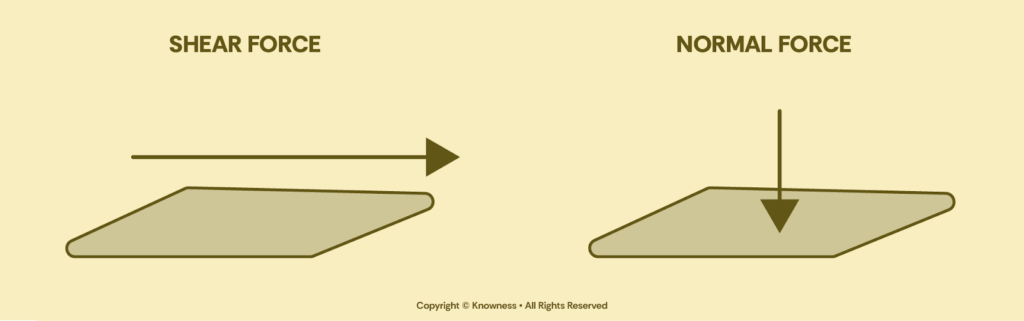
Tensor notation is useful when considering shear forces and normal forces, demonstrated by Figure 1. When a shear force is applied to an object it is applied parallel to the plane, whilst a normal force is applied perpendicular to the plane. The equation for the stress, or pressure, in the two scenarios is calculated in the same way, as shown by Equation 1, but has a different direction and effect.
\(\text{Stress \: } (Pa)= \frac{\text{Force \:} (N)}{\text{Area \: }(m^2)}\), \(\text{Pressure \: } (Pa)= \frac{\text{Force \:} (N)}{\text{Area \: }(m^2)}\)
A key difference between solids and fluids is that, when a shear stress is applied, solids will deform or resist the stress, whilst a fluid will flow.
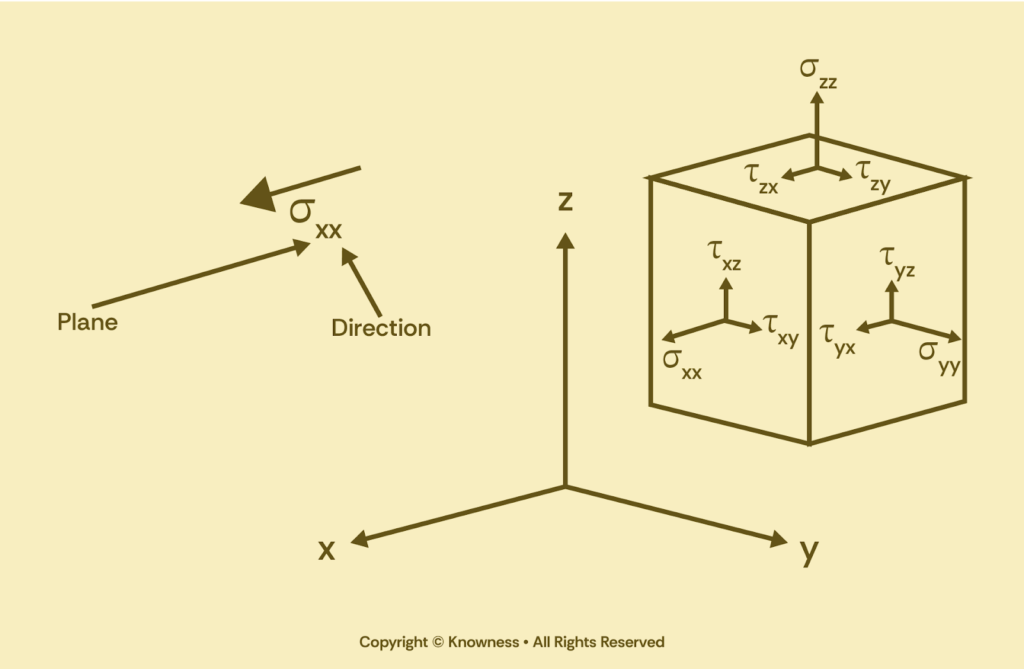
Figure 2 shows the Cauchy-Stress TensorSecond-order tensor encompassing all normal and shear forces on a 3D object., which results in the 3x3 matrix shown in Figure 3. Each stress here is described with a subscript where, for example, the normal force \(\sigma_x_y\) conveys that the stress is acting on the plane perpendicular to the x-axis in the y-direction.
\(\begin{bmatrix}\sigma_x_x & \tau_x_y & \tau_x_z \\\tau_y_x & \sigma_y_y & \tau_y_z \\\tau_z_x & \tau_z_y & \sigma_z_z \\\end{bmatrix}\)