

2.3 Fundamental Thermodynamics
Thermodynamics is the study of relationships between heat and other energy forms, thus relating all energy forms with one another. For Chemical Engineers, Thermodynamics encompasses many areas, from reaction kineticsA Branch of Chemistry and Thermodynamics that studies the rate of chemical reactions and their influencing factors. to phase equilibriaTwo or more phases existing in a stable state, with many mathematical relationships that can describe these. This lesson will give an example of a derivation for one such equation you may encounter in studying Thermodynamics.
Clausius-Clapeyron Equation Derivation
The previous lesson introduced the concept of Gibbs Free Energy, G, and its relationship to temperature, pressure, volume, enthalpyA measure of the total heat content of a system., and entropyAn indicator of the physical disorder of a system.. Applying this to 2 phases in equilibrium (i.e. where G = 0), yields the analysis shown in Equation 1.
\(dG(g) = dG(l) \therefore V(g)DP - S(g)dT = V(l)dP - S(l)dT\)
\(\frac{dP}{dT} = \frac{S(g) - S(l)}{V(g)-V(l)}\)
\(\frac{dP}{dT} = \frac{\Delta S_v}{\Delta V_v}\)
\(\text{As} \: \Delta G= 0 \: \text{and} \: \Delta G = \Delta H - T \Delta S\)
\(\Delta S_v = \frac{\Delta H_v}{T}\)
\(\therefore \frac{dP}{dT} = \frac{\Delta H_v}{T \Delta V_v}\)
This first derivation gives us the Exact Clapeyron equation. Given a Pressure-Temperature phase diagram graph, this can be used to give the gradient of tangents to the curve which separates two phases, shown in Figure 1.
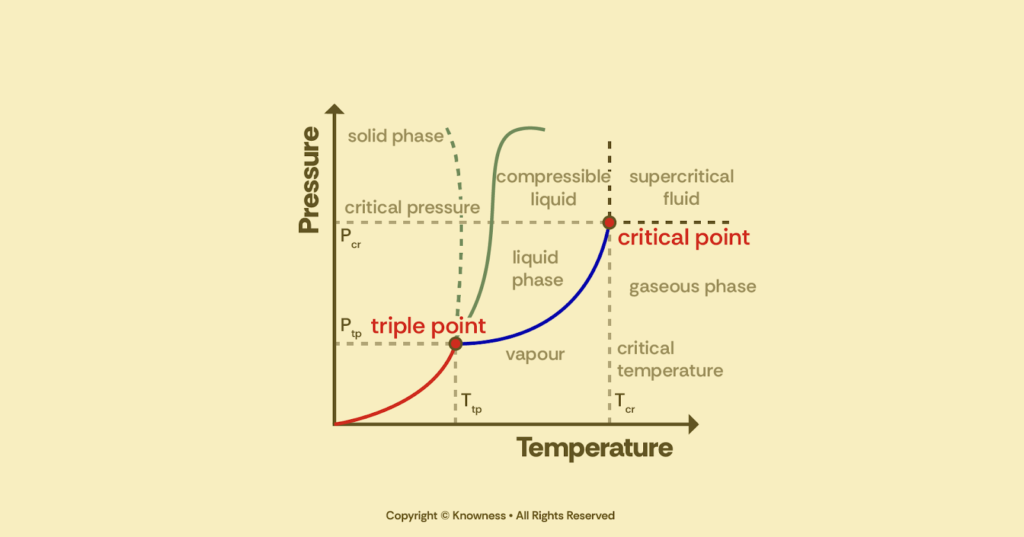
The Clausius-Clapeyron equation can be used when the vapour involved behaves perfectly, thus following the ideal gas law. The derivation of this relationship is shown in Equation 2. This is frequently used to calculate the vapor pressure of a liquid, which is the point at which a substance can exist in all three phases.
\(\text{Assume}\: \Delta V_v \simeq V(g) \therefore V(g) = \frac{RT}{P}\)
\(\frac{dP}{dT} = \frac{\Delta H_v}{RT^2} P\)
\(\text{Thus} \: \frac{dlnP}{dT} = \frac{\Delta H_V}{RT^2}\)