

3.4 Pipe Flow Analysis
The equations and theories of fluid dynamics become invaluable when looking for meaningful insights into flows within vessels and pipes. This lesson will introduce one method of measuring flow within a pipe, the venturi flowmeter, as well as introducing an equation to measure pressure drop within a pipeline.
Flow Measurements
The Venturi effectReduction in fluid pressure and increase in fluid velocity as a result of a pipe constriction. describes the reduction in fluid pressure as a result of a fluid passing through a reduction in pipe diameter, as seen in Lesson 3.3 Laws of Conservation. This effect can be used with a venturimeter that uses the pressure drop over such a constriction which can be used to determine the fluid velocity. This is based on Bernoulli’s principle from Lesson 3.3 Laws of Conservation.
Figure 1 shows a venturimeter, consisting of a U-Tube manometerUsed to determine pressure drop over a section of pipe based on hydrostatics. that measures the pressure difference in the two sections of pipe. According to Bernoulli’s principle, energy must be conserved in this process, with the law of mass conservation demanding the fluid velocity must increase with a simultaneous pressure drop.
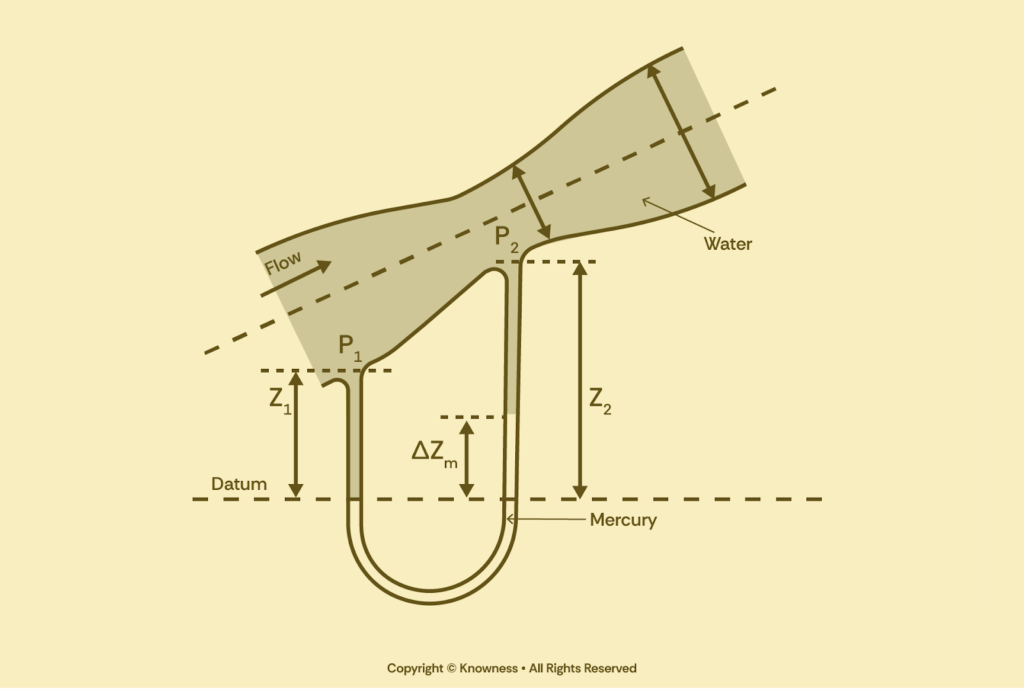
According to Pascal’s LawDescribes the principle of transmission of fluid-pressure., pressure along the datum line (the dashed line in Figure 1) is constant, giving the first equation shown in Equation 1. Similarly, Bernoulli’s equation can be arranged to also give the pressure drop \((P_1 - P_2)\), as shown in Equation 1, thus equating the two to give the third line in Equation 1. Finally, this can be rearranged to give the velocity difference as the subject.
\(P_1 - P_2 = (Z_2 - \Delta Z_m - Z_1) \rho_wg + \Delta Z_m \rho_m g\)
\(P_1 - P_2 = \rho (\frac{u_2^2 - u_1^2}{2}) + \rho g (Z_2 - Z_1)\)
\((Z_2 - \Delta Z_m - Z_1) \rho_wg + \Delta Z_m \rho_m g = \rho (\frac{u_2^2 - u_1^2}{2}) + \rho g (Z_2 - Z_1)\)
\(u_2^2 - u_1^2 = 2 \Delta Z_m g (\frac{\rho_m}{\rho} - 1)\)
The volumetric throughput of the equation can be found using the law of conservation of mass, where the volumetric throughput is assumed to remain constant, according to the equation in Equation 2.
\(u_1A_1 = u_2A_2 = Q\)
Thus, the equation in Equation 3 can be used to calculate the volumetric throughput within the venturi flowmeter.
\(Q = A_2 (\frac{2 \Delta Z_m g (\frac{\rho_m}{\rho} - 1)}{1 - (\frac{A_2}{A_1})^2})^{1/2}\)
The mass flow rateRate at which a mass of a substance passes through a given area over a unit of time, typically expressed in kg/s. and fluid velocity can then be determined using the equations in Equation 4.
\(\dot{m} = \rho A_2 (\frac{2 \Delta Z_m g (\frac{\rho_m}{\rho} - 1)}{1 - (\frac{A_2}{A_1})^2})^{1/2}\)
\(u = (\frac{2 \Delta Z_m g (\frac{\rho_m}{\rho} - 1)}{1 - (\frac{A_2}{A_1})^2})^{1/2}\)