

7.2.1 Levels of Organisation
In this lesson, we will explore the levels of organisation in ecosystems, the role of producersBusinesses or organisations that combine resources to produce goods and services for consumers. in biomass production, and the methods used by ecologists to study species distribution and abundance. We will also explore the concept of abundance and the statistical tools used to describe and analyse data related to organism abundance. Additionally, we will delve into the concept of trophic levels and the flow of energy through different levels in an ecosystem.
Ecosystems
Ecosystems are complex systems comprising living organisms and their interactions with the environment. To understand the organisation of ecosystems, it is important to recognise the different levels of organisation within them.
Producers and the Production of Biomass
Producers, typically green plants or algae, play a vital role in ecosystems by converting sunlight, water, and carbon dioxide into organic compounds through photosynthesisThe process by which plants use light energy to produce glucose..
- Photosynthesis is the process by which producers synthesise glucose, a form of stored energy, using sunlight as an energy source.
- Producers are the foundation of food chains and serve as the primary source of biomass, which is the total mass of living matter in an ecosystem.
- The energy and nutrients captured by producers through photosynthesis are passed on to other organisms through feeding relationships.
Food Chains and Trophic Levels
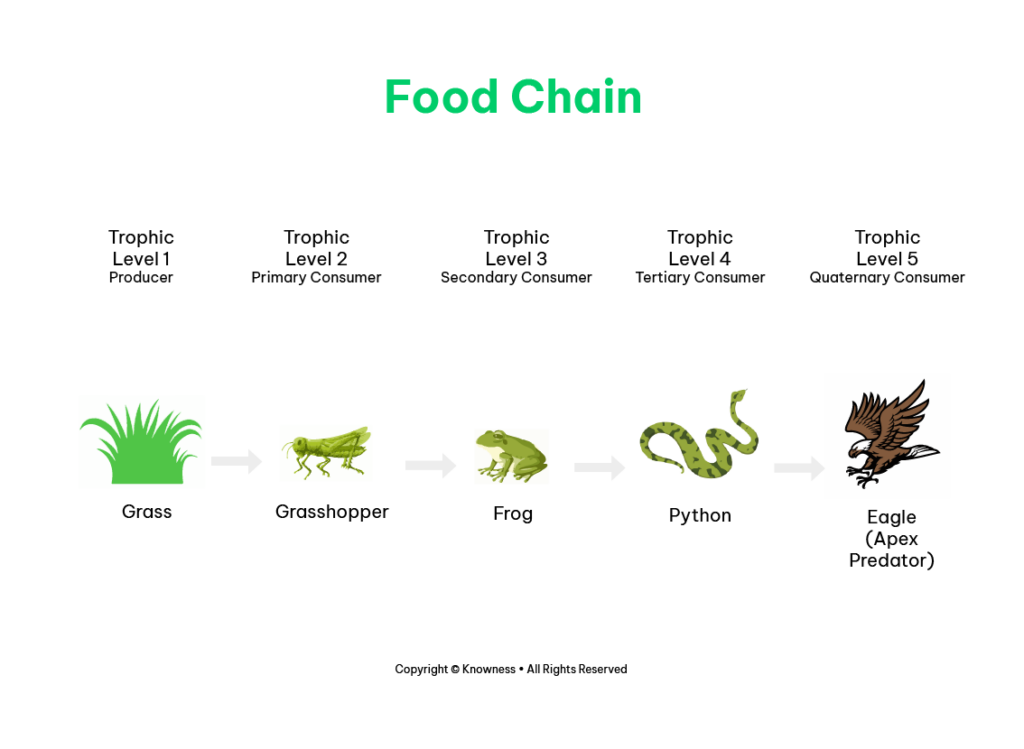
Feeding relationships in an ecosystem can be represented by food chains, which illustrate the transfer of energy and nutrients from one organism to another.
- All food chains begin with a producer, which is consumed by primary consumersIndividuals or households that buy and use goods and services to satisfy their needs and wants. (herbivores), which are in turn consumed by secondary consumers (carnivores or omnivores), and so on.
- Each step in a food chain is known as a trophic levelThe position an organism occupies in a food chain, influencing nitrogen isotope ratios., representing the position of an organism in the energy flow.
- Decomposers, such as bacteriaA single-celled prokaryotic microorganism. and fungi, play a crucial role in breaking down organic matter and returning nutrients to the environment, completing the cycle.
Determining Species Distribution and Abundance
Ecologists use various experimental methods to study the distribution and abundance of species within an ecosystem.
- Transects involve establishing a straight line across a habitat and recording the presence and abundance of species at regular intervals along the line.
- Quadrats are defined areas within a habitat where the types and numbers of organisms are counted and recorded.
- These methods provide data on species composition, population sizes, and patterns of distribution, helping ecologists understand the structureThe organisation and order of information in a text. and dynamics of ecosystems.
Abundance of Organisms
Abundance refers to the number of individuals or population size of a particular species in a given area or ecosystem. Measuring and understanding abundance provides insights into the distribution patterns, population dynamics, and ecological interactions within an ecosystem.
Descriptive Statistics
- Mean: The mean is a measure of central tendency that provides an average value of a set of data. To calculate the mean, add up all the values and divide by the total number of observations. The mean is influenced by extreme values, so it is important to consider the range and variability of the data.
- Mode: The mode is the value or values that occur most frequently in a dataset. It can help identify the most common or dominant characteristic in a population.
- Median: The median is the middle value in a dataset when the values are arranged in ascending or descending order. It is less influenced by extreme values compared to the mean and can provide a better representation of the typical value in a skewed dataset.
Calculation of Arithmetic Means
Arithmetic means can be calculated to determine the average abundance of organisms in a given ecosystem. To calculate the arithmetic mean, sum up the individual abundance values and divide by the total number of observations.
Graphical Representation
Graphs provide a visual representation of abundance data and facilitate the interpretation of trends and patterns.
- Depending on the nature of the data, different types of graphs can be used, such as bar graphs, line graphs, or histograms.
- Selecting appropriate scales for the axes is crucial to accurately represent the data and highlight any variations or trends.
Application and Analysis
Analysing and interpreting abundance data can reveal important information about the distribution and interactions of organisms within an ecosystem. It can help identify dominant species, assess population changes over time, and detect patterns related to environmental factors or ecological processes.
Trophic Levels
Trophic levels represent the different positions that organisms occupy in a food chain or food webA complex network of feeding relationships between organisms, used in isotope studies to trace dietary inputs. based on their source of energy and feeding relationships.
- The energy flow within an ecosystem starts with producers, which are autotrophic organisms capable of synthesising organic compounds through photosynthesis or chemosynthesis.
- Primary consumers are herbivores that feed directly on producers, obtaining energy from plant materials.
- Secondary consumers are carnivores or omnivores that feed on primary consumers, acquiring energy from consuming other organisms.
- Tertiary consumers are carnivores that feed on secondary consumers or other tertiary consumers.
Energy Flow
Energy flows through trophic levels in an ecosystem in a unidirectional manner.
- Producers capture solar energy and convert it into chemical energy stored in organic compounds through photosynthesis.
- Primary consumers obtain energy by consuming producers, converting plant material into their own biomass.
- Secondary consumers acquire energy by consuming primary consumers, transferring energy from herbivores to carnivores.
- Tertiary consumers feed on secondary consumers, representing the top predators in the food chain.
Food Chains and Food Webs
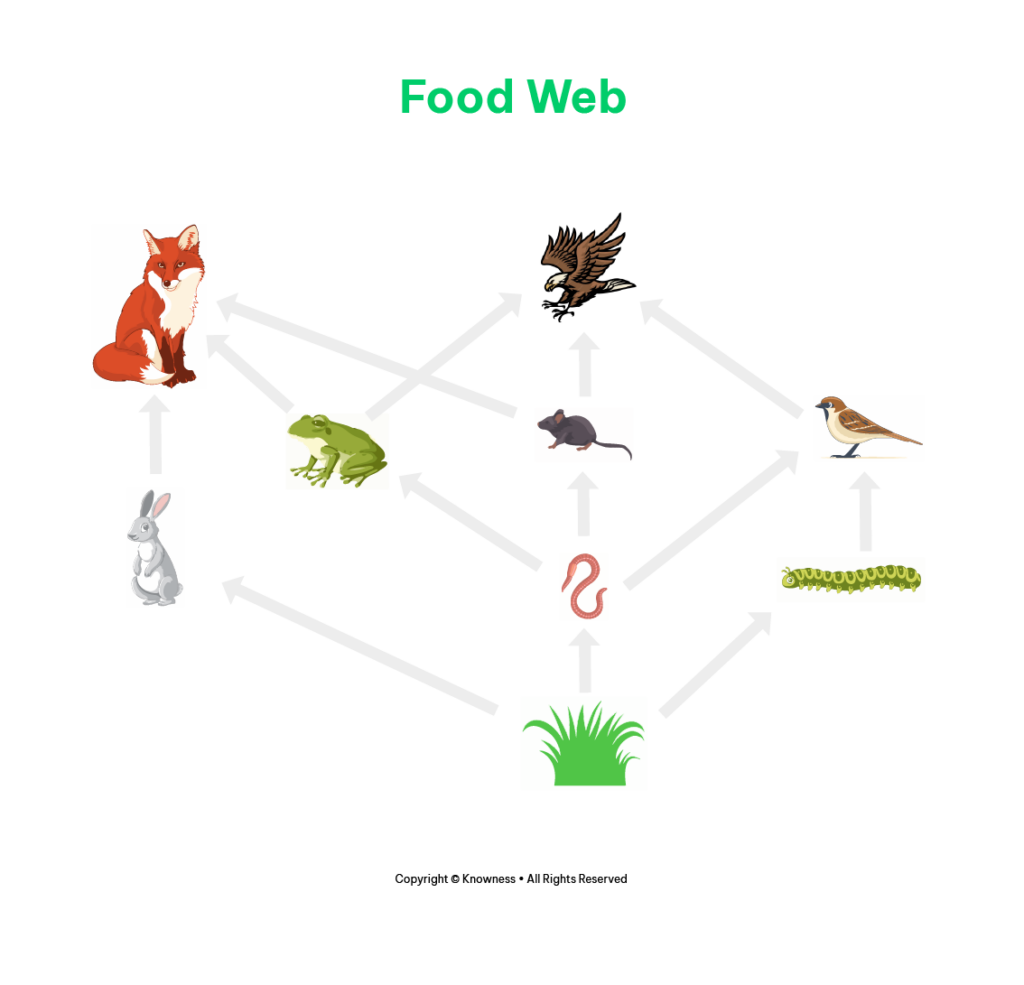
A food chain is a linear representation of the feeding relationships in an ecosystem, depicting the flow of energy from producers to consumers. However, most ecosystems have complex interactions and interconnected food chains, forming a food web.
A food web shows the intricate network of feeding relationships and energy flow among various species within an ecosystem.
Energy Transfer and Loss
- Energy is transferred from one trophic level to another, but not all energy is converted into biomass or available for consumption.
- The majority of energy is lost as heat through metabolic processes and other inefficiencies, limiting the amount of energy available to higher trophic levels.
- Consequently, the biomass and population sizes generally decrease as we move up the trophic levels.
Predator-Prey Relationships
Within an ecosystem, some organisms act as predators, while others serve as prey.
- Predators are consumers that actively hunt, kill, and feed on other animals to obtain energy and nutrients.
- Prey, on the other hand, are organisms that are hunted and consumed by predators.
Predator-prey relationships are vital ecological interactions that can influence population sizes and community structure.
Population Cycles
In a stable community, the populations of predators and prey often exhibit cyclical patterns. These population cycles involve fluctuations in the numbers of predators and prey over time.
- Initially, an increase in prey populations provides a larger food supply for predators, leading to an increase in the predator population.
- As the predator population grows, more prey individuals are consumed, causing the prey population to decline.
- With a reduction in available prey, predator populations also decrease due to limited food resourcesThe inputs used to produce goods and services, including the factors of production..
- As predator numbers decrease, the prey population can recover and begin to increase again, restarting the cycle.
Factors Influencing Predator-Prey Cycles
The predator-prey cycles are influenced by several factors, including the availability of food, predator efficiency, reproductive rates, and other ecological interactions.
- When prey populations are abundant, predators have more food available, leading to increased reproduction and population growth.
- As predator populations rise, they exert greater pressure on prey populations, causing prey numbers to decline.
- The decline in prey populations subsequently reduces the food supply for predators, resulting in a decrease in predator numbers.
Importance of Predator-Prey Cycles
Predator-prey cycles play a significant role in maintaining the balance and stability of ecosystems. By controlling prey populations, predators prevent excessive herbivory and help regulate the distribution and abundance of prey species. These cycles can also influence the behaviour and adaptations of both predators and prey, leading to evolutionary changes over time.
Conclusion
The levels of organisation in ecosystems provide a framework for understanding the intricate relationships and interactions between organisms and their environment. Producers, through photosynthesis, form the basis of biomass production and energy flow in ecosystems, with feeding relationships represented by food chains illustrating the transfer of energy and nutrients between trophic levels. Ecologists employ experimental methods like transects and quadrats to study species distribution and abundance. By studying ecosystems at different levels of organisation, including energy flow and predator-prey relationships, we gain valuable insights into the complexity and dynamics of ecological systems, enabling informed decisions about conservationThe professional care, preservation, and restoration of archaeological materials and sites, often requiring scientific expertise. and environmental management.