

GCSE
Biology
-
Introduction to GCSE Biology (AQA) Coming soon
-
1.1 Cell Structure
-
1.2 Cell Division Coming soon
-
1.3 Transport in Cells Coming soon
-
2.1 Principles of Organisation Coming soon
-
2.2 Animal Tissues, Organs and Organ Systems Coming soon
-
2.3 Plant Tissues, Organs and Systems Coming soon
-
3.1 Communicable Diseases Coming soon
-
3.2 Monoclonal Antibodies [HT] Coming soon
-
3.3 Plant Disease Coming soon
-
4.1 Photosynthesis Coming soon
-
4.2 Respiration Coming soon
-
5.1 Homeostasis Coming soon
-
5.2 The Human Nervous System Coming soon
-
5.3 Hormonal Coordination in Humans Coming soon
-
5.4 Plant Hormones Coming soon
-
6.1 Reproduction Coming soon
-
6.2 Variation and Evolution Coming soon
-
6.3 The Development of Understanding of Genetics and Evolution Coming soon
-
6.4 Classification of Living Organisms Coming soon
-
7.1 Adaptations, Interdependence and Competition Coming soon
-
7.2 Organisation of an Ecosystem Coming soon
-
7.3 Biodiversity and the Effect of Human Interaction on Ecosystems Coming soon
-
7.4 Trophic Levels in an Ecosystem Coming soon
-
7.5 Food Production Coming soon
1. Cell Biology
In this lesson, we will investigate cell specialisationThe development of specific structures in a cell to enable it to perform a particular function. and how different cells are adapted for specific functions. We will examine specialised animal cells such as sperm, nerve and muscle cells, and specialised plant cells including root hair, xylemPlant tissue that transports water and mineral ions from roots to the rest of the plant. and phloemPlant tissue that transports dissolved sugars around the plant. cells. We will link the structural features of these cells directly to their functions within tissues, organs and organA structure made of different tissues working together to perform a specific function. systems in multicellular organisms.
What is Cell Specialisation?
Cell specialisation is the process by which a cell develops particular structures that allow it to carry out a specific function. In multicellular organisms, cells become specialised so that the whole organism can function efficiently. Groups of specialised cells form tissues, tissues form organs, and organs work together in organ systems.
In exam answers, always link structure to function clearly. Write one clear sentence explaining how each adaptation helps the cell do its job. For example, “The flagellumA long tail-like structure that enables movement in some cells, such as sperm cells. provides propulsion, enabling the sperm to reach the egg.”Tip
Specialised Cells in Animals
In animals, specialised cells are adapted to carry out important functions necessary for survival, including reproduction, movement and communication. Specialised cells in animals include sperm cells, nerve cells, and muscle cells.
Think of a multicellular organism like a company. Each cell type is a specialist employee: muscle cells create movement, nerve cells send messages, and sperm cells deliver genetic information. All of them work together to keep the organism functioning.Analogy
Sperm Cells
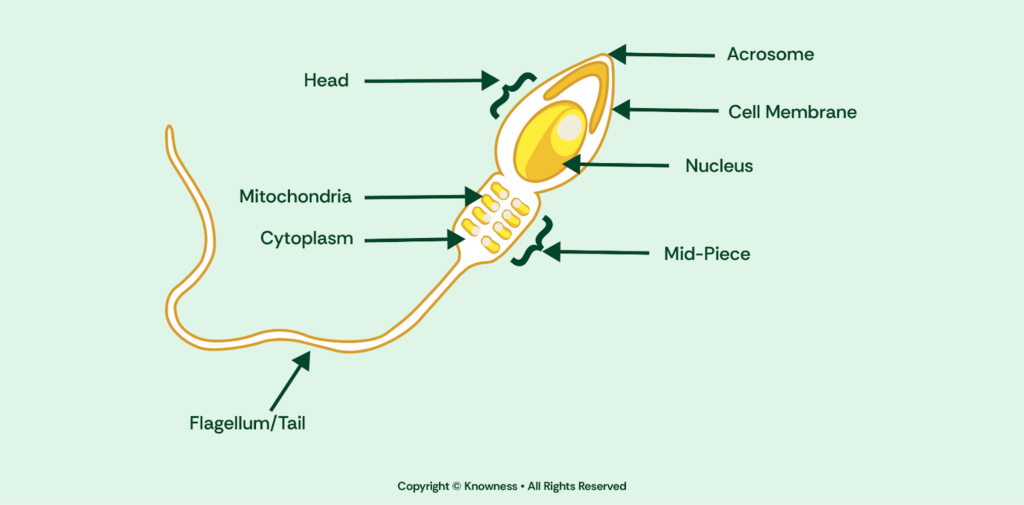
Sperm cells are specialised male reproductive cells designed to reach and fertilise an egg cell. A sperm cellA specialised male reproductive cell adapted to fertilise an egg. has several adaptations that increase the chance of fertilisation. It has a long tail called a flagellum, which allows it to swim towards the egg. The mid-piece contains many mitochondriaAn organelle where aerobic respiration occurs and energy is released. to release energy for movement. The head contains a nucleusA membrane-bound organelle in eukaryotic cells that contains DNA. with half of the genetic materialDNA that carries the instructions for cell structure and function. needed to form a new organism. At the tip of the head is the acrosome, which contains enzymes that help the sperm penetrate the outer layers of the egg.
The other half of the genetic material comes from the nucleus of the egg cell during fertilisation.Footnote
Nerve Cells
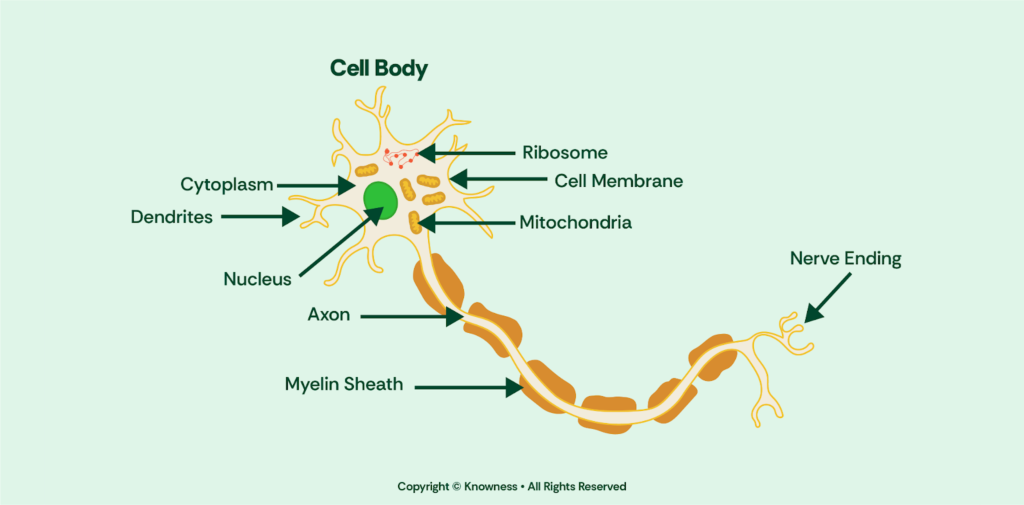
Nerve cells, also called neurons, are specialised cells that carry electrical impulses around the body. A nerve cellA specialised cell that transmits electrical impulses around the body. has a long extension called an axonA long extension of a neuron that carries electrical impulses away from the cell body., which allows electrical impulses to travel long distances. It also has branched endings called dendrites that allow it to connect to other nerve cells. The long structure of the neuronA specialised cell that transmits electrical impulses around the body. makes rapid communication possible between different parts of the body, enabling coordination and response to stimuli. Neurons are essential for sensory perception, movement, and overall coordination in the body.
Students sometimes confuse dendrites and axons. Dendrites receive signals, while the axon carries the impulse away from the cell body.Common Mistake
Muscle Cells
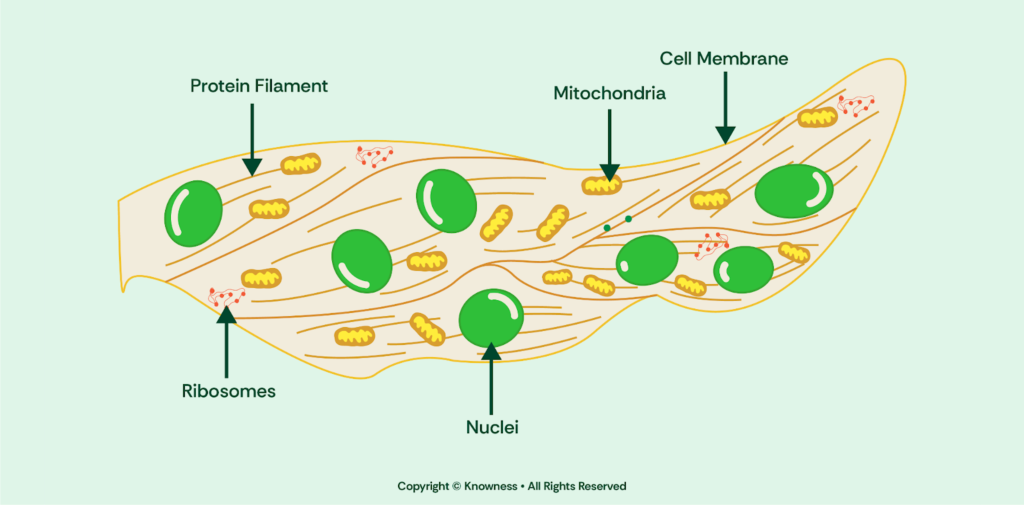
Muscle cells are specialised to contract and produce movement. Muscle cells are long and contain special protein filaments that can slide past each other, causing the cell to shorten. This shortening is called contraction and produces movement. Muscle cells contain many mitochondria to provide the energy needed for contraction. Many muscle fibres also contain multiple nuclei, which support the production of proteins required for repeated contraction.
Specialised Cells in Plants
Plants also contain specialised cells that allow them to absorb water and minerals and transport substances around the plant. This ensures the plant can grow, reproduce, and thrive in different environments. Specialised cells in plants include root hair cells, xylem cells, and phloem cells.
Root Hair Cells
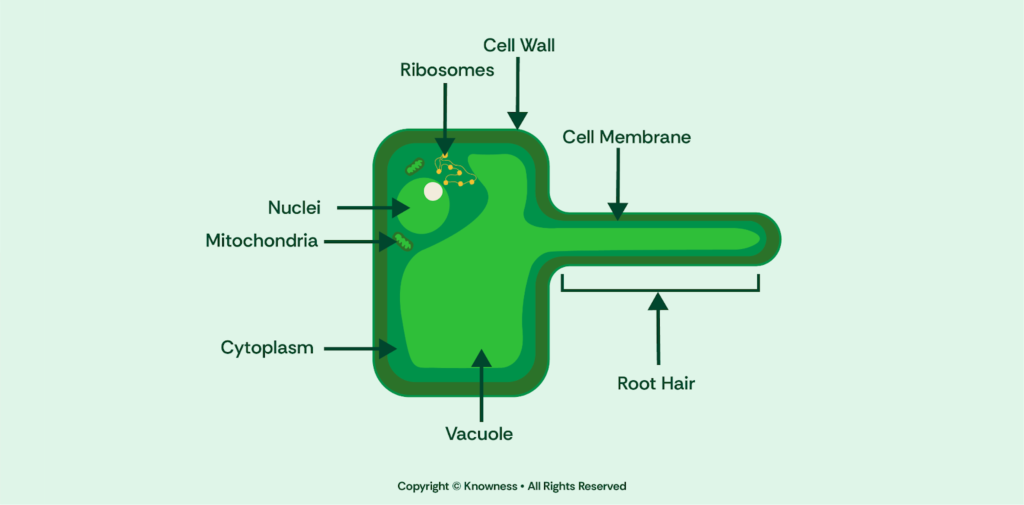
Root hair cells are specialised for absorbing water and mineral ions from the soil. A root hair cellA specialised plant cell adapted to absorb water and mineral ions from the soil. has a long projection (the root hair) that greatly increases its surface area, allowing more water and mineral ions to be absorbed. It has a thin cell wallA rigid outer layer that strengthens and supports the cell; made of cellulose in plants and peptidoglycan in bacteria. to reduce the distance substances must travel into the cell. A large vacuoleA fluid-filled space in plant cells that maintains internal pressure. helps maintain a concentration gradientA difference in concentration between two areas. for water movement by osmosisThe movement of water across a partially permeable membrane from a dilute solution to a more concentrated solution.. Root hair cells also contain many mitochondria to provide energy for the active transportThe movement of substances against a concentration gradient using energy from respiration. of mineral ions. They do not contain chloroplasts because they are found underground where there is no light.
Do not say that root hair cells absorb water by active transport. Water enters mainly by osmosis (which is covered in Lesson 1.3.2 Osmosis), while mineral ions may enter by active transport (which is covered in Lesson 1.3.3 Active Transport).Common Mistake
Xylem Cells
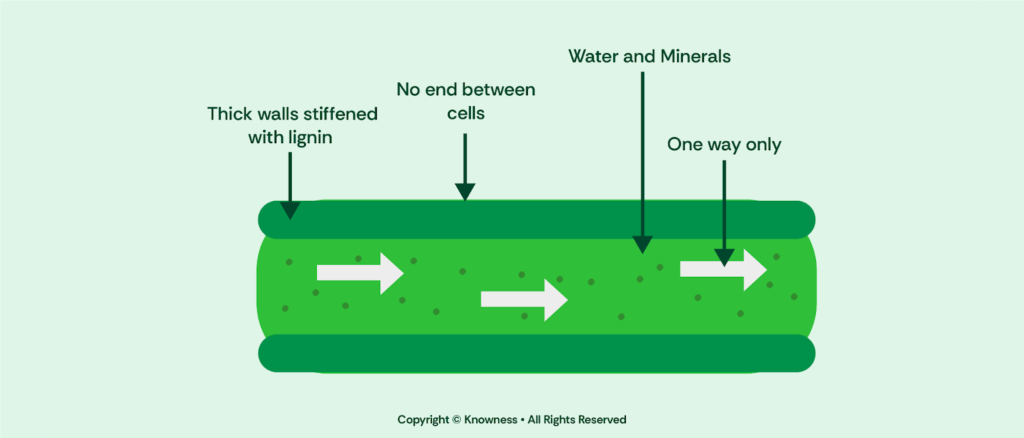
Xylem tissueA group of similar specialised cells working together to perform a function. is specialised for transporting water and mineral ions from the roots to the rest of the plant. Xylem vessels are made from cells that have lost their contents and become hollow tubes. The end walls break down so the cells form a continuous column. Their walls are thickened with lignin, which strengthens the vessel and prevents it from collapsing. This structure allows water to move upwards through the plant efficiently and also provides support.
Phloem Cells
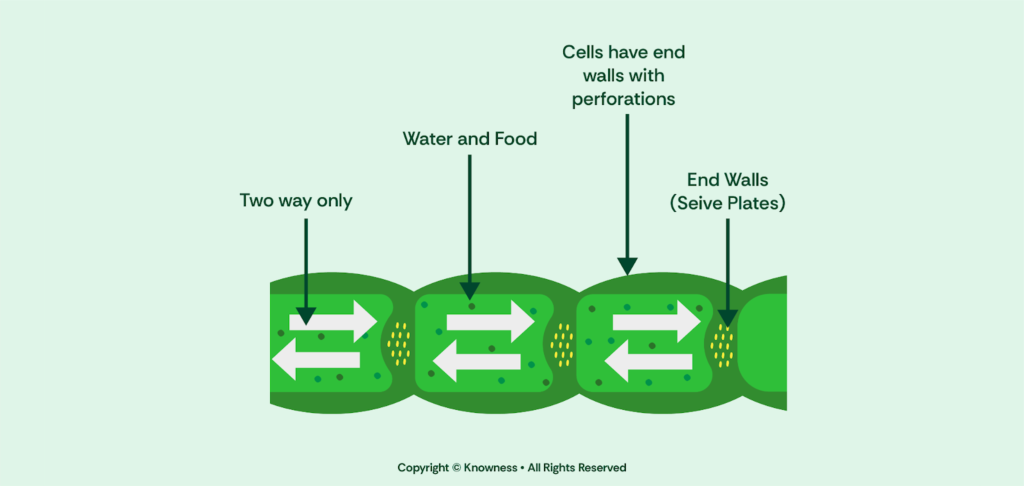
Phloem tissue is specialised for transporting dissolved sugars produced during photosynthesisThe process by which plants use light energy to produce glucose.. Phloem is made of living cells called sieve tube elements. These cells are arranged end to end, and their end walls form sieve plates that allow sap to flow between cells. Phloem transport sugars such as sucrose from the leaves to other parts of the plant where they are needed for growth or storage. Transport in the phloem can occur in both directions, depending on the plant’s needs.
Do not confuse xylem and phloem. Xylem transports water upwards only, while phloem transports sugars in both directions.Common Mistake
What is Cell Specialisation?
- Cell specialisation is the process by which a cell develops particular structures that allow it to carry out a specific function.
- In multicellular organisms, cells become specialised so that the whole organism can function efficiently.
- Groups of specialised cells form tissues, tissues form organs, and organs work together in organ systems.
Specialised Cells in Animals
- In animals, specialised cells are adapted to carry out functions necessary for survival, including reproduction, movement and communication.
- Specialised animal cells include sperm cells, nerve cells and muscle cells.
- Sperm cells are specialised male reproductive cells designed to reach and fertilise an egg cell.
- They have a long tail called a flagellum that allows them to swim towards the egg.
- The mid-piece contains many mitochondria to release energy for movement.
- The head contains a nucleus with half of the genetic material needed to form a new organism.
- The acrosome at the tip of the head contains enzymes that help the sperm penetrate the outer layers of the egg.
- Nerve cells (neurons) are specialised to carry electrical impulses around the body.
- They have a long extension called an axon that allows impulses to travel long distances.
- They have branched endings called dendrites that connect to other nerve cells.
- Their long structure allows rapid communication for coordination and response to stimuli.
- Muscle cells are specialised to contract and produce movement.
- They contain protein filaments that slide past each other, causing contraction.
- They contain many mitochondria to provide energy for contraction.
- Many muscle fibres contain multiple nuclei to support protein production for repeated contraction.
Specialised Cells in Plants
- Specialised plant cells allow plants to absorb water and minerals and transport substances around the plant, ensuring they can grow and reproduce.
- Specialised plant cells include root hair cells, xylem cells and phloem cells.
- Root hair cells are specialised for absorbing water and mineral ions from the soil.
- They have a long projection that increases surface area for absorption.
- They have a thin cell wall to reduce the distance substances travel into the cell.
- A large vacuole helps maintain a concentration gradient for water movement by osmosis.
- They contain many mitochondria to provide energy for active transport of mineral ions.
- They do not contain chloroplasts because they are underground and not exposed to light.
- Xylem tissue transports water and mineral ions from the roots to the rest of the plant.
- Xylem vessels are hollow tubes formed from cells that have lost their contents.
- The end walls break down to form a continuous column.
- The walls are thickened with lignin to strengthen the vessel and prevent collapse.
- Xylem also provides structural support.
- Phloem tissue transports dissolved sugars produced during photosynthesis.
- Phloem is made of living cells called sieve tube elements.
- Sieve plates in the end walls allow sap to flow between cells.
- Phloem transports sugars such as sucrose from the leaves to other parts of the plant.
- Transport in phloem can occur in both directions.