

GCSE
Biology
-
Introduction to GCSE Biology (AQA) Coming soon
-
1.1 Cell Structure
-
1.2 Cell Division Coming soon
-
1.3 Transport in Cells Coming soon
-
2.1 Principles of Organisation Coming soon
-
2.2 Animal Tissues, Organs and Organ Systems Coming soon
-
2.3 Plant Tissues, Organs and Systems Coming soon
-
3.1 Communicable Diseases Coming soon
-
3.2 Monoclonal Antibodies [HT] Coming soon
-
3.3 Plant Disease Coming soon
-
4.1 Photosynthesis Coming soon
-
4.2 Respiration Coming soon
-
5.1 Homeostasis Coming soon
-
5.2 The Human Nervous System Coming soon
-
5.3 Hormonal Coordination in Humans Coming soon
-
5.4 Plant Hormones Coming soon
-
6.1 Reproduction Coming soon
-
6.2 Variation and Evolution Coming soon
-
6.3 The Development of Understanding of Genetics and Evolution Coming soon
-
6.4 Classification of Living Organisms Coming soon
-
7.1 Adaptations, Interdependence and Competition Coming soon
-
7.2 Organisation of an Ecosystem Coming soon
-
7.3 Biodiversity and the Effect of Human Interaction on Ecosystems Coming soon
-
7.4 Trophic Levels in an Ecosystem Coming soon
-
7.5 Food Production Coming soon
1. Cell Biology
In this lesson, we will explore the structureThe organisation and order of information in a text. and functions of key regions of the brain, including the cerebral cortex, cerebellum, and medulla. We will also explore some of the difficulties encountered in studying the brain and treating brain disorders.
The Human Brain
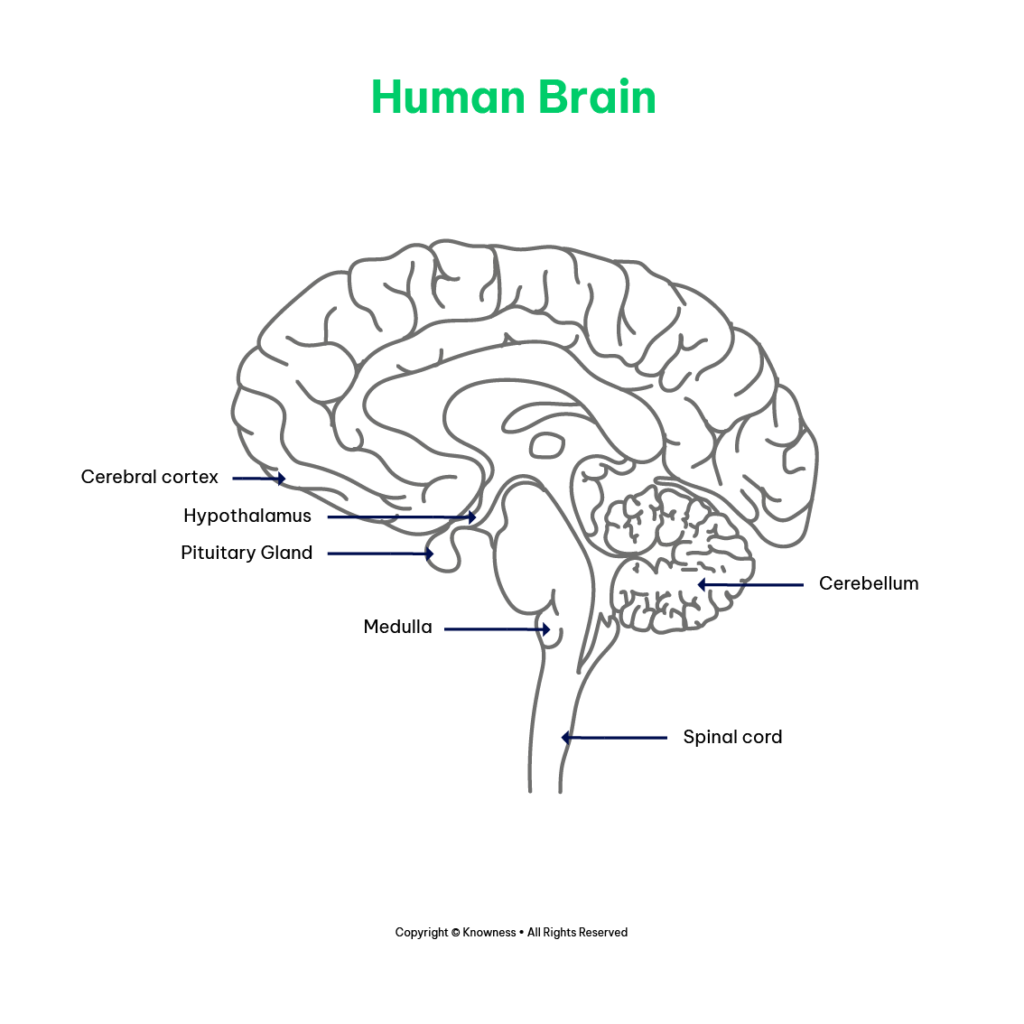
The human brain is an incredibly complex and remarkable organA structure made of different tissues working together to perform a specific function. that controls our thoughts, emotions, and behaviours. It is made up of billions of interconnected neurons and contains specialised regions that carry out specific functions.
Cerebral Cortex:
The cerebral cortex is the outer layer of the brain and is highly folded to increase its surface area. It is responsible for many higher-order functions, including sensory perception, voluntary movement, language, memoryA unified system that stores both data and program instructions in the same location., and conscious thought. The cerebral cortex is divided into two hemispheres (left and right) and is further subdivided into four lobes:
- Frontal lobe: Controls executive functions, decision-making, planningThe process of preparing ideas, structure, and possible answers before delivering the spoken presentation., and motor control.
- Parietal lobe: Processes sensory information, including touch, temperature, and pain.
- Temporal lobe: Involved in auditory processing, language comprehension, and memory.
- Occipital lobe: Processes visual information from the eyes.
Cerebellum:
The cerebellum is located at the back of the brain, beneath the cerebral hemispheres. It plays a crucial role in coordinating voluntary movements, balance, posture, and motor learning. The cerebellum receives sensory input from various parts of the body and integrates it to ensure smooth and coordinated movements.
Medulla:
The medulla, also known as the medulla oblongata, is located at the base of the brainstem.
It controls essential functions for survival, such as regulating breathing, heart rate, blood pressure, and reflexes like swallowing and coughing. The medulla connects the brain to the spinal cord and serves as a relay station for signals travelling between the brain and the rest of the body.
Mapping Brain Function (HT only)
Investigating brain function involves understanding how different regions of the brain are responsible for specific functions. Neuroscientists have made significant progress in mapping brain functions by studying patients with brain damage. By observing changes in behaviour and cognitive abilities resulting from specific brain injuries, they can link damaged areas to impaired functions.
Another methodHow a writer presents perspective or viewpoint through language/structure. used is electrically stimulating different parts of the brain to observe the effects on behaviour and cognitive processes. Advanced imaging techniques, such as magnetic resonance imaging (MRI), provide detailed images of the brain's structure and can help identify abnormalities or damaged areas.
Complexity of the Brain (HT only)
The brain is a highly complex organ composed of billions of neurons and intricate networks of connections. Each region of the brain can have multiple functions, and many functions involve the interaction of multiple brain regions.
The brain's plasticity, its ability to reorganise and adapt, can complicate the understanding of specific functions and the impact of brain damage. The delicate nature of the brain poses challenges in investigating its function, as even minor damage or disruption to neural pathways can have significant effects on overall brain function.
Treating Brain Disorders (HT only)
Treating brain disorders and injuries is complex due to the brain's intricate structure and the potential for long-term consequences. Many brain disorders, such as neurodegenerative diseases or psychiatric disorders, have multifactorial causes, making treatment challenging.
Developing effective treatments often requires a deep understanding of the underlying mechanisms of the disorder, which is still an ongoing area of research. The blood-brain barrier, a protective mechanism that prevents many substances from freely entering the brain, can limit the delivery of medications to the affected areas.
Conclusion
The brain is a complex and intricate organ that controls our behaviour and allows us to interact with the world around us. It consists of interconnected neurons and contains specialised regions with specific functions. The cerebral cortex plays a crucial role in higher-order cognitive functions, while the cerebellum is responsible for coordinating movements and maintaining balance. The medulla controls vital functions necessary for our survival. Neuroscientists have made significant progress in mapping brain functions and understanding the complexities of the brain's structure and functions. However, the intricate nature of the brain, its plasticity, and the difficulties in delivering treatments pose ongoing challenges.
Continue the lesson
This section is available to learners with course access. Continue learning with Knowness to unlock the full explanation, examples, revision tools, and progress tracking.
The remaining lesson content includes further guided explanation, important learning points, and supporting interactive material designed to help you understand and revise this topic.
Unlock this topic to view the full activity, worked examples, common mistakes, and additional revision support.
More content available
Knowness lessons are structured to build understanding step by step. Create an account or upgrade your access to continue from this point.
This preview does not include the hidden lesson text, answers, explanations, or embedded interactions.
Continue learning with Knowness
Sign up to access the full lesson, predicted grades, revision tools, progress tracking, and more.
Create a free account