

GCSE
Biology
-
Introduction to GCSE Biology (AQA) Coming soon
-
1.1 Cell Structure
-
1.2 Cell Division Coming soon
-
1.3 Transport in Cells Coming soon
-
2.1 Principles of Organisation Coming soon
-
2.2 Animal Tissues, Organs and Organ Systems Coming soon
-
2.3 Plant Tissues, Organs and Systems Coming soon
-
3.1 Communicable Diseases Coming soon
-
3.2 Monoclonal Antibodies [HT] Coming soon
-
3.3 Plant Disease Coming soon
-
4.1 Photosynthesis Coming soon
-
4.2 Respiration Coming soon
-
5.1 Homeostasis Coming soon
-
5.2 The Human Nervous System Coming soon
-
5.3 Hormonal Coordination in Humans Coming soon
-
5.4 Plant Hormones Coming soon
-
6.1 Reproduction Coming soon
-
6.2 Variation and Evolution Coming soon
-
6.3 The Development of Understanding of Genetics and Evolution Coming soon
-
6.4 Classification of Living Organisms Coming soon
-
7.1 Adaptations, Interdependence and Competition Coming soon
-
7.2 Organisation of an Ecosystem Coming soon
-
7.3 Biodiversity and the Effect of Human Interaction on Ecosystems Coming soon
-
7.4 Trophic Levels in an Ecosystem Coming soon
-
7.5 Food Production Coming soon
1. Cell Biology
4.1.2 Rate of Photosynthesis
In this lesson, we will explore the effects of temperature, light intensity, carbon dioxide concentration, and the amount of chlorophyllA green pigment found in chloroplasts that absorbs light energy for photosynthesis. on the rate of photosynthesisThe process by which plants use light energy to produce glucose.. We will also explore the concept of inverse proportion and the role of limiting factors.
Temperature
Photosynthesis rates increase with temperature until reaching an optimal range. Each plant species has a specific temperature range at which photosynthesis is most efficient. Enzymes involved in photosynthesis work optimally within certain temperature ranges.
Temperature Extremes:
- At temperatures below the optimal range, photosynthesis slows down.
- Low temperatures can decrease enzymeA biological catalyst that speeds up chemical reactions in cells. activity, limiting the production of ATP and NADPH, which are necessary for photosynthesis.
- At temperatures above the optimal range, photosynthesis may decrease due to enzyme denaturation.
Light Intensity
Light is the primary source of energy for photosynthesis. Increased light intensity generally leads to higher photosynthesis rates, up to a certain threshold.
- The light saturation point is the point at which further increases in light intensity do not increase the photosynthesis rate.
- At this point, other factors, such as temperature or carbon dioxide concentration, become limiting factors.
Carbon Dioxide Concentration
Carbon dioxide (CO2) is an essential raw material for photosynthesis. Higher concentrations of CO2 generally result in increased photosynthesis rates, up to a certain point.
- If CO2 concentration is low, photosynthesis may be limited even if other factors such as temperature and light intensity are optimal.
- In certain environments, such as closed spaces or dense vegetation, CO2 availability can become a limiting factor.
Chlorophyll Amount
Chlorophyll is a pigment essential for capturing light energy during photosynthesis. Higher chlorophyll content generally correlates with increased photosynthesis rates.
Factors Affecting Chlorophyll Amount:
- Adequate nitrogen supply promotes chlorophyll production.
- Environmental stressors, such as nutrient deficiencies or diseases, can decrease chlorophyll content, reducing photosynthetic efficiency.
Inverse Proportion and the Inverse Square Law (HT only)
Inverse proportion is a relationship in which one variable increases while the other decreases at a proportional rate. In the contextA discrete unit of archaeological evidence, such as a layer of soil, a structure, or a feature, that can be recorded and interpreted. of photosynthesis, the relationship between light intensity and the rate of photosynthesis follows inverse proportion.
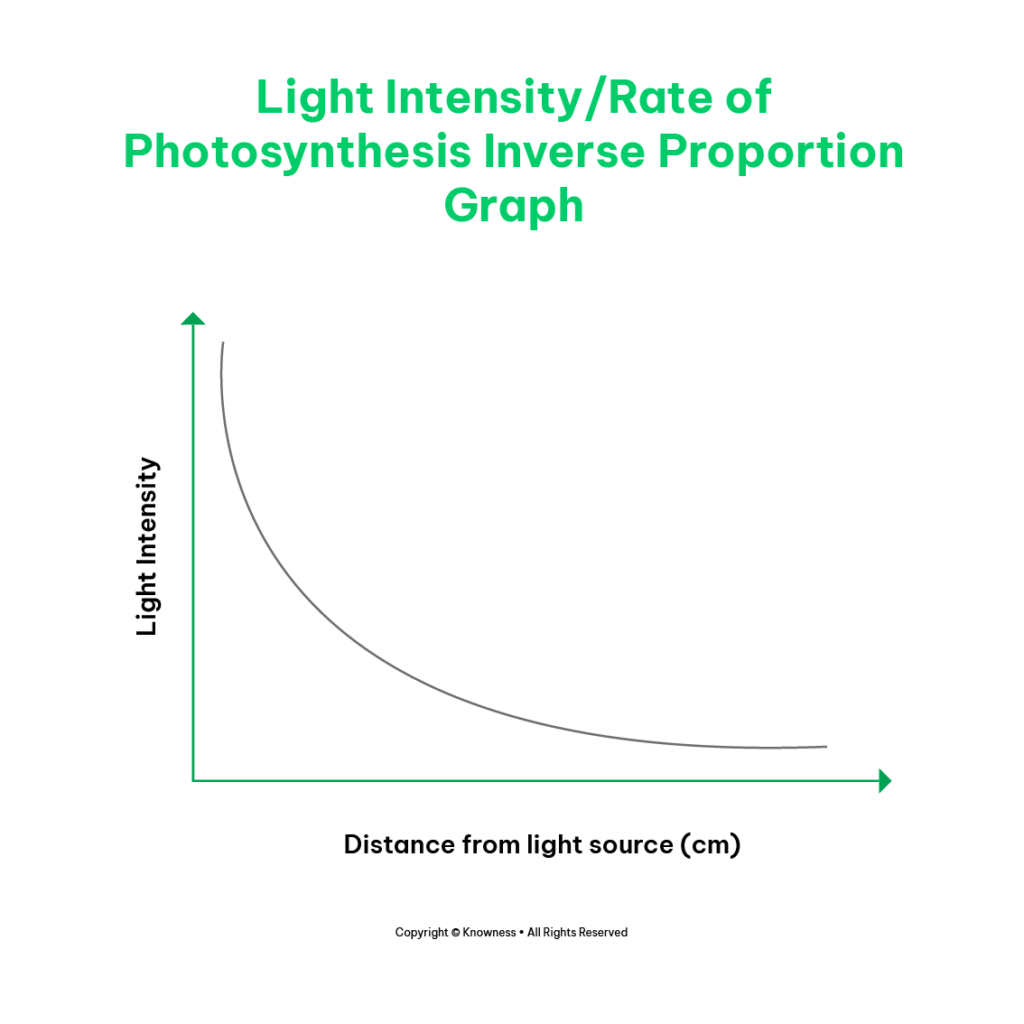
The Inverse Square Law:
- The inverse square law states that the intensity of light decreases as the square of the distance from the source increases.
- This law applies to light intensity, which affects the rate of photosynthesis.
Light Intensity as a Limiting Factor (HT only)
Light is a crucial factor in photosynthesis as it provides the energy needed for the process. Light intensity influences the rate of photosynthesis, but only up to a certain point.
Limiting factors are the factors that restrict or limit the rate of photosynthesis when they are not available in sufficient quantities. Light intensity can become a limiting factor if it falls below a certain threshold. Other limiting factors include carbon dioxide concentration and temperature.
Economics of Enhancing Conditions in Greenhouses (HT only)
Greenhouses provide controlled environments to optimise conditions for plant growth, including photosynthesis. Artificial lighting systems are used to supplement natural light and maintain optimal light intensity.
Maximising Photosynthetic Efficiency:
- Greenhouse operators aim to maximise the rate of photosynthesis to enhance plant growth and yield.
- This involves adjusting factors such as light intensity, temperature, and carbon dioxide levels to minimise limiting factors.
Balancing Profitability and Optimal Conditions:
- Greenhouse operators must consider the cost of enhancing conditions and the potential increase in productivity.
- They aim to find the optimal balance between the cost of energy, equipment, and resourcesThe inputs used to produce goods and services, including the factors of production. used and the resulting economic benefits.
Conclusion
The rate of photosynthesis is influenced by temperature, light intensity, carbon dioxide concentration, and the amount of chlorophyll. Each of these factors has an optimal range at which photosynthesis is most efficient. By maintaining suitable conditions for photosynthesis, we can enhance plant growth, crop yields, and the overall efficiency of energy conversionThe act of changing someone's religion. in the ecosystem. Understanding the principles of inverse proportion and the role of limiting factors in photosynthesis is crucial for maximising productivity in greenhouses. By applying the inverse square law and considering factors such as light intensity, temperature, and carbon dioxide concentration, greenhouse operators can create optimal conditions for photosynthesis.
Continue the lesson
This section is available to learners with course access. Continue learning with Knowness to unlock the full explanation, examples, revision tools, and progress tracking.
The remaining lesson content includes further guided explanation, important learning points, and supporting interactive material designed to help you understand and revise this topic.
Unlock this topic to view the full activity, worked examples, common mistakes, and additional revision support.
More content available
Knowness lessons are structured to build understanding step by step. Create an account or upgrade your access to continue from this point.
This preview does not include the hidden lesson text, answers, explanations, or embedded interactions.
Continue learning with Knowness
Sign up to access the full lesson, predicted grades, revision tools, progress tracking, and more.
Create a free account