

General
Chemistry
-
1. Introduction to Physical Sciences
-
Introduction to Chemistry
-
History of Chemistry
-
Fundamentals of Chemistry
-
Atomic Structure
-
Stoichiometry
-
Thermochemistry
-
Gas Laws
-
Quantum Mechanics and the Electronic Structure of Atoms
-
Periodic Trends
-
Bonding
-
Solutions
-
Acids and Bases
-
Redox Reactions
-
Organic Chemistry
-
Biochemistry
-
Future of Chemistry
-
Careers in Chemistry
Legacy Course
Electrochemistry and Galvanic Cells
Electrochemistry is the study of the relationship between electricity and chemical reactions, and it is an important branch of chemistry. Galvanic cells are devices that are used to generate electricity by means of a chemical reaction, and they are an important application of electrochemistry.
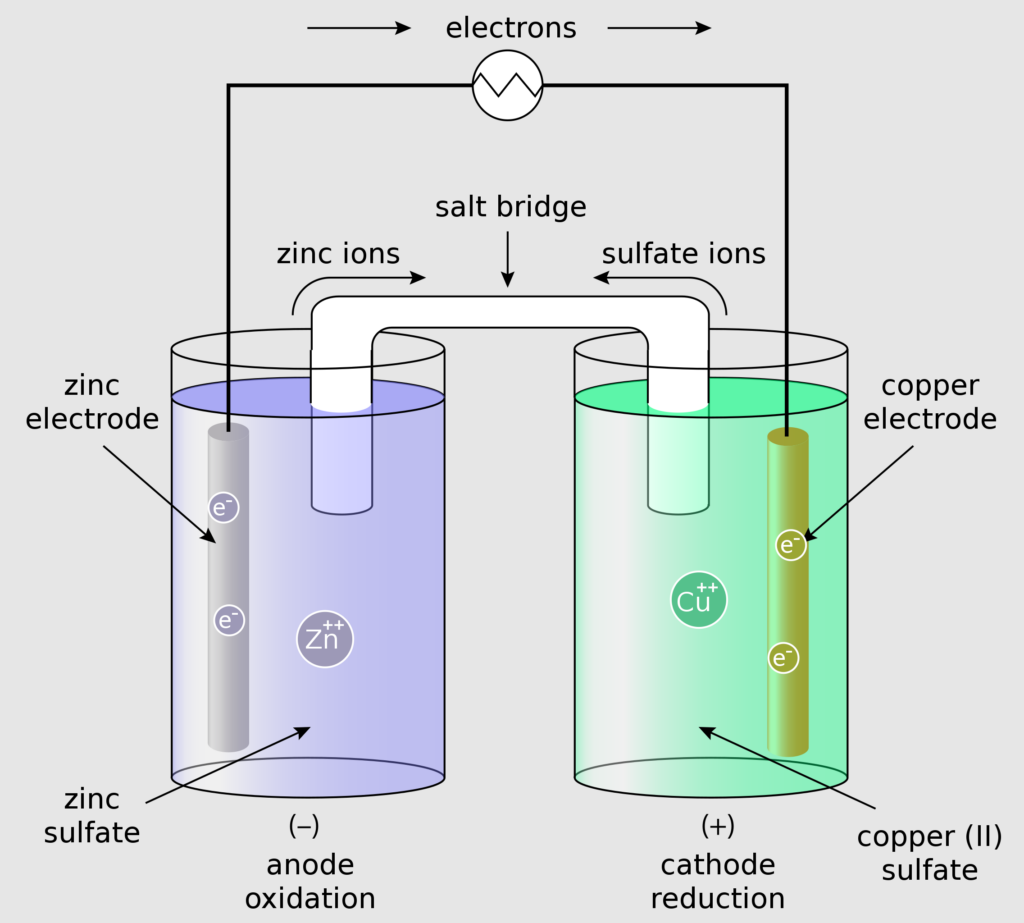
This file is licensed under the Creative Commons Attribution 3.0 Unported license.
A galvanic cell consists of two half-cells, one for the oxidation half-reaction and one for the reduction half-reaction. The two half-cells are separated by a salt bridge, which allows the ions to flow between the half-cells and complete the circuit.
The flow of ions between the half-cells generates an electric current, which can be used to do work or power electrical devices. The voltage generated by a galvanic cell is determined by the difference in the standard reduction potentials of the two half-reactions, and it is a measure of the potential energy difference between the two half-cells.
The efficiency of a galvanic cell is determined by its electromotive force (EMF), which is the maximum potential difference that can be produced by the cell. The EMF of a galvanic cell can be calculated using the Nernst equation, which takes into account the concentration of the reactants and products in the half-cells.
Galvanic cells are used in a variety of applications, including batteries, fuel cells, and solar cells. They are an important source of electrical energy, and they are used in a wide range of technologies and industries.
Continue the lesson
This section is available to learners with course access. Continue learning with Knowness to unlock the full explanation, examples, revision tools, and progress tracking.
The remaining lesson content includes further guided explanation, important learning points, and supporting interactive material designed to help you understand and revise this topic.
Unlock this topic to view the full activity, worked examples, common mistakes, and additional revision support.
More content available
Knowness lessons are structured to build understanding step by step. Create an account or upgrade your access to continue from this point.
This preview does not include the hidden lesson text, answers, explanations, or embedded interactions.
Continue learning with Knowness
Sign up to access the full lesson, predicted grades, revision tools, progress tracking, and more.
Create a free account