

General
Chemistry
-
1. Introduction to Physical Sciences
-
Introduction to Chemistry
-
History of Chemistry
-
Fundamentals of Chemistry
-
Atomic Structure
-
Stoichiometry
-
Thermochemistry
-
Gas Laws
-
Quantum Mechanics and the Electronic Structure of Atoms
-
Periodic Trends
-
Bonding
-
Solutions
-
Acids and Bases
-
Redox Reactions
-
Organic Chemistry
-
Biochemistry
-
Future of Chemistry
-
Careers in Chemistry
Legacy Course
The Periodic Table and its Organization
The periodic table is a chart that shows the chemical elements organized according to their properties. The periodic table is organized into rows and columns, and each element is represented by a symbol and a name. The elements are arranged in order of increasing atomic number, which is the number of protons in the nucleusA membrane-bound organelle in eukaryotic cells that contains DNA. of the atom.
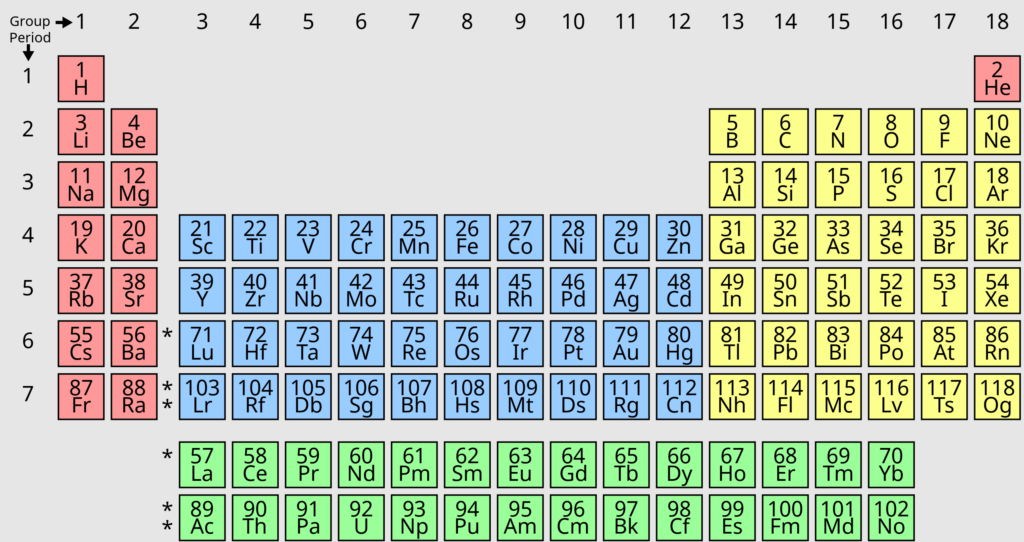
This file is licensed under the Creative Commons Attribution-Share Alike 4.0 International license.
The periodic table is an important tool for understanding the chemical properties of the elements, and it is used to predict the behavior of the elements in chemical reactions. The elements on the periodic table are arranged in a way that reflects their chemical and physical properties, and this arrangement is based on the structureThe organisation and order of information in a text. of the atoms and their electronic configurations.
The periodic table is divided into 18 vertical columns, called groups, and 7 horizontal rows, called periods. The groups are numbered from 1 to 18, and they are designated by the letters A through G. The periods are numbered from 1 to 7, and they are designated by the Roman numerals I through VII.
The elements in each group have similar properties, and the elements in each period have similar electron configurations. For example, the elements in group 1 are called the alkali metals, and they are characterized by having one valence electron. The elements in group 17 are called the halogens, and they are characterized by having seven valence electrons. The elements in period 2 have two electron shells, and the elements in period 3 have three electron shells, etc.
The periodic table also includes several special categories of elements, such as the noble gases, which are located in group 18, and the transition metalsGet their name from the fact that they sit in the d-block in between the highly reactive s-block and less reactive p-block., which are located in the center of the periodic table. The noble gases are characterized by their low reactivity and their stable electron configurations, and the transition metals are characterized by their ability to form multiple ions and by their diverse chemical properties.
Continue the lesson
This section is available to learners with course access. Continue learning with Knowness to unlock the full explanation, examples, revision tools, and progress tracking.
The remaining lesson content includes further guided explanation, important learning points, and supporting interactive material designed to help you understand and revise this topic.
Unlock this topic to view the full activity, worked examples, common mistakes, and additional revision support.
More content available
Knowness lessons are structured to build understanding step by step. Create an account or upgrade your access to continue from this point.
This preview does not include the hidden lesson text, answers, explanations, or embedded interactions.
Continue learning with Knowness
Sign up to access the full lesson, predicted grades, revision tools, progress tracking, and more.
Create a free account