

General
Chemistry
-
1. Introduction to Physical Sciences
-
Introduction to Chemistry
-
History of Chemistry
-
Fundamentals of Chemistry
-
Atomic Structure
-
Stoichiometry
-
Thermochemistry
-
Gas Laws
-
Quantum Mechanics and the Electronic Structure of Atoms
-
Periodic Trends
-
Bonding
-
Solutions
-
Acids and Bases
-
Redox Reactions
-
Organic Chemistry
-
Biochemistry
-
Future of Chemistry
-
Careers in Chemistry
Legacy Course
Atomic Spectra and the Bohr Model
Atomic spectra are the characteristic patterns of electromagnetic radiation (light) emitted or absorbed by atoms. These spectra can be used to identify the elements present in a sample, and they are an important tool in chemistry and physics.

The Bohr model of the atom is a model developed by Niels Bohr that explains the emission and absorption of electromagnetic radiation by atoms. It is based on the idea that the electrons in an atom are confined to specific energy levels or shells around the nucleusA membrane-bound organelle in eukaryotic cells that contains DNA., and that they can only transition between these energy levels by absorbing or emitting electromagnetic radiation. The energy of the emitted or absorbed radiation is determined by the energy difference between the energy levels of the electron.
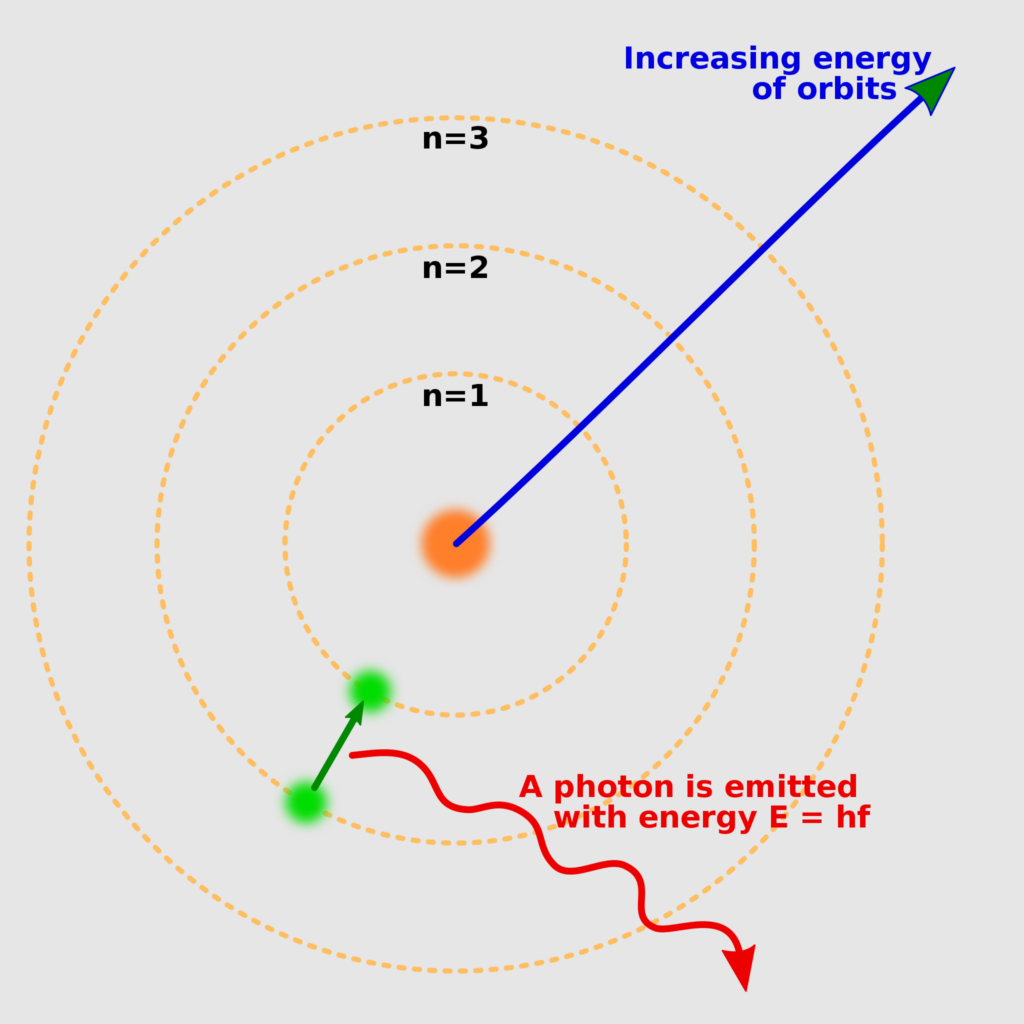
This file is licensed under the Creative Commons Attribution-Share Alike 3.0 Unported license.
The Bohr model was able to explain many of the observed features of atomic spectra, including the discrete lines and series that are observed in the spectra of different elements. It was a significant advancement in our understanding of the atom and its behavior, and it laid the foundations for the development of quantum mechanicsThe theory used to describe the behaviour of very small particles (atomic and subatomic level). Unlike classical physics which is deterministic, quantum mechanics is a probabilistic theory., which is a more sophisticated and accurate theory of the atom and its structureThe organisation and order of information in a text..
However, the Bohr model has been largely superseded by more advanced models that are based on quantum mechanics, and it is now mainly used as a conceptual tool to understand the behavior of atoms and their interactions with electromagnetic radiation.
Continue the lesson
This section is available to learners with course access. Continue learning with Knowness to unlock the full explanation, examples, revision tools, and progress tracking.
The remaining lesson content includes further guided explanation, important learning points, and supporting interactive material designed to help you understand and revise this topic.
Unlock this topic to view the full activity, worked examples, common mistakes, and additional revision support.
More content available
Knowness lessons are structured to build understanding step by step. Create an account or upgrade your access to continue from this point.
This preview does not include the hidden lesson text, answers, explanations, or embedded interactions.
Continue learning with Knowness
Sign up to access the full lesson, predicted grades, revision tools, progress tracking, and more.
Create a free account