

General
Chemistry
-
1. Introduction to Physical Sciences
-
Introduction to Chemistry
-
History of Chemistry
-
Fundamentals of Chemistry
-
Atomic Structure
-
Stoichiometry
-
Thermochemistry
-
Gas Laws
-
Quantum Mechanics and the Electronic Structure of Atoms
-
Periodic Trends
-
Bonding
-
Solutions
-
Acids and Bases
-
Redox Reactions
-
Organic Chemistry
-
Biochemistry
-
Future of Chemistry
-
Careers in Chemistry
Legacy Course
The Wave-Particle Duality of Matter
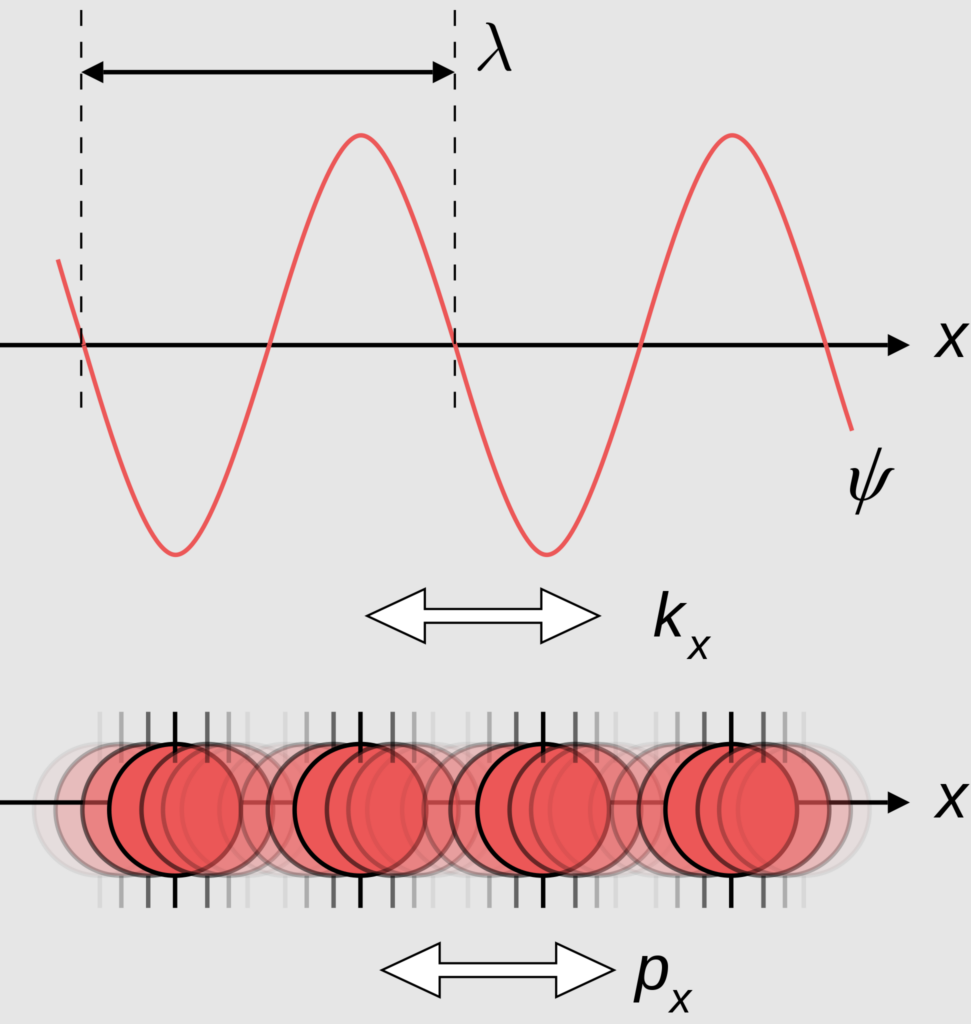
The wave-particle duality of matter is a fundamental principle in quantum mechanicsThe theory used to describe the behaviour of very small particles (atomic and subatomic level). Unlike classical physics which is deterministic, quantum mechanics is a probabilistic theory., the branch of physics that describes the behavior of matter at the atomic and subatomic level. It was first proposed by Louis de Broglie in the early 20th century and was later confirmed through a series of experiments.

This file is licensed under the Creative Commons Attribution-Share Alike 3.0 Unported license.
It states that particles of matter, such as electrons and atoms, can exhibit both wave-like and particle-like properties. This means that particles can behave like waves, with properties such as frequency, wavelength, and interference, as well as like particles, with properties such as mass and energy.
Continue the lesson
This section is available to learners with course access. Continue learning with Knowness to unlock the full explanation, examples, revision tools, and progress tracking.
The remaining lesson content includes further guided explanation, important learning points, and supporting interactive material designed to help you understand and revise this topic.
Unlock this topic to view the full activity, worked examples, common mistakes, and additional revision support.
More content available
Knowness lessons are structured to build understanding step by step. Create an account or upgrade your access to continue from this point.
This preview does not include the hidden lesson text, answers, explanations, or embedded interactions.
Continue learning with Knowness
Sign up to access the full lesson, predicted grades, revision tools, progress tracking, and more.
Create a free account