

GCSE
Biology
-
Introduction to GCSE Biology (AQA) Coming soon
-
1.1 Cell Structure
-
1.2 Cell Division Coming soon
-
1.3 Transport in Cells Coming soon
-
2.1 Principles of Organisation Coming soon
-
2.2 Animal Tissues, Organs and Organ Systems Coming soon
-
2.3 Plant Tissues, Organs and Systems Coming soon
-
3.1 Communicable Diseases Coming soon
-
3.2 Monoclonal Antibodies [HT] Coming soon
-
3.3 Plant Disease Coming soon
-
4.1 Photosynthesis Coming soon
-
4.2 Respiration Coming soon
-
5.1 Homeostasis Coming soon
-
5.2 The Human Nervous System Coming soon
-
5.3 Hormonal Coordination in Humans Coming soon
-
5.4 Plant Hormones Coming soon
-
6.1 Reproduction Coming soon
-
6.2 Variation and Evolution Coming soon
-
6.3 The Development of Understanding of Genetics and Evolution Coming soon
-
6.4 Classification of Living Organisms Coming soon
-
7.1 Adaptations, Interdependence and Competition Coming soon
-
7.2 Organisation of an Ecosystem Coming soon
-
7.3 Biodiversity and the Effect of Human Interaction on Ecosystems Coming soon
-
7.4 Trophic Levels in an Ecosystem Coming soon
-
7.5 Food Production Coming soon
1. Cell Biology
5.3.1 Human Endocrine System
In this lesson, we will explore the principles of hormonal coordination and control by the human endocrine system.
The Endocrine System
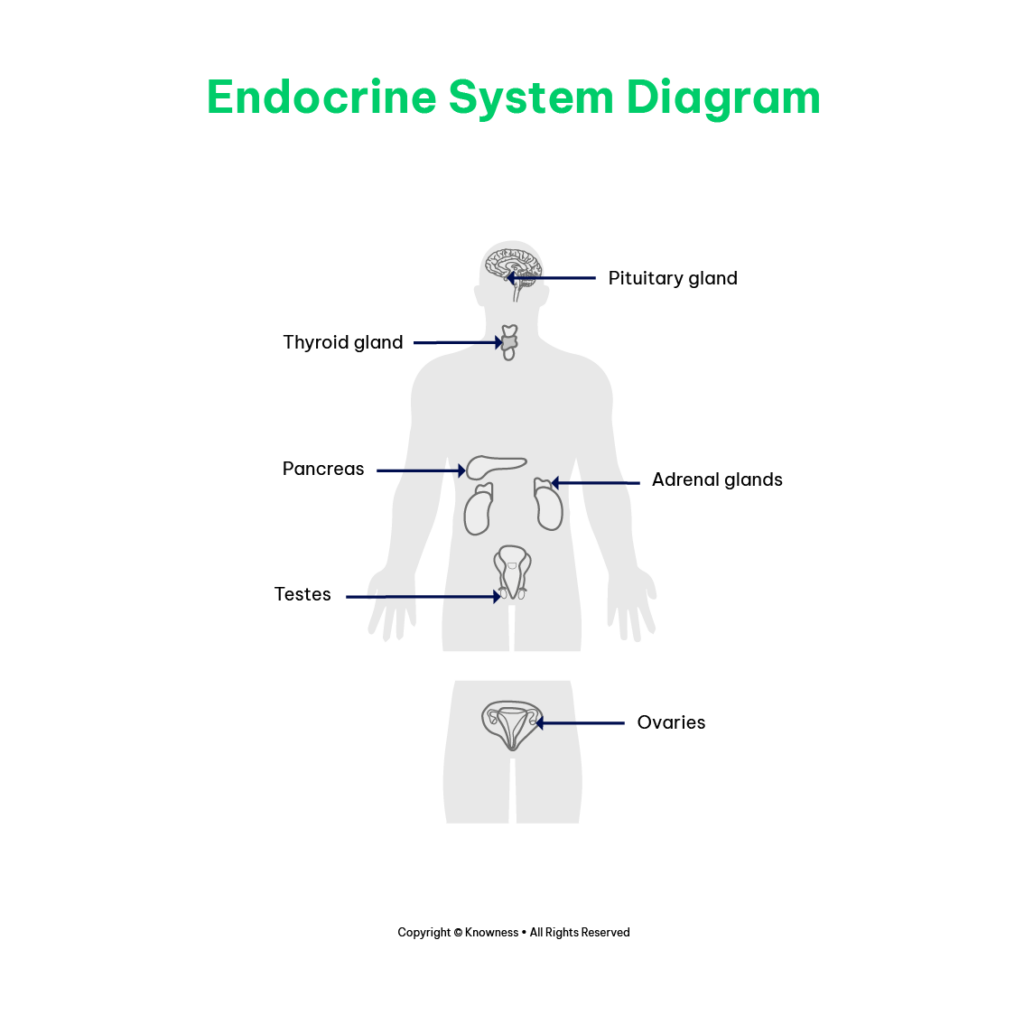
The endocrine system plays a crucial role in regulating various processes in the body through the secretion of hormones. These hormones are chemical messengers that are released into the bloodstream and act on target organs to produce specific effects. Compared to the nervous system, the endocrine system's effects are slower but last for a longer duration.
Pituitary Gland:
The pituitary gland, located in the brain, is often referred to as the "master gland" because it controls the functioning of several other endocrine glands. The pituitary gland secretes various hormones in response to signals from the hypothalamus, a region of the brain that acts as a control centre for many bodily functions. These hormones released by the pituitary gland act on other glands in the body, stimulating them to produce and release their own hormones.
Pancreas:
The pancreas is both an exocrine gland (secretes digestive enzymes) and an endocrine gland (secretes hormones). The endocrine portion of the pancreas is responsible for producing and releasing two important hormones: insulin and glucagon.
- Insulin helps regulate blood glucose levels by facilitating the uptake of glucose by cells, thereby lowering blood sugar levels.
- Glucagon, on the other hand, stimulates the liver to release stored glucose into the bloodstream, raising blood sugar levels when needed.
Thyroid:
The thyroid gland, located in the neck, produces hormones that regulate metabolismChemical reactions within a cell allowing microorganisms to maintain themselves and multiply., growth, and development. The main hormone produced by the thyroid gland is thyroxine (T4), which plays a crucial role in maintaining the body's metabolic rate. Another hormone produced by the thyroid gland is calcitonin, which helps regulate calcium levels in the blood.
Adrenal Gland:
The adrenal glands are located on top of each kidney and are divided into two main regions: the adrenal cortex and the adrenal medulla. The adrenal cortex produces hormones called corticosteroids, which are involved in regulating salt and water balance, as well as the body's response to stress. The adrenal medulla produces adrenaline and noradrenaline, which are responsible for the body's "fight-or-flight" response in stressful situations.
Ovary and Testes:
The ovaries, found in females, and the testes, found in males, are responsible for the production of sex hormones.
- In females, the ovaries produce oestrogen and progesterone, which regulate the menstrual cycle and support pregnancy.
- In males, the testes produce testosterone, which is responsible for the development of male reproductive organs and secondary sexual characteristics.
Conclusion
The human endocrine system consists of glands that secrete hormones into the bloodstream, which then act on target organs to regulate various bodily functions. The pituitary gland, as the "master gland," plays a central role in coordinating the actions of other endocrine glands.
Continue the lesson
This section is available to learners with course access. Continue learning with Knowness to unlock the full explanation, examples, revision tools, and progress tracking.
The remaining lesson content includes further guided explanation, important learning points, and supporting interactive material designed to help you understand and revise this topic.
Unlock this topic to view the full activity, worked examples, common mistakes, and additional revision support.
More content available
Knowness lessons are structured to build understanding step by step. Create an account or upgrade your access to continue from this point.
This preview does not include the hidden lesson text, answers, explanations, or embedded interactions.
Continue learning with Knowness
Sign up to access the full lesson, predicted grades, revision tools, progress tracking, and more.
Create a free account